
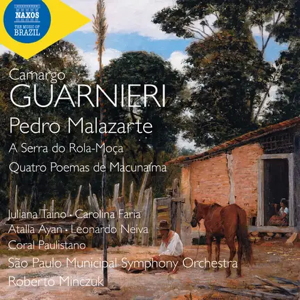
Camargo Guarnieri (1907-1993)
Sung texts by Mário de Andrade (1893-1945)
Pedro Malazarte (1932, rev. 1943)
A Serra do Rola-Moça (1941)
Rondó do eco e do descorajado, version for voice and strings (1949)
Louvação do amor êtê (1944)
Quatro Poemas de Macunaíma (1931, 1948)
Juliana Taino (mezzo-soprano), Carolina Faria (mezzo-sopranos), Atalla Ayan (tenor), Leonardo Neiva (baritone), Coral Paulistano (choir), São Paulo Municipal Symphony Orchestra / Roberto Minczuk
rec. (live) March 2022, Theatro Municipal, São Paulo, Brazil
Naxos 8.660528 [58]
According to the Naxos summary of this disc, “Camargo Guarnieri loved writing for the human voice, composing hundreds of vocal works over the course of his long and distinguished career”. So far, the revelatory series “The Music of Brazil” has focused on Guarneri’s excellent concertante and solo piano works. The equally fine series on BIS gave us all of his symphonies. This collection of choral works alongside a very entertaining brief chamber opera is therefore all the more valuable. The works are either first commercial recordings or first recordings of the versions presented here.
The opera Pedro Malazarte is a work of just 30 minutes, with threesolo roles and chorus, in a single scene. The story is so slight as to bear little explanation: a lonely wife, a flirtatious stranger who arrives with a cat and a door (!), and an unexpectedly returning husband. All’s well that ends well. The husband buys the cat – he has been conned into believing it is magical – while Pedro departs after a good meal, paid handsomely for the moggie.
Guarnieri received the first version of the libretto in 1928, completed the opera four years after that, and later revised it for a conventional orchestra with a harp and small percussion section added. Here is an interesting observation: Gustav Holst’s The Wandering Scholar,from almost the same time, has a very similar narrative arc set in a rustic environment – with a fourth character and no chorus – and an even more compact time-frame of less than 25 minutes. So, whilst the liner notes claim that Guarnieri’s work reflects the influence of Brazilian Modernism, there was clearly a wider movement away from the traditions of Grand Opera.
Apart from anything else, this is a light-hearted, easily attractive work. Sadly, the booklet does not include the libretto; it can be found in Portuguese on the Naxos website. Curiously, the booklet doesinclude the Portuguese texts and English translations of the other works on the disc. There is a bief but adequate synopsis.
The work sets out its stall from the opening bars of the pert and bright-eyed brief Overture. Matters are helped hugely by a team of performers completely at ease in the idiom; singers perform in their mother tongue. All the performances on this disc come from live concerts. The engineers have done an excellent job balancing the various elements, while the audience are completely inaudible. I particularly liked the voice of mezzo-soprano Juliana Taino, who sings the role of Baiana. Her voice is flexible and brilliant, but she has that focused feisty quality that I imagine would make her an excellent Rosina in Rossini’s Barber of Seville.
Interestingly, in the opera’s first version the flirtatious visitor was the tenor role, while the not-quite-jilted husband was a baritone. By the time of the revision, Guarnieri had swapped the voices around. Here, Pedro is virilely sung by Leonardo Neiva, to great effect. In the words of the synopsis, track 5: “Malazarte sums up his life story and some of his exploits”. Here is a perfect example of the idiomatic, characterful writing and the performance – a kind of latter-day Latin-American patter song! The sheer quality of the São Paulo Municipal Symphony Orchestra is evident here too. (Note that this is a differentorchestra from the São Paulo Symphony Orchestra, which has become internationally admired in recent years.)
Librettist Mário de Andrade furnished Guarnieri with three folksongs from Northern Brazil in the hope they would be incorporated into the score. They get individual settings to increase the sense of local colour, and the chorus often sets the scene. I assume it is one of these songs that Baiana sings to her husband when she lulls him to sleep; that allows Malazarte to make good his escape but not before selling the ‘magical’ cat. All this is about as inconsequential as an opera can be but it is totally charming. The performance has exactly the right amount of light wit and sparkle.
Next we have A Serra do Rola-Moça – The Rola-Moça (Falling Girl) Mountains – a ten-minute dramatic scena for mezzo-soprano and orchestra. It is as stark an emotional contrast as could be imagined, a tragic story of two young people who die on their wedding day when they and their horses plunge into a ravine. Carolina Faria sings the vocal role. Her intense and vibrant voice seems very well suited to this dark tale. Guarnieri deploys a less obviously nationalistic, folk-inspired orchestral palette. There is a brooding, ominous quality to much of the orchestral writing as it rises to the fateful “But then, inviolable Fortune! The horse stumbled. The bride and her steed were thrown into the ravine.” I appreciate it how the music is frozen with shock at the end: “Their landing made no sound. A deathly silence reigns, all was quiet in the high peaks… Then, spurring on his horse, the groom too rode over the rocky crag into the ravine. / And the Rola-Moça Mountains acquired the name Rola-Moça.” Guarnieri gives this final phrase a rather consonant major-key quiet ending, counter-intuitive perhaps but rather effective.
The three remaining works are shorter. Leonardo Neiva returns for Rondó do eco e do descorajado (Rondo of the Echo and the Lovelorn Man);where the man queries the wind. The instrumental writing is for strings alone who take the role of the wind replying to the questions. The piece works as well as it does because it is short; strings and voice only really perform together in the third of the three verses when the wind gives the man an equivocal answer whether he will soon die. The effect is rather touching in its simplicity.
The Choral Paulistano and Carolina Faria return for the very brief Louvação do amor êtê (In Praise of Love) written with just flute and cello accompaniment. It is dedicated to two American friends and their flautist daughter. It is well-crafted for sure but so short and slight that it is hard to form much of an impression before it is finished.
This valuable overview of Guarnieri’s writing for voice concludes with the Quatro Poemas de Macunaíma (Four Poems from Macunaíma). Guarnieri took a song he wrote in 1948 and placed it first with a group of three earlier songs. Andrade’s sources for the texts range from traditional rhymes, sayings and songs to indigenous mythology and stories. The four songs run for ten minutes, so again compact expression is the key. The first and the third song, the longest, have the most sombre texts with. No.3, Mandu sarará, isespecially impressive in its brooding intensity and pared-back orchestration: “Papa came and said to me: – Love’s not for the likes of you! – Mandu sarará. Mama came and over my head slipped a necklace made of sorrow. – Mandu sarará.” By contrast, Nos.2 and 4 are celebratory borderline-nonsense rhymes. They bring the mini-cycle and the whole programme to an upbeat conclusion. The works are listed as for baritone and orchestra but it is tenor Atalla Ayan who is the impressive soloist.
As usual in my reviews of Latin American music, this is where I note (and lament!) a depressing fact: in over 100 years of the Proms – the self-styled “World’s Greatest Classical Music Festival” – not one note of music by Camargo Guarnieri (and many fellow composers from South America) has ever been played. Yet, as this disc proves, here is a very skilled composer of interesting, individual and attractive music which would seem tailor-made for a celebration of works from around the globe.
The performances are completely convincing, and very well-presented. Conductor Roberto Minczuk, clearly immersed in the idiom, draws confident and skilled performances from choir, soloists and orchestra. The liner notes say that Minczuk was principal horn in this orchestra by the age of 13 (!), a soloist at the Carnegie Hall by 17, and a member of the Leipzig Gewandhaus at 20. This is just one more thing to add to the list of impressive achievements of this collection. The Guarnieri revival continues apace.
Nick Barnard
Buying this recording via the link below generates revenue for MWI, which helps the site remain free
Vocal performers
Pedro Malazarte: Juliana Taino, Atalla Ayan, Leonardo Neiva, Coral Paulistano
A Serra do Rola-Moça: Carolina Faria
Rondó do eco e do descorajado: Leonardo Neiva
Louvação do amor êtê: Carolina Faria, Coral Paulistano
Quatro Poemas de Macunaíma: Atalla Ayan













