
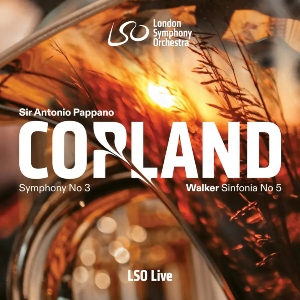
Aaron Copland (1900-1990)
Symphony No. 3 (1944-46)
George Walker (1922-2018)
Sinfonia No. 5 ‘Visions’ (2016)
London Symphony Orchestra/Sir Antonio Pappano
rec. live, 6 February 2025 (Walker), 14/17 September 2025 (Copland), The Barbican Hall, London
LSO Live LSO0916 SACD [58]
Recent LSO Live releases by the London Symphony Orchestra and Sir Antonio Pappano have principally focused on British music. In the year that the USA is celebrating 250 years since the Declaration of Independence it’s quite appropriate that this latest release presents two very different American symphonic works.
George Walker’s Sinfonia No 5 ‘Visions’ is an extraordinary work. It is quite short, here playing for just 15:15, but it feels like a big statement. It was composed two years before the composer’s death, so I presume it’s one of his last works. It’s worth outlining the background to the composition, which is explained in Stephen Johnson’s helpful booklet note. The work was Walker’s response to a ghastly event in recent US history. In July 2015, a young white supremacist intruded into the Emanuel African Methodist Episcopal Church in Charleston, South Carolina, where a Bible study group was in session. The intruder sat there for some time, as if participating in the Bible study; then, in what Johnson rightly labels a “chilling, deranged event”, he proceeded to shoot dead nine people, one of whom, I believe, was the Senior Pastor of the church. Johnson tells us that Walker, an African American himself, had visited Charleston not long before this awful event; so deeply was he affected by what had happened that “he decided to channel his anger and anxiety into an orchestral composition…he felt the shock of this atrocity in his blood and bones”.
Walker’s Sinfonia is, as you might expect, a powerful piece of writing which is not comfortable to hear – nor should it be, given the circumstances which prompted its creation. It’s in a single movement and for much of the time the music is, unsurprisingly, powerful, dark and agitated. The writing is often jagged and the LSO articulates the spiky rhythms very well; the performance seems to me to be taut and assured. This work is the music of an angry man – and that’s to be expected – however, Walker’s anger is disciplined. There’s extensive use of what sounds like a large percussion section but these instruments don’t overwhelm the rest of the orchestra; rather, they impart thrust and additional energy into the performance. In the second half of the piece there are some passages of relative calm but even here the tension is palpable. I learned from Stephen Johnson’s essay that the work can be performed with a fragmentary spoken text sequence; Pappano doesn’t take that option. I don’t feel that I have properly understood Sinfonia No 5 – I’m not sure for instance, why it bears the title ‘Visions’; in all probability I never will fully get to grips with it but it’s been interesting to hear it. The following night, Pappano and the orchestra repeated the concert and my Seen and Heard colleague John Rhodes was present (review).
From a completely different concert, presented a few months later, we get the chance to hear Copland’s Third Symphony. This comes from a different, possibly happier, time in the history of the USA. When Copland began work on it his country was still embroiled in World War II, albeit victory was in sight; by the time he completed it that victory had been won. On the surface, America seemed at peace with itself although, as we now know, the social and racial tensions which reared their ugly head that night in Charleston in 2015 were even then present, though possibly less obvious to the casual observer. It was not unreasonable, therefore, that Copland expressed optimism in a way that Geroge Walker could not do in his Sinfonia No 5.
This four-movement work is on a grand scale. Ony just recently I reviewed a recording of Copland’s 1929 Dance Symphony; the Third is getting on for twice as long in duration and it is more of an audience pleaser than the earlier work. I think Pappano does it very well. The first movement begins almost innocently but fairly soon the music grows in intensity. Thereafter, passages of calm alternate with episodes of craggy grandeur; the whole is knitted together convincingly by Pappano and played marvellously by the LSO. The orchestra delivers the playful scherzo with admirable precision. The Trio (from 3:50) is initially dominated by various solo woodwinds; hereabouts the music is delicate and almost pastoral, as is the performance. I like the way Copland cleverly disguises at first the return to the scherzo (around 5:50). The slow movement opens with hushed and searching string polyphony, which here shows the excellence of the LSOs string choir. The perky quicker music (5:04 – 7:15) could have come right from the pages of Appalachian Spring (1944). Pappano and his orchestra bring off very well indeed the inspired, hushed segue into the finale. This last movement is, of course, founded on the composer’s Fanfare for the Common Man (1942). The fanfare is discreetly introduced by solo flute and clarinet before the music is heard in its familiar brass and percussion guise. In the context of the symphony – and especially after being so quietly introduced – the fanfare seems even more aspirational than in its standalone original version. From 3:08 Copland uses the fanfare as the basis for symphonic development and he does so very successfully. Here again, the music is often highly reminiscent of Appalachian Spring. I very much enjoyed the bracing performance by the LSO; their precision invests the music with great vitality until the moment (9:38) when grinding, dissonant chords on brass and woodwind bring a sudden halt to the jollity. As the symphony builds to its grand peroration, built on the Fanfare, of course, it’s easy for the music to become overblown; that’s a trap into which I feel Leonard Bernstein falls in his live 1985 recording with the New York Philharmonic (DG); Pappano, I think, avoids this but he doesn’t underplay the optimistic grandeur.
I enjoyed this disc very much. The Copland is much easier to love than the Walker piece – and I’m much more familiar with it, of course – but the latter work is well worth hearing. These two scores make a fascinating juxtaposition. The performances by Pappano and the LSO are excellent and they’ve been recorded very successfully by the team from Classic Sound Ltd.
John Quinn
Buying this recording via the link below generates revenue for MWI, which helps the site remain free













