
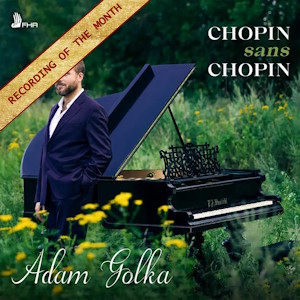
Chopin sans Chopin
Adam Golka (piano)
rec. 2023, Kulturstiftung Marienmünster, Höxter, North Rhine-Westphalia, Germany
First Hand Records FHR168 [56]
Chopin has had such a huge influence on so many composers for the piano that one could say pianists have been playing Chopin without Chopin for years. But I like Adam Golka’s idea, and I like the music he has chosen to illustrate it. Perhaps the most obvious connection – just glancing through the contents – is the association by genre, whether it be nocturne, mazurka, prélude, fantasy, scherzo, ballade or étude. Chopin mastered them all and made his own. John Field may have invented the nocturne but it is Chopin who is remembered. And, although he built on the shoulders of earlier virtuosi, Chopin’s études are those to stand the test of time.
Fauré’s love of Chopin’s music played out in substantial fashion: consider nocturnes and barcarolles, twelve of each, and forays into prélude, valse, ballade and impromptu. The influence is clear in his E flat nocturne, in the long cantilena over a left-hand accompaniment (as in the first and third of Chopin’s Op.15 or Op.37 No.1 or Op.62 No.2). Add a dramatic, contrasting central section – and we have a nocturne that, with Faure’s harmonic and melodic genius, creates a new chapter in the genre.
I never particularly thought of Chopin’s influence on Brahms. Even an early scherzo by the 18-year-old composer shows much that is distinctly Brahmsian: the muscularity of chord writing, the rhythmic devices, the ben marcato passages with their sforzandi markings and insistent repeated B flats. All that shouts to the rooftops that this is Brahms. Yet a glance at the score and careful listening reveal aspects of Chopin’s writing, not least in the second trio section which recalls the lyricism of the B flat minor scherzo.
To stay with familiar composers, Scriabin’s early works clearly acknowledge their heritage. His fantasy Op.28 is a very different beast than Chopin’s F minor Fantasy, but the writing has the kind of lyricism that we associate with the Pole. Elements of the ballades, the Polonaise-Fantasy, especially the climax, the nocturnes and the préludes – all that can be found here. There also are huge doses of Chopin’s contemporary Adolf von Henselt, who had large influence on later Russian composers, as Daniel Grimwood points out in his excellent book on Henselt’s études (ISBN 978-1-3999-2343-9).
Gershwin may not immediately spring to mind, but listen to the second of his preludes alongside Chopin’s second prélude with its meandering bass chords. The composers achieve different outcomes with each piece, but the similarities are there. And let us face it: it was Chopin who made the humble prélude into a work worthy of the concert platform. At first, a prélude was just an improvisatory few bars to ease audiences into the mood or key of the next piece.
The same is true of the étude. Kalkbrenner, Hummel, Montgeroult, Steibelt and others wrote études that go beyond their didactic value. Yet Chopin’s études stand out as the blossoming of the concert étude genre, and many later composers stood on his shoulders. As recently as 1984, Russian composer Nikolai Kapustin, classically trained but jazz-influenced, wrote his wonderful Concert études, an amalgam of 19th century writing, late-Romantic Russians and jazz. Golka plays the final two, the gloriously lyrical and ultimately jaunty Intermezzo, and the fabulously energetic toccata finale.
Golka also presents four composers off the beaten path with music that is absolutely worthy of inclusion here. Natalia Janotha was, shall we say, an interesting character – just read Harold C. Schonberg’s The Great Pianists for a brief sketch. She would not play a concert without her dog Prince White Heather on stage. Golka’s entertaining notes mention that she sued a baroness, accusing her of trying to poison her black cat also called Prince White Heather. (Was this her go-to name for pets, or a mix up in translation somewhere along the line?) She would also place a prayer book on the piano at each recital. Her four published recordings include Chopin’s student fugue and her own Gavotte imperiale which shows she certainly had a great command of the keyboard if dubious taste. An unpublished recording of Chopin’s tarantelle would seem to confirm this; it has extended-across-the-entire-keyboard introduction, a grand interlocking octave and chordal trill ending – and frantically swift playing. All that aside, I love her melancholy mazurka in E minor, a first recording, it would appear, and considerably more musical than her imperial gavotte.
Roman Maciejewski composed many mazurkas. Golka writes that there are forty; Wikipedia suggests as many as sixty. He was a pupil of Kazimierz Sikorski and Nadia Boulanger, and was mentored by Szymanowski. He wrote the 13th mazurka while he was in Sweden. It is more wide-ranging in mood than Chopin’s tend to be, while the language remains relatively tonal. Many years ago Muza Records released a set of LPs that contained a different Maciejewski mazurka, played live by Stanisław Szpinalski, and his many two piano arrangements of classics and spirituals have been recorded. Perhaps now is the time for some adventurous pianist to explore more of his output.
A third mazurka is by Władysław Szpilman, famously portrayed in the film The Pianist. His pianistic credentials were exceptional: studies with Alexander Michałowski, Józef Śmidowicz, Artur Schnabel and Leonid Kreutzer, and study of composition with Franz Schreker. He was equally at home in light music; he wrote film music and some 800 songs. His gift and fame in this regard, at least in Poland, and his abilities as a pianist have led to neglect of the classical side of his output. So, it is good to hear his little F minor mazurka whose gentle melancholy and melodiousness match that of his songs from the same post-war period.
The last work to mention is the colourful Balada Mexicana by Manuel Ponce. It bookends one folk song, Acuerdate (remember me), with another, Me de he comer un durazmo (I shall eat a peach). Golka likens it to Chopin’s third ballade “in terms of its form, charm and poetic spirit”. That is a fair comment but otherwise the two are not alike. If anything, I would describe it as Liszt sans Liszt in terms of its treatment of the piano and the material, especially in the grand climax.
Golka’s playing is lovely. He has boundless energy, unerring technique and a lyrical heart, and he has assembled a wonderful variety of pieces to illustrate his ideas. The balance of familiar and unfamiliar works is perfect, and there is nothing here that sounds out of place or is overshadowed by more illustrious companions. Golka adds judicious little touches to a couple of items, such as an alternative end to Gershwin’s third prelude and some textural filling in Janotha’s Mazurka, but it is all very subtle and tastefully done. Altogether it is a rather special recital.
Rob Challinor
Contents
Gabriel Fauré (1845-1924)
Nocturne No.4 in E Flat Major Op.36 (c.1884)
Johannes Brahms (1833-1897)
Scherzo in E Flat Minor Op.4 (1851)
Natalia Janotha (1856-1932)
Mazurka in E Minor Op.6 No.1 (1894)
Alexander Scriabin (1872-1915)
Fantasie in B Minor Op.28 (1900)
Roman Maciejwski (1910-1998)
Mazurka No.13 Upon Evening (1990)
Manuel Ponce (1882-1948)
Balada Mexicana (1915)
George Gershwin (1898-1937)
Three Preludes (1926)
Władysław Szpilman (1911-2000)
Mazurka in F Minor (1942)
Nikolai Kapustin (1937-2020)
Eight Concert Études Op.40 (1984)
– Intermezzo No.7
– Finale No.8
Buying this recording via the link below generates revenue for MWI, which helps the site remain free













