
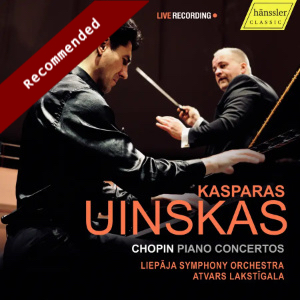
Frédéric Chopin (1810-1849)
Piano Concerto No. 1 in E Minor Op 11
Piano Concerto No. 2 in F Minor Op 21
Kasparas Uinskas (piano)
Liepāja Symphony Orchestra/Atvars Lakstīgala
rec. live, February 2025, Liepāja Great Amber Hall, Latvia
Hänssler Classic HC25047 [73]
These live performances of the Chopin piano concertos from Lithuanian pianist, Kasparas Uinskas, and the Liepāja Symphony Orchestra were recorded last year in Latvia. The first thing to say is that they are very good indeed and the audience clearly agrees judging by their reaction on the recording.
Chopin wrote his piano concertos in 1830 immediately prior to his departure for Paris. The second concerto was written first so they were published in reverse order. Both concertos were essentially calling cards for the young Chopin to display his credentials as a virtuoso pianist. The orchestra provides a framing device and emotional backdrop to the soloist and is not treated as an equal partner in a symphonic battle. Recent musical scholars have questioned whether Chopin was the sole author of the orchestral scores. While there is evidence to suggest some editorial input, there is no doubt Chopin wrote the core orchestration.
All the performers in this recording approach the E Minor Concerto as if it is a newly-minted work and much of the playing is fresh and vibrant. There is scrupulous attention to detail from Atvars Lakstīgala and the orchestra in the opening movement. In the orchestral exposition, the dynamics markings are observed, the string phrases are beautifully shaped and shaded and the wind melodies are given space to breathe. Uinskas strikes an excellent balance between the dramatic and more poetic, lyrical aspects of the concerto. His cantabile playing is exquisitely beautiful, and he handles Chopin’s bel canto ornamentation with consummate refinement. Uinskas unleashes the virtuoso fireworks when required, although there he clearly has an eye to Chopin’s maestoso marking and there is an aristocratic quality to the playing.
Chopin described the central Larghetto as “reviving in one’s soul’s beautiful memories….a sort of meditation in beautiful spring weather, but by moonlight”. Uinskas brings an emotional vulnerability to Chopin’s gorgeous bel canto phrases and uses tasteful rubato which allows the long singing lines to breathe in a seamless way. Lakstīgala and the strings provide a cushion of sound while the woodwind and horn entries enhance the enchanting quality of the movement. Orchestra and soloist change gears in the Krakowiak finale. Uinskas’ articulation is crystalline in the opening section and he clearly relishes the dance-like qualities in the music. He dispatches Chopin’s rapid-fire passagework with turbo-charged athleticism while ensuring the articulation remains clean and transparent. There is tight interplay between soloist and orchestra throughout and Uinskas succeeds in bringing the house down in an electrifying coda.
The F Minor Concerto is if anything marginally better and this is certainly one of the best recordings I have heard of this work. Lakstīgala and the Liepāja Symphony Orchestra once again produce fresh and vibrant playing in the exposition to the opening movement. Uinskas’ playing catches fire in this movement and he creates a wonderful blend of poetic cantabile playing and barnstorming virtuosity. His filigree ornamentation is exquisite in the Larghetto slow movement, and he plumbs the depths of submerged passion in the central section in an incendiary way. In the finale, Uinskas combines dazzling virtuosity with a perfectly calibrated execution of Chopin’s rustic dance rhythms. The section with piano and col legno strings is particularly striking and effective. The final salutation from the hunting horn ushers in a thrilling virtuoso display from the soloist bringing the movement to a triumphant conclusion.
There are many recordings of these concertos from some of the world’s greatest pianists. Martha Argerich brings a fiery spontaneity and turbo-charged virtuosity to her recordings with Abbado and Dutoit. Krystian Zimerman’s recording with the Polish Festival Orchestra highlights features of the orchestral writing in new and original ways while Zimerman’s playing is highly meticulous and polished. Perahia in his recordings with Mehta brings a crystalline clarity to the piano writing, while the young Korean pianist Seong-Jin Cho produces refined, flawless piano playing in his recordings. This recording from Uinskas and Lakstīgala compares well with these outstanding performances and the fact that both concertos were recorded live give the playing an extra edge and adrenaline rush.
Robert Beattie
Buying this recording via the link below generates revenue for MWI, which helps the site remain free













