
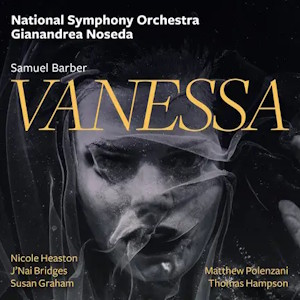
Samuel Barber (1910-1981)
Vanessa (1957, rev. 1964)
Vanessa: Nicole Heaston (soprano)
Erika: J’Nai Bridges (mezzo-soprano)
Anatol: Matthew Polenzani (tenor)
The Old Baroness: Susan Graham (mezzo-soprano)
The Old Doctor: Thomas Hampson (baritone)
University of Maryland Concert Choir, The National Symphony Orchestra / Gianandrea Noseda
rec. January & February 2025, Kennedy Center Concert Hall, Washington, DC, USA
National Symphony Orchestra NSO0023 SACD [2 SACDs: 117]
Samuel Barber’s opera Vanessa lurks around the fringes of the core repertoire, at least in America – not exactly central, but with enough revivals and occasional recordings to be far from forgotten. This recording comes from a group of live concert performances in early 2025. In its own right, it is very fine and deserves to be heard by anyone with an interest in this composer of 20th-century American opera. Vanessa was Barber’s first essay; the chamber opera Hand of Bridge and the large-scale Anthony and Cleopatra followed within a decade. A valid comparison is often made with Walton’s Troilus and Cressida: in the chilly artistic world after World War II, both composers were seeking to emulate the scale and style of the great Romantic operas. Seventy years on, one can appreciate the sheer quality of both scores without being blinded by their relative musical conservatism.
On disc, Vanessa has been quite lucky. The first recording of the original cast under Dmitri Mitropoulos has pretty much stayed in the catalogue ever since its release. It remains a powerful testament to the work and the performers. The additional interest is that it is the only recording of the original four-act version, so it is the benchmark against which to measure any new version. All subsequent recordings are of the 1964 revision. Mitropoulos also conducted the European premiere in August 1958 at the Salzburg Festival, with much the same singing cast but with the Vienna PO in the pit. That performance has been preserved on the Orfeo d’Or label.
Jump ahead to 2003 and the first ‘modern’ recording on Naxos under Gil Rose. Not for the first time, the National Symphony Orchestra of Ukraine showed themselves to be remarkably idiomatic in American music. Generally, the recording was welcomed even if the voices were not all first rank. A year later, the Naxos recording was put in the shade by an SACD release on Chandos with top-notch soloists and Leonard Slatkin conducting the BBC SO and Singers. (I have not heard that performance but contemporary reviews seem to have been very positive.) That means it has been over twenty years till this recording.
Conductor Gianandrea Noseda is clearly convinced of the opera’s enduring brilliance and worth. He galvanises all the performers into an interpretation of genuine dramatic power. The criticism sometimes levelled at Barber and librettist Gian Carlo Menotti is the tension between the occasionally staid and wordy text and the passionate music that surrounds it. The truth is that these characters are living lives of turmoil and emotional longing but must conform to the conventions and niceties of their social circle. As so often in the best opera, the music carries a message, emotional and literal, that the text alone does not.
The title role went to Nicole Heaston who, according to a review of the 2025 concerts, took it over from the previously announced Sondra Radvanovsky. It is unclear quite how much notice Heaston had, but she sings with great technical skill and with expressive insight into the conflicted character of Vanessa. It is probably a fair observation on the dramatic arc of the main characters that Vanessa stays stuck emotionally, whereas the role of her niece Erika – impressively sung by J’Nai Bridges – gets a rather more satisfactory trajectory.
The third main character, Anatol, is an unredeemed cad from first to last. The suitably youthful-sounding Matthew Polenzani performs with relish. Thomas Hampson joins the luxury main cast in the light-relief role of The Old Doctor. Susan Graham has moved from her interpretation of the role of Erika for Slatkin to singing The Old Baroness. The University of Maryland Concert Choir are very polished too, although the chorus mainly act as set-dressing – it makes no significant dramatic contribution to the work.
The drama of the work is entirely domestic – no grand spectacular theatrical set-pieces. That is why the opera’s effect wholly relies on the quality of the performance, musical and dramatic, if it is to engage the audience. The concert review I mentioned pointed to a couple of occasions when the scale and dynamism of Barber’s score threatens to overwhelm the singers. Partly because of the post-production balancing on disc, I do not find this to be an issue here. Yet as and when the opulence of the writing is quite extreme, I think there is a valid case that this once more represents the unspoken emotions that threaten to overwhelm the rational spoken word.
I feel that Noseda’s handling of this passionate score is excellent. He draws from the National Symphony Orchestra some of the finest playing I have heard in recent years. This is their first release that I have heard on their own label. Previous releases ranged from a Beethoven symphony cycle, via Mahler to a concert with William Shatner (a.k.a. Captain Kirk). This performance has been engineered and produced by Soundmirror, who have made the superb live recordings of the Pittsburgh Orchestra with Manfred Honeck for Reference Recordings. This set is technically right up there with those award winnings discs.
Here is one of the advantages of the fine technical quality of this recording: it reveals the sheer skill and meticulousness of Barber’s writing. He was a craftsman in the best sense of the word both. He allowed the orchestra to express the unspoken emotions in which this work abounds and the detail, and the illustrative and expressive precision of the writing. Noseda’s long experience in the opera house is evident at every turn too. He paces and points the score with a clear understanding of the work’s dramatic arc.
Curiously, for all the quality evidenced by performers and production team, I must admit the characters in the opera irritated me more than before! Vanessa seems frozen in an idealised past. That she falls in love with the young Anatol is at best self-delusion. Anatol is simply an opportunist: one cannot really imagine how the marriage between him and Vanessa can end well. I also do not understand why Erika – who has the most interesting character arc – decides not to reveal Anatol’s machinations to her Aunt. Instead, she seems “happy” to assume the victim role as a kind of latter-day Ms Haversham. There is a sense that all the main characters live rather narrow and spoilt lives of wealth and security in a gilded cage of privilege. All that aside, I genuinely thought this was a tremendous presentation of an impressive score. However much the characters may annoy me, the music they get is glorious!
The SACD discs (in stereo and 5.0 surround sound; I listened to stereo) are presented in a very attractive hard-back-book format, with the discs tucked into the front and back covers. The 68-page booklet in English is beautifully presented. There is full libretto, biographies, concert photographs and essays on the work itself. This is a major American opera of the 20th century, so new recordings will always be welcome and valuable – and this one is very fine indeed.
Nick Barnard
Buying this recording via the link below generates revenue for MWI, which helps the site remain free













