
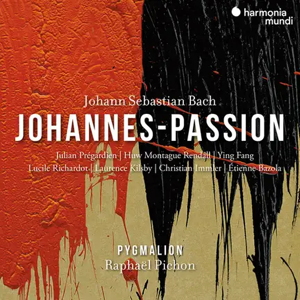
Johann Sebastian Bach (1685-1750)
Johannes-Passion, BWV 245 (1749 version)
Julian Prégardien (tenor, Evangelist), Huw Montague Rendall (baritone, Christus), Ying Fang (soprano), Lucile Richardot (mezzo-soprano), Laurence Kilsby (tenor), Christian Immler (bass-baritone, Pilatus), Etienne Bazola (baritone)
Pygmalion / Raphaël Pichon
rec. 2025, Grand Manège, Namur, France
German text, English and French translations included
Harmonia Mundi HMM902774/75 [2 CDs: 116]
In 2021, Raphaël Pichon and his ensemble, Pygmalion recorded the Matthäus-Passion for Harmonia Mundi. I’ve not yet heard that recording. I noticed that their most recent Bach offering, the Johannes-Passion, had received a lot of positive media comment. I don’t think we received a review copy but I invested in the discs for my Easter listening.
I think listeners’ reactions to this performance may be mixed. It is superbly performed but the interpretation may not be to all tastes; it’s very dramatic at times. I was metaphorically rocked back on my heels the first time I played the opening chorus; indeed, repeated listening hasn’t really lessened the impact. The pace which Pichon sets is quite brisk, though not excessively so by modern HIP standards. But it’s not the pacing that startles; rather, it’s the vehemence – no other word will suffice – with which the orchestra attacks the music that really makes one sit up. The sound is almost confrontational. The Johannes-Passion is much more dramatic in nature than the more reflective Matthäus-Passion and this opening underlines that fact. When the chorus begins to sing, they are also very dramatic in their delivery, though I was also struck by the degree of dynamic contrast that the singers achieve. Intriguingly, when the da capo is played, Pichon’s orchestra is slightly less assertive. I honestly can’t recall hearing this opening chorus performed in such an urgent, dynamic fashion, though I came to find it very stimulating. In some ways, that opening number sets the tone for what is to follow. However, I use the words ‘in some ways’ deliberately. Having experienced Pichon’s way with the opening, I was expecting the Judgement scene in Part II to be searingly dramatic. So it is, but there’s also a surprising – and welcome – amount of compassion in that part of the performance.
The German tenor Julian Prégardien is Pichon’s Evangelist, as he was in the earlier recording of Matthäus-Passion. He is a compelling and individual narrator. He consistently held my attention as he told the Passion story. He brings out the drama in a very human way and something which impressed me again and again is the degree of poetry with which he invests the narrative. Particularly in Part II, the way he narrates the action demonstrates compassion for Christ. Examples of this compassion include his description of Christ being clothed in a purple robe and, again, the very sympathetic way in which he describes the soldiers dividing the clothing of the crucified Christ. In the closing section of the work Prégardien tells of the Crucifixion and its aftermath in a very moving way. His father, Christophe Prégardien was a distinguished Bach tenor and his son has definitely followed in his footsteps. I was greatly impressed with his key contribution to this performance.
In most respects, the other soloists are also very successful. Christian Immler takes the role of Pilate, as he did for Pichon in the Matthäus-Passion. He portrays the authoritative Pilate, to be sure, but in a deeply expressive account of ‘Betrachte, meine Seel’ I think he also conveys the Governor’s inner doubts. The other artist who is common to both of Pichon’s Passion recordings is alto Lucile Richardot. I must admit I’m in two minds about her contribution. Her singing is accomplished and there’s no doubting her commitment to the music. However, I’m not entirely at ease with the sound of her voice. It seems to have an edge to it which, to my ears, almost suggests a male alto. The sound is suitable for ‘Von den Stricken’ but, for me, it’s more problematical in ‘Es ist vollbracht’. Here, I think a softer, warmer sound is required in order to convey compassion. That said, Ms Richardot sings the aria expressively and her voice is suited to the vivace section. Soprano Ying Fang gives a light, eager account of ‘Ich folge dir gleichfalls’ and is very affecting in ‘Zerfließe, mein Herze’. Pichon has two British singers in his roster of soloists. One is the tenor, Laurence Kilsby, who has two very challenging arias to sing. ‘Ach, mein Sinn’ is simply a brute of a piece; not only is the tessitura demanding but the dotted rhythms pose great difficulties; Kilsby is the master of all these challenges and then, a little later, he gives a rendition of ‘Erwäge’ which is simply outstanding, both technically and emotionally. He seems to have all the time in the world to deliver long, expressive lines. As Christus, Huw Montague Rendall makes a fine impression. His singing is dignified and eloquent. Like Prégardien, he paces the recitatives expertly and in a very natural way.
Pichon has a very fine team of instrumentalists at his disposal. Without exception, the obbligato contributions are distinguished and, as they should, these add an extra dimension to the arias. The one reservation I have concerns the continuo playing. The continuo group comprises cello, double bass, harpsichord, organ and theorbo. The players are all extremely accomplished but I wonder if other listeners may feel, as I do, that in the recitatives there is a tendency for the two keyboard players and the theorboist to over-decorate at times.
The choral singing is absolutely superb. I’ve already referenced the opening chorus, which is not only intensely dramatic but also benefits from considerable attention to detail in the matter of dynamics. That attention to detail pervades all the choral singing. Elsewhere, the choir vividly suggests a baying mob during the Trial scene, and in ‘Lasset uns den nicht zerteilen’, which Pichon takes very swiftly, his choir sings with a precision and lightness of articulation which, even for professionals, is quite remarkable. Throughout the performance their discipline is superb and they achieve great clarity of both texture and diction. They also carry out scrupulously Pichon’s wishes in the delivery of the chorales (of which more in a moment).
Raphaël Pichon has clearly thought deeply about every bar of the score. This is an interpretation that takes nothing for granted. I found myself gripped by what I was hearing. However, Pichon’s conception of the work may not be to all tastes. There are occasions when I thought his dynamic contrasts were a bit extreme and you may also be less than wholly persuaded by the chorales: are some of them over-interpreted? It’s certainly an interpretation that will make you think afresh about Bach’s great masterpiece and, arguably, that’s how it should be. However, I would recommend that you sample the performance prior to making a purchase decision. For myself, I’m glad to add this at-times provocative but always thoughtful interpretation and performance to my collection.
Harmonia Mundi have not stinted on the presentational aspects of this release. The recorded sound is truly excellent in all respects. The booklet runs to just over 80 pages and includes texts and translations as well as an essay on the work by Pichon.
On the strength of this listening experience, I have now ordered a copy of Pichon’s recording of Matthäus-Passion.
John Quinn
Buying this recording via the link below generates revenue for MWI, which helps the site remain free













