
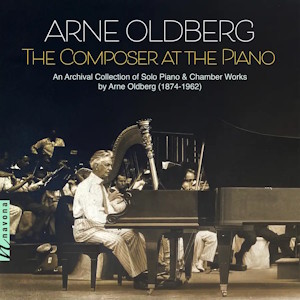
Arne Oldberg: The Composer at the Piano
Arne Oldberg (1874-1962)
Carillon, op. 27 no. 3 (1907)
A Legend (1907)
Canzone (1950)
Fantasia in B-flat Major (1948)
Sextet for piano, horn, and strings (1950-1951)
Cello Sonata, op. 45* (1934)
Arne Oldberg (piano)
Philip Farkas (horn); Arcule Sheasby (violin); Franz Polesny (violin); Harold Newton (viola)
Dudley Powers (cello)
Unknown (cello)*
rec. ca. 1950-1952
reviewed as digital download
Navona Records NV6855 [81]
Arne Oldberg’s musical trajectory was once a common occurrence in the United States. The son of a Swedish immigrant father and an Ohioan mother, Oldberg studied in Chicago with a host of talented Swedish or German transplants including August Hyllestad, Wilhelm Middelschute, and Adolph Koelling before being packed off to Europe to work with Theodor Leschetizky (and later, Josef Rheinberger). On his return to the United States in 1897, Oldberg took up a post at Northwestern University, teaching both piano and composition until his retirement in 1947. Hundreds of similarly talented pianists or composers from this period toiled in obscurity only to disappear completely with the passage of time. Oldberg was lucky to have a great-grandson who is a record producer. Jim Greer discovered these solo and chamber recordings among his mother’s effects after her death, and this generously filled album is the result, a true labor of love across the generations.
Oldberg’s style is described in the materials accompanying the recording as a sort of Brahms-Grieg-Rachmaninoff hybrid. What some might hear as a Rachmaninoff-ian influence, I hear more as just a competent understanding and use of the full keyboard. The writing in Oldberg’s solo piano pieces is similar to his Leschetizky studio mate Ignaz Friedman’s music, being busy with passagework, thick left-hand accompaniments, filled-in octave passages in the right hand, etc. The American composer lacks Friedman’s humor or sensuousness, but harmonically and melodically speaking, there is a great deal going on in his music.
Each of the solo piano items is introduced verbally by the composer in his quaint Midwestern accent. Carillon, from the Three Miniatures op. 27, is an effective depiction of bells, and Oldberg plays it clearly and cleanly, though he does not attempt the range of dynamics indicated in the score. (Some notes are marked “Harmonics” to be played “very softly,” and others “almost inaudibly.”) After finishing this beautiful bit of tintinnabulation, Oldberg chortles as if pleased by his handiwork, and then speaks to his daughter Elsa (the grandmother of the producer). The composer describes A Legend as being a “dramatic narrative.” This is a very effective piece that modern pianists would enjoy tackling; the musical language strikes me as owing something to MacDowell’s piano sonatas, with its brawny chords and rather severe sonic landscape. There is also a single moment of Debussyian harmony thrown in for transitional purposes. Oldberg the pianist is more in evidence here, displaying the propensity of Leschetizky pupils for playing melodic lines with great body and intensity. He handles the piece’s technical hurdles with aplomb, easily negotiating the chordal batteries. The octave scales are light and clean. It’s unclear whether the composer was playing from the score; there are some small changes to the melodic line near the opening. A short Canzone is greatly reminiscent of Friedman, offering some gossamer filigree amidst old-world nostalgic harmonies. This piece is a real charmer, and Oldberg plays it with much panache. A “Fantasy” (as introduced by Oldberg) is another larger-scale work, being roughly nine minutes long, but it is more diffuse than the earlier A Legend, and is musically weaker as a result.
The Sextet is the centerpiece of the album; it functions as a sort of catalog of Oldberg’s compositional strengths and weaknesses. This is very “listenable” music, pleasing to the ear, with lush harmonies, intricate keyboard work, and a valuable sense of forward-moving energy. At the same time, the melodies are not memorable enough to support the imposing length of the score, and the textures are generally too busy. The first movement is in sonata form, a musical structure that should be able to help the auditor organize their listening experience. There is an impressively solemn but short introduction before the strings begin a semi-tremolando figure that underpins a piano statement of the rather Franckian theme. The horn seems to play a mostly supporting role while the piano and strings trade moments in the spotlight. These many soloistic moments are responsible for obscuring the compositional argument; bits of tunes surface and then disappear as a different instrument takes over, and the result is a sort of melodic fatigue.
On my initial listen, I had no memory of the opening theme by the time the recapitulation rolled around and only recognized it as a return to the opening material via the key and accompanimental texture. The overall impression given is one of a composer who felt the urge to put all his ideas on the page, possibly at the expense of a coherent argument. The second movement (“Andante espressivo”) is lovely without leaving much of an impression. The scherzo movement is much stronger than any of the other movements, possibly due in part to its brevity. It owes much to the scherzo of the Brahms 2nd Piano Concerto, possessing a nearly identical rhythmic profile. Oldberg handles the gnarly piano part well, though he generally plays too loudly throughout this sextet recording. (He may have been the closest musician to the recording microphone.) I would note that the final two movements (the scherzo, which is mentioned by the composer in his notes for the piece, and an “Animato” movement) seemed to have been crammed onto a single track labeled “III. Animato.” I suspect that the scherzo ends at 3’23”, and that the remainder of the 11’32” track is the fourth movement.
The Cello Sonata is a recording of unknown provenance, with an anonymous cellist, to boot. This work is more successful than the Sextet; having two instruments instead of six seems to tame the composer’s urge to throw everything but the kitchen sink into the mix, making for a more lucid musical argument. Oldberg indulges in some very Brahmsian piano figures in the first movement, and we seem to visit with Debussy again in the opening of the second movement. There are some legitimately lovely moments here, in particular a lyrical episode near the end of the first movement that has a plainspoken dignity to it. The anonymous cellist is an acceptable if sedate performer, but one wonders what impression the work would give with a more passionate string player.
Overall, this is a valuable document of a forgotten American composer and pianist. The piano works deserve to be heard in concert; perhaps instead of the usual suspects, we could get a bit of Oldberg?
Richard Masters
Buying this recording via the link below generates revenue for MWI, which helps the site remain free













