
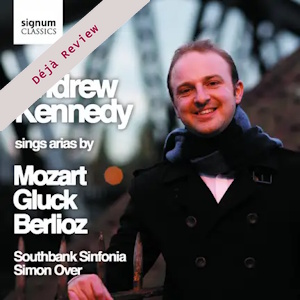
Déjà Review: this review was first published in July 2010 and the recording is still available.
Arias by Gluck, Mozart and Berlioz
See below for full track list
Andrew Kennedy (tenor)
Southbank Sinfonia/Simon Over
rec. All Hallows, Gospel Oak, London 2-5 July 2009
Texts and English translations enclosed
Signum SIGCD189 [62]
Andrew Kennedy has come to the fore in the last few years. I reviewed a Liszt recital not long ago, where he was an important contributor, though I wasn’t too happy with his tone production, which tended to be pinched and strained under pressure. This is also the case with the present issue. The programme is interesting with some Gluck arias followed by Mozart and then Berlioz, which I can’t recall ever seeing as a coupling on record, whether on LP or CD. It is an interesting juxtaposition and, whatever the qualities of the Gluck and Mozart items, it is the Berlioz aria that catches the interest.
He comes off to a quite unsuccessful start with Achille’s aria from Iphigenie e Aulide, which is undernourished and – yes, pinched – and this is the recurrent problem with his singing. But this opening number is, fortunately, an exception, since he shows great involvement and true lyricism in a lot of what he sings later on. The aria from Orphée et Euridice, better known as Che faro in its Italian version, is sensitively sung, though he can’t challenge predecessors like Gedda and Simoneau, nor Fouchecault in the quite recent Naxos recording.
His Mozart is even better and the two arias from Die Entführung aus dem Serail are fresh and lively and so are the less frequently heard arias from La clemenza di Tito. Here he is elegant and fluent – but also rather monochrome. Where he comes into his own is, somewhat surprisingly, in the Berlioz arias. First of all this is music of the utmost beauty that is too rarely heard and Kennedy seems to be especially suited to them. Iopas’s aria from Les Troyens, with its beautiful orchestral intro, is a gem, and the lively and eager solo from Béatrice et Bénédict is in the same league. Lélio, a sequel to Symphonie fantastique, is a rather peculiar composition, which I still have to come to terms with, but the tenor solo recorded here is a full-blooded romantic outpouring, ravishingly sung, and the magical scoring in the postlude is in itself worth the outlay. Best of all, as singing, is the aria from La damnation de Faust, so beautifully scaled down but with telling climaxes.
The Southbank Sinfonia are a superb orchestra and their playing in the two Mozart overtures is beyond reproach. I can’t say that Andrew Kennedy trumps my favourite singers in the Gluck and Mozart repertoire but he is definitely worth a listen for his Berlioz – not only for his singing, which is excellent, but for the music as such. At his best, which he certainly is in these arias, few 19th century composers can challenge Berlioz. Andrew Kennedy does him proud.
Göran Forsling
Buying this recording via the link below generates revenue for MWI, which helps the site remain free
Contents:
Christoph Willibald Gluck (1714 – 1787)
Iphigénie en Aulide
1. Calchas, d’un trait mortel percé
Alceste
2. Misero! E che faro! … No, si atroce costanza
Orphée et Euridice
3. J’ai perdu mon Euridice
Iphigénie en Tauride
4. Divinité des grandes âmes
Wolfgang Amadeus Mozart (1756 – 1791)
Die Entführung aus dem Serail
5. Overture
6. Hier soll ich dich denn sehen
7. Ich baue ganz auf deinem stärke
La clemenza di Tito
8. Overture
9. Del più sublime soglio
10. Ah, se fosse intorno al torno
11. Se’all impero
Hector Berlioz (1803 – 1869)
Les Troyens
12. Ô blonde Cérés
Béatrice et Bénédict
13. Ah! je vais l’aimer
Lélio, ou Le retour à la vie. Op. 14b, No. 4
14. Chante du Bonheur
Le Damnation de Faust
15. Air de Faust













