
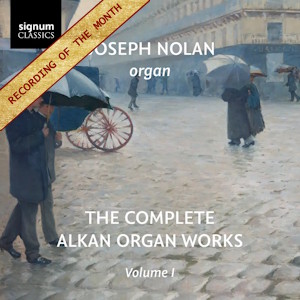
Charles-Valentin Alkan (1813-1888)
Complete Organ Works – Volume 1
11 Grand Preludes and Transcription of Handel’s Messiah, Op 66 (1867)
Petits préludes sur les huit gammes du plainchant (1859)
Impromptu on Luther’s “Un Fort Rempart Est Notre Dieu” Op. 69 (1866)
Joseph Nolan (organ)
rec. 2024, Église Saint-Martin de Dudelange, Dudelange, Luxembourg
Signum Classics SIGCD982 [76]
The vastly underrated English pianist Ronald Smith (1922-2004) did more than most to bring Alkan in from the cold during the second half of the twentieth century. He was encouraged to take up the Concerto for solo piano, Op 39 by the composer (and Liszt maven) Humphrey Searle as a young man during the 1940s; it took him three decades to commit it to vinyl in a recording which still stands comparison to justly celebrated 21st century accounts by the likes of Marc-André Hamelin (Hyperion) and Paul Wee (BIS).
Smith’s remarkable biographical diptych Alkan: The Man/The Music represents one of the finest composer portraits I have read – quite apart from the density of its detail Smith wore his encyclopaedic expertise lightly and created a richly entertaining confection. It’s a book whose unconscious aim seems to be to make the reader want to like this outsider composer’s music via his unusual persona, and Smith’s approach certainly worked on me. The section on Alkan’s organ music is brief and oddly haunting. In a quizzically titled chapter ‘Organ or Pedal Piano?’, the author addresses a future generation of Alkanistes in encouraging them to embrace a repertoire which was basically unknown in the 1980s, one that Smith himself regarded as of vital originality.
Alkan initially became acquainted with the pedal-piano during the 1840s but was a convinced devotee of the instrument a decade or so later by which time Érard had made one permanently available to him. As a student the composer had achieved the premier prix for organ at the Paris Conservatoire in 1834, but thereafter seemingly had little or no access to the renowned instruments that city had to offer (despite his friendships with luminaries such as Franck) although as Seth Blacklock points out in his introductory booklet note for the present disc Alkan was appointed as organist of the Synagogue de Nazareth in 1851 only to resign promptly for ‘artistic reasons’ although by this time the composer was becoming increasingly misanthropic and reclusive. Alkan was also by now preoccupied with his study of the Bible and the Talmud, as well as the organ music of Johann Sebastian Bach which he enthusiastically investigated with the help of his Érard instrument.
Thus it’s important to note that the only work wholly conceived for organ on Joseph Nolan’s magnificent new disc are the Petits préludes sur les huit gammes du plainchant from 1859, a set of eight refined pastel preludes. These little white note aphorisms for manuals only (the longest lasts just ninety seconds) traverse the eight Gregorian modes and provide an unexpectedly restrained contrast to the grandiosity of the other material on this disc. The fourth, marked vivace encapsulates what Ronald Smith (referring to its mode) evocatively characterises as “hypophrygian ferocity”, yet struck this listener as a perfectly compact half minute of proto-Mahler! Frankly, it’s hard to imagine many innocent ears correctly guessing the guiding hand responsible for these teasing miniatures. They are performed with exquisite precision by Nolan although as austere or delicate as they are in the main, it would be stretching it a bit to suggest these pieces, the only works Alkan specifically intended for the organ, would represent the main reason to buy this disc.
The 11 Grand Preludes and Transcription of Handel’s Messiah, Op 66, were originally conceived for pedal piano. It’s a fifty-odd minute sequence in which Alkan alternates pairs of major and relative minor keys (the ever-illuminating Ateş Orga points out in a detailed booklet note the scheme of keys in descending fifths (for the odd-numbered pieces) mirrors that of Liszt’s Douze Études d’exécution transcendante). A single play of the opening 85 second Allegro (in F) through my speakers proved to be a ‘pinch me’ moment. I don’t have an especially deluxe system and I play a lot of organ music but the clarity, drive and ambience of Signum’s recording of what sounded like an especially spectacular instrument seemed unprecedented. I had to play this rather unexceptional prelude again immediately to confirm my initial impression – the unadorned naturalness of the sound once more proved unusually striking. This time I continued through the cycle. No 2, a virile and virtuosic 3/4 which rapidly gets under one’s skin, is dominated by what Ronald Smith characterises as Alkan’s favoured ‘happy and glorious’ (think National Anthem) rhythm. A cushioned pedal recitative launches No 3, before modal ruminations gradually reveal an Andantino which builds to a severe conclusion. In the opening bars of the fourth prelude Alkan appears to be having a laugh with a jaunty, stumbling rhythm, but it develops into something more ambiguous and even rather menacing. No 5 seems rather strait-laced until the emergence of the dark colorations which presage the dramatic chordal outburst at its core. Another more enigmatic Andantino follows, its weird stacatissimi magically articulated by Joseph Nolan. I have to say this unassuming little outlier proved to be the most alluring of the set to my ears, yet it is one of two which Ronald Smith felt would probably prove incompatible with organ.
The seventh number is a rather stark Andante additionally marked Alla giudesca (‘in the Jewish style’), which evolves from a mysterious, winding monody. No.8 seems at first to depend on a formal clarity which I hadn’t really noticed in the cycle to this point; It builds to a dramatic orchestral conclusion (with the echo of L’ Eglise Saint-Martin De Dudelange ravishingly, yet most naturally captured by the Signum engineers, of whom more later). At just shy of eight minutes the ninth prelude is the longest prelude and in its pace, shape and harmonic progression again uncannily anticipates Bruckner. A puckish, oddly Tchaikovskian Scherzando follows, its Slavic mien only reinforced by Nolan’s lovely flute stylings at its centre. Nolan harnesses the Dudelange instrument marvellously as the prelude’s subtle gradations of colour emerge although Ronald Smith felt this piece was even more unsuited to the organ than the 6th piece. The final prelude proper, a pared down Lento seems to inhabit a deeply personal spiritual space, at least until its affirmative conclusion. Handel’s recitative and arioso emerge cleanly and subside rather abruptly in the finale of this impressive sequence, whose pianistic variety and emotional unpredictability have been majestically captured here by Joseph Nolan, performing on what proves to be a singular instrument indeed. I feel deeply ashamed that these preludes have completely passed me by until now, not least since Kevin Bowyer recorded them for Toccata (review) over two decades ago, on an instrument which under normal circumstances would be a forty minute walk away for me (but not with the slipped disc which is currently confining me to barracks). Blackburn, England and Dudelange, Luxembourg; who could have imagined these two modest industrial towns would eventually spearhead the Alkan organ revival?
So, although Alkan’s gargantuan Op 66 cycle has proved to be is a find, his Op 69 is ‘different gravy’ entirely, as some of us say round these parts. I have never detected even the faintest impression that Joseph Nolan is a doyen of hyperbole, so when he boldly proclaims, as he does in the opening salvo of this disc’s lavish booklet that “it is probably one of the greatest pieces written, ever, for any instrument”, even the most cynical listener might just be tempted to give Alkan’s catchily titled Impromptu on Luther’s “Un Fort Rempart est Notre Dieu” a whirl. Trust me, this is the reason you must buy this recording. Nor is it just the piece; it’s a collision of composer, performer, instrument and production team which seems to have owed far more to haphazard circumstance than rigorous organisation (though I suspect a splash of that helped too).
If I might indulge my own taste for hyperbole, Alkan’s styling of this ornate, fervent and joyously cussed tour de force as an ‘impromptu’ is somewhat akin to describing Beethoven’s Fifth as a ‘bagatelle’, although repeated listens in recent weeks have unexpectedly revealed (to my ears at least) something of a kinship between Charles-Valentin Alkan and Keith Jarrett! Ronald Smith however emphasises the work’s quadripartite sonata form (introduction/scherzo/slow movement/finale). He also points out that another major unifying factor in the piece is Alkan’s versatile adaptation of the chorale theme “as a passacaglia bass, theme for variations and fugue subject”. Smith additionally identifies Alkan’s cunning manipulation of the Impromptu’s constant (mm.=63) pulse to create the illusion of constantly varying tempi, a strategy which will be instantly recognisable to readers familiar with Robert Simpson’s masterly Symphony No 9.
The work opens with an agreeably gruff unison presentation of the first couple of phrases of the chorale. These are then subjected to a wild, occasionally completely unhinged set of variations which seem utterly incompatible with the 1860s. Successive treatments of the tune anticipate the likes of Ives, Sorabji, Delius and Norman Cocker to name but four. As the work builds and contracts Joseph Nolan harnesses its momentum to perfection. The clarity of projection of Alkan’s massive fugue is something to behold in sonic as well as musical terms. This is precisely the sort of complex organ piece which on the printed score offers showpiece potential to the player on the one hand, and seemingly insuperable challenges to the engineers on the other. I can well imagine this fugue ending up as the aural equivalent of primordial sludge during a recording – even in a live performance. So whilst it’s hats off indeed to Joseph Nolan’s by now to-be-expected taste and virtuosity, equal kudos should, I think be directed towards engineers Tom Lewington and Mike Hatch as well as producer Tim Oldham. Collectively they have managed to reveal Alkan’s Impromptu to be as invigorating and thrilling a masterpiece as Carl Nielsen’s Commotio, Jehan Alain’s Trois Danses orArnold Schoenberg’s Variations on a Recitative. It’s certainly not the only work by Alkan which seems way ahead of its time, but it’s the only one likely to be heard on an instrument that’s not a piano.
And I haven’t really elaborated on the organ which graces this disc. This is the Stahlhuth/Jann instrument at L’Église Saint Martin in the city of Dudelange in Luxembourg. As far as I am aware, Joseph Nolan had originally committed to record Alkan’s complete organ works on the legendary French instruments he had used for his celebrated Widor recordings on Signum, but COVID-19 put paid to that. When the opportunity arose again, those instruments weren’t available. Nolan’s eventual choice of instrument arose almost by chance, via a recommendation from a colleague. Whilst Luxembourg may not exactly renowned as a centre of organ excellence, this advice proved to be priceless. The original three manual Stahlhuth instrument was installed at Saint Martin in 1912; after an ill-advised tweaking in 1962 it deteriorated to the point of unplayability and was eventually renovated by Thomas Jann and his team at the turn of the millennium. What an instrument it is, and what an acoustic! I don’t imagine recording organ music has ever been a straightforward enterprise, but this is genuinely the most thrillingly realistic organ sound I think I have ever encountered on a commercial recording. Given the bells and whistles involved in Alkan’s exhilarating Impromptu the sonics achieved seem uncommonly refined and uncluttered. To the extent that this represents the first ever solo organ recording I have unilaterally enjoyed through headphones and portable DAC. It sounds incredible!
Another feather in the cap for Dr Nolan, then, and I believe we can look forward to three more volumes in this Alkan project over the next couple of years. Bring it on!
Richard Hanlon
Other review: Dominy Clements
Buying this recording via the link below generates revenue for MWI, which helps the site remain free













