
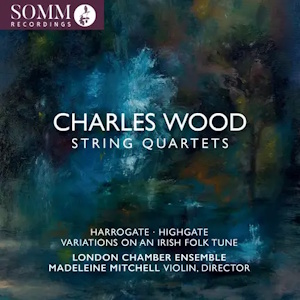
Charles Wood (1866-1926)
String Quartet No.4 in E flat ‘Harrogate’ (1912)
Variations on an Irish Folk Tune (1916)
String Quartet No.2 in E flat ‘Highgate’ (1893)
London Chamber Ensemble Quartet (Madeleine Mitchell, Gordon Mackay (violins); Bridget Carey (viola); Joseph Spooner (cello))
rec. 2025, St Silas Church, Kentish Town, London, UK
SOMM Recordings SOMMCD0723 [69]
This is the second disc that the London Chamber Ensemble Quartet (LCEQ) has made for SOMM on which the chamber music of Charles Wood has featured. The first, released in 2024, included the Sixth String Quartet (1915-16), paired with music by Howells. I didn’t review the disc myself but Jonathan Woolf’s warm welcome for it, following on from Nick Barnard’s positive review, encouraged me to invest in a copy. I will admit that I knew little of Wood’s output beyond some of his sacred choral works and my curiosity was aroused as much by the rare Howells that the LCEQ had recorded. However, I enjoyed Wood’s quartet very much and so I’m glad to find a follow-up disc has been devoted entirely to Wood.
The earliest of the three works on this disc is the Second Quartet, to which Wood gave the name ‘Highgate’. It appears that the nickname was prompted by Wood’s frequent visits around this time to his older brother William, who was music master at Highgate Grammar School until his sadly premature death in 1895. It is cast in four movements. In his authoritative notes, Jeremy Dibble tells us that contemporary critics, including Edward J Dent noted a “stylistic deference to Brahms” in the first movement (Allegro con moto). I think that judgement was not unfair; the very opening is especially suggestive of Brahms. However, it seems to me that this influence is well absorbed and Wood is not slavishly tied to the Brahmsian influence; he’s his own man. The music is inventive and well laid out for the four instruments. This first movement is, I think, serious but also attractive. There’s plenty of evidence of Wood’s contrapuntal skill; furthermore, he shows great understanding in the way he writes for the four instruments. That latter point should not surprise us because Wood played the viola and so would have had a good grounding in how to write for strings. Jeremy Dibble describes the second movement, marked Molto moderato, as “a short melodious intermezzo in minuet style”. Here, I think the (beneficent) influence of Brahms is apparent again, especially in the outer sections of this ternary structure. Though the first movement is, by some distance, the longest in the work, I think that the third movement is the emotional heart of the quartet. It’s a passacaglia, which contains eight variations. The opening material, which forms the foundation for the variations, is very serious in tone. The passage that really made me sit up and take notice is a lovely, eloquent variation (from 2:57). This, I suspect is the tranquillo section of the movement and it put me in mind of Brahms in a very good way. The whole movement is impressive and original – and, in places, profound. The members of the LCEQ really do it justice. If the third movement was introverted then, by contrast, the finale is extrovert. The music – and the performance – is light-hearted, indeed vivacious. It also offers further evidence of the composer’s contrapuntal skills but these skills are put entirely at the service of the music; in no way is the writing academic.
The other two works on the disc come from much later in Wood’s career. The Variations on an Irish Folk Tune date from 1916, though the work had to wait for a performance until 1925. A BBC broadcast followed later that year; on that occasion it was given by the Music Society Quartet and I was intrigued to learn from Jeremy Dibble’s essay that the MSQ’s cellist was none other than the young John Barbirolli. Wood used an old tune from County Mayo, which had been published in a 1909 volume, Old Irish Folk Music and Songs. I think he chose well; the tune is attractive and it turns out to have excellent potential for variation. There are ten variations in all and, as Jeremy Dibble points out, the composer grouped them in twos or threes. After an appealing first set of variations, the fourth (2:44) heralds a greater degree of urgency and seriousness. Variations 7 and 8 (from 4:10) are more relaxed, but the ninth (from 6:12) is, in Dibble’s description, “a passionate Adagio”. This seems to me to be the emotional core of the whole work; the music is very serious and it’s beautifully played by the LCEQ. The final variation, number 10 begins at 9:04 and it’s by some distance the most extended of all (the complete work plays for 12:46). It’s a rondo, the ingenuities of which are fully explained by Jeremy Dibble. Wood’s Variations on an Irish Folk Tune is a fine and attractive composition; though it’s technically assured, the technical prowess does not mean that the music is anything other than engaging to hear. It receives an excellent performance here.
Jeremy Dibble tells us that Charles Wood composed his Fourth Quartet while he and his wife were taking the waters at the fine Yorkshire spa town of Harrogate; hence, the name he gave to the work. Like the Second Quartet, the ‘Harrogate’ has four movements. The opening Allegro con moto opens with an appealing mix of elegance – very apt for music written in Harrogate – and energy. Everything that follows is well laid out for the four stringed instruments and Wood develops his ideas very well. Jeremy Dibble references the “severe contrapuntal activity of the development”; whilst I wouldn’t take issue with that statement in the academic sense, I don’t hear the music itself as “severe”; as happens elsewhere in the works on this disc, Wood manages to balance a mastery of musical technique without sacrificing the inherent attractiveness of his writing. The movement receives a lively, engaging performance which makes an excellent case for what is a fine movement.
There follows a C major Scherzo. I think Dibble hits the nail on the head in describing this as “somewhat Beethovenian”; that said, Wood’s Scherzo is, at 3:35, an awful lot more succinct than many a Beethoven scherzo. The Trio, in the relative minor key, is fluent and contrasts nicely with the scherzo material. The Adagio is founded on what Jeremy Dibble tells us is a “synthetic Irish folk song”. Actually, Wood’s tune is pretty convincing; it becomes the subject of four variations. An air of Celtic melancholy pervades the movement. I liked it a lot and I admired very much the sensitivity with which the LCEQ plays it. Wood rounds off his quartet with a “reel-like rondo”; this, Jeremy Dibble explains, is based on a tune by the Irishman, Thomas Moore. Once again, there’s plenty of technical accomplishment in this movement but that doesn’t get in the way of a cheerful and smiling ambience. If the first movement of this quartet has the elegance of a gracious Yorkshire spa town, then the lovely third movement and the spirited fourth take us back to Charles Wood’s Irish roots.
I very much enjoyed the music on this disc. Equally, I admired greatly the excellent performances by Madeleine Mitchell and her colleagues. On a technical level their playing is first class but, just as importantly, I had the distinct impression that they have taken this unfairly neglected music to their hearts. The centenary of Charles Wood’s death falls in 2026; this fine CD is an ideal anniversary tribute. I presume that all three works here appear on disc for the first time. It’s good news indeed that the LCEQ are to complete the cycle of his six quartets for SOMM; those recordings are keenly anticipated. I’m also looking forward very much to hearing these musicians live at the Three Choirs Festival in late July; their programme will include Wood’s ‘Highgate’ Quartet and also, appropriately enough since the Festival will be held in Gloucester, the original version of Howells’ ‘In Gloucestershire’, which featured on their first SOMM disc.
The performances on this disc have been very sympathetically recorded by engineer Adaq Khan and producer Siva Oke. The booklet essay is by Jeremy Dibble, who has just written a major biography of Wood, which is being published to coincide with the composer’s centenary. I’ve learned a lot from Dibble’s essay, even if he is a bit too technically inclined at times.
The string quartet repertoire is vast and with so many masterpieces vying for the attention of ensembles it’s inevitable that the music of too many composers will struggle to gain a hearing. Even making all due allowances, though, it strikes me as frankly absurd that the quartets of Charles Wood which I’ve so far heard – and those of many other British composers – have been banished to the fringes of the repertoire. All credit, then, to Madeleine Mitchell and her colleagues for giving us the opportunity to hear Wood’s excellent works both in concert and on CD. It’s particularly important that they’ve been committed to disc; that should bring them to the wider audience they deserve.
John Quinn
Previous review Jonathan Woolf













