
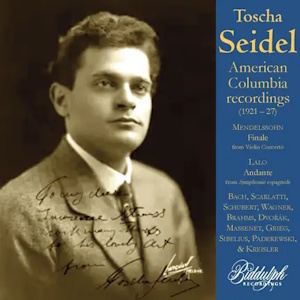
Toscha Seidel (violin)
American Columbia recordings, 1921-27
Biddulph 85070-2 [77]
A month ago I reviewed Toscha Seidel’s American Columbia recordings covering the years 1918 to 1921. Now Biddulph moves on to the years 1921-27 to ensure that ever more elements of his discography are restored to the catalogue – and not before time.
I won’t reprise what I wrote about this great violinist in that review or indeed in another Biddulph disc devoted to two late sonata recordings where some biographical details can be found. However, I will first note that among his panoply of gifts, from his rich tonal resources to his Golden Age portamenti, and through the lustrous sensuality of his playing, he lacked one thing only; musical discipline, which manifested itself most obviously in sonata recordings but which also could appear in his vignette discs where rhythmic caprice is audible. That’s true in Paderewski’s Minuet, notwithstanding his vibrant, lively tonal production.
American Columbia allocated him these charmers to match Victor’s Heifetz and Zimbalist discs, as all three were Leopold Auer students. It’s good to hear Anitra’s Dance in Hans Sitt’s arrangement, as it’s the kind of thing one doesn’t hear these days, a somewhat faded pleasure perhaps but full of refined elegance. A vehicle like Braga’s Angel’s Serenade is a perfect fit for Seidel’s songful playing and, despite some surface noise, Rimsky-Korsakov’s Chanson arabe, in Kreisler’s arrangement, is a perfect embodiment of Seidel’s sensuous art. A number of violinists active at this time recorded the music of Cecil Burleigh, a violinist and composer of, let’s say, sub-Kreislerian genre pieces. The Indian Snake Dance is one such example, played with panache and stylistic generosity by Seidel. Heifetz and the British violinist Margaret Harrison, sister of Beatrice, also recorded Burleigh’s charmers.
There are two versions of Dvořák’s Slavonic Dance No.2 in E minor in Kreisler’s arrangement – one from 1923 and an electrically recorded remake from 1927 where Seidel not only had more time but is actually a more accurate representation of his tonal breadth. Three of the pieces are orchestrally-accompanied, the Andante from Lalo’s Symphonie espagnole and the finale, poorly cut, from Mendelssohn’s Concerto. To us, the bass reinforcements may sound aurally absurd and intrusive but that wouldn’t have been the case when listening in 1923 on the reproducing equipment of the time. There’s also tenor Charles Hackett singing Schubert, in English, with Seidel’s extensive obbligato, and orchestra.
The arrangement of a Scarlatti Sonata as ‘Pastorale’ is one of the many and varied repertorial selections open to a violinist in the teens and twenties but one can’t help but wish that Columbia had selected something less flimsy for so great a player. Columbia celebrated Seidel’s first electric recording in June 1926 – one third of the pieces in this selection are electrics – with Dvořák’s Humoresque, played quite straight, and then focused on a rather unadventurous diet until the end of this sequence. It included a piquant Massenet Meditation, warmly textured and full of colour, an intensely lyric reading of great personality, and Bach’s Air on the G-string, a canny choice given the voluptuous nature of Seidel’s tone. Possibly as a riposte to HMV/Victor’s disc featuring the recording by the ineffably Gallic Jacques Thibaud, Columbia also recorded Seidel in Saint-Saëns’ Prelude to Le Déluge. Ardour and richness irradiate Wagner’s Albumblatt.
Tonal richness and ardour, in fact, sum up Seidel’s playing here – ravishing, communicative, intensely beautiful, and sometimes a little indulgent and undisciplined. It’s a small price to pay, though, for that molten tone. The transfers are good and Wayne Kiley’s booklet note equally so.
Jonathan Woolf
Buying this recording via the link below generates revenue for MWI, which helps the site remain free
Contents
Ignacy Paderewski (1860-1941)
Minuet in G arr. Fritz Kreisler
Edvard Grieg (1843-1907)
Peer Gynt – Anitra’s Dance arr. Hans Sitt
Henry Kaufman (piano), rec. March and October 1921
Gaetano Braga (1829-1907)
Angel’s Serenade
Fritz Kreisler (1875-1962)
Schön Rosmarin
Francesco Longo (piano), rec. October 1922
Nikolai Rimsky-Korsakov (1844-1908)
Chanson arabe arr. Fritz Kreisler
Maurice Eisner (piano), rec. February 1923
Franz Schubert (1797-1828)
Valse sentimentale arr. Sam Franko
Cecil Burleigh (1885-1980)
Indian Snake Dance, Op.6 No.4
Antonín Dvořák (1841-1904)
Slavonic Dance No.2 in E minor arr. Fritz Kreisler
Francesco Longo (piano), rec. May and September 1923
Edouard Lalo (1823-1892)
Symphonie espagnole – Andante
Felix Mendelssohn (1809-1847)
Violin Concerto in E minor – Finale
Orchestra/unidentified conductor, rec.1923
Franz Schubert (1797-1828)
Schwanengesang – Serenade
Charles Hackett (tenor) and orchestra, rec. 1923
Domenico Scarlatti (1685-1757)
Pastorale
Fritz Kreisler (1875-1962)
Rondino on a theme of Beethoven
Zdeněk Fibich (1850-1900)
Souvenir poétique arr. Kurt Schindler
Jean Sibelius (1865-1957)
Valse triste
Antonín Dvořák (1841-1904)
Humoresque
Arthur Loesser (piano), rec. February and May 1924
Johann Sebastian Bach (1685-1750)
Air on the G-string arr. August Wilhelmj
Jules Massenet (1842-1912)
Thaïs – Meditation
Camille Saint-Saëns (1835-1921)
Le Déluge – Prelude
Richard Wagner (1813-1883)
Albumblatt arr. August Wilhelmj
Waldemar Lischowsky (piano), rec. April 1927
Antonín Dvořák (1841-1904)
Slavonic Dance No.2 in E minor arr. Fritz Kreisler
Johannes Brahms (1833-1897)
Hungarian Dance No.1 in G minor arr. Joseph Joachim
Emanuel Bay (piano), rec. October 1927













