
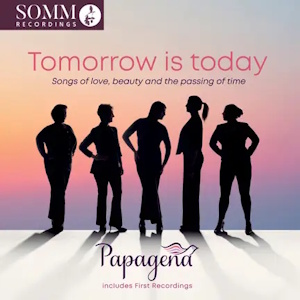
Tomorrow is Today. Songs of love, beauty and the passing of time.
Papagena
rec. 2025, St Michael and All Angels, Oxford, UK
Texts and English translations included
SOMM Recordings SOMMCD 0721 [67]
This is the third album that the vocal quintet Papagena has recorded for SOMM. I reviewed their debut album, The Darkest Midnight and also the follow-up release Hush! (review). That second album was recorded in 2019. Since then, there have been a couple of changes in personnel but this new disc indicates that the ensemble’s quality has not changed, nor has their propensity to choose stimulatingly eclectic programmes.
As before, the programme follows a theme and I can do no better than to quote the explanation given by Robert Matthew-Walker in the booklet. He says that “many of the pieces are variously connected with themes of beauty (human and divine as well as that of the natural world) together with the passing of time, in an attempt to create a narrative relating to these subjects and presented in a sequence that weaves individual tonalities, tempos and styles into a broader sense of organic flow”. He goes on to say, rightly, that the programme need not be experienced complete but I have to say that I found it pleasant and satisfying to surrender to the ordering that Papagena have devised; I decided to ‘go with the flow’.
With eighteen separate items on the programme, I won’t try to comment on everything; rather, I’ll pick out a few numbers which I especially enjoyed. In fact, the very first piece falls into that category. It’s an arrangement for female voices of Sir James MacMillan’s lovely Burns setting, The Gallant Weaver. It’s one of three consecutive arrangements by Sarah Tenant-Flowers, who is one of Papagena’s two altos. MacMillan’s original is for unaccompanied SATB but within that scoring the sopranos are especially prominent; indeed, in the version that I have in my collection by the BBC Singers three solo sopranos are credited; the text is, after all, one that gives voice to the thoughts of a woman. The present arrangement works exceptionally well and Papagena’s performance is captivating. Ms Tenant-Flowers has also arranged the Monteverdi madrigal Si ch’io vorrei morire. Again, her work seems to have been entirely successful. Monteverdi’s music is already sensuous, and hearing it voiced by five beautifully poised and well blended female voices is a treat; the singers give an added dimension to Monteverdi’s aching, languorous dissonances.
A little later in the programme we hear an arrangement for unaccompanied voices of Purcell’s ‘Music for a while’. The vocal line from Purcell’s original is given to soprano Imogen Ram-Prasad, who sings it very well. Her four colleagues fill in the rest of the (instrumental) parts and the success of the arrangement is such that the solo line is embedded in, yet at the same time distinct from, the rest of the texture. When the point is reached at which Purcell repeatedly sets ‘drop’, the word is distributed round the five voices and, dare I say, I think that works better than in the original where the same voice sings the word over and over.
O cruor sanguinis by Hildegard von Bingen has been arranged by the members of Papagena. Robert Matthew-Walker tells us that the harmonies “…are entirely by Papagena, with no attempt at being ‘authentic’”. The harmonisation seems to me to work well and this delicate piece is ideally suited to this ensemble.
I’m a little less taken with one or two items later in the programme. I courted a sailor is by Kate Rusby; it’s a modern folk song. I’ve not heard the original so I can’t really comment on the arrangement by Suzzie Vango, one of Papagena’s sopranos. However, I’m sorry to say that I didn’t find the song itself especially memorable. In Welcom somer the Canadian composer Don Macdonald sets some lines by Chaucer. I may be missing something but I feel that Chaucer’s lines require a rather more robust and earthily joyful treatment than Macdonald gives them; maybe the singers could have imparted more of that quality?
On the other hand, I liked Sandy Denny’s Who Knows Where the Time Goes? This is sung in another Suzzie Vango arrangement. I’m not familiar with the original song but here it comes across as a thoughtful reflection, which I’m sure is what Denny intended. I’ve previously heard and liked a few compositions by Janet Wheeler. Her piece Tomorrow is today, from which the album’s title is taken, was commissioned by Papagena. In it, Janet Wheeler sets words by her daughter, Sarah Cattley who is, I think I’m right in saying, a successful composer in her own right. Robert Matthew-Walker tells us that in commissioning the piece, Papagena asked for “something cheerful, fast-paced and with bird references”. On Janet Wheeler’s website I read that the text her daughter has provided “likens each new dawn to the new life of a chick emerging from its egg. The music incorporates layered birdsong effects to create a dawn chorus.” The piece is most enjoyable to hear; it sounds great fun and, as I listened, I reflected that it would probably be very entertaining to see it in live performance.
The programme opened with a beautiful piece by James MacMillan. It ends beautifully as well. O du stille Zeit sets lines by Eichendorff. The melody, by Cesar Bresgen, has been arranged delightfully by Simon Wawer. We’re told in the booklet that Papagena often include this piece in concerts during the season of Advent. It’s very touching and the performance is lovely; it’s an ideal conclusion to this programme.
Throughout this disc the five members of Papagena give immaculate performances. The blend of the voices is perfect and you get a distinct sense of five singers who enjoy making music together. The programme works well but if I have a reservation, it would be that so much of it is beautiful and serene in character. After a while I began to wish that, musically speaking, the group would let their hair down a bit more. I would have liked two or three items on the programme that were more unbuttoned and extrovert. Having seen the group in performance, albeit a few years ago, I know they are more than capable of having musical fun.
The singers have been recorded very successfully by engineer Dave Rowell and producer Ben Parry; incidentally, the latter is pressed into service as a “body percussionist” for a couple of the items!
John Quinn
Buying this recording via the link below generates revenue for MWI, which helps the site remain free
Contents
James MacMillan (b 1959)
The Gallant Weaver (arr. Sarah Tenant-Flowers)
Claudio Monteverdi (1567-1643),
Si ch’io vorrei morire, SV89 (arr. Sarah Tenant-Flowers) (Madrigals, Book 4: SV75-93)
Traditional
Oy khodyt son (arr. Sarah Tenant-Flowers)
Kaval sviri (arr. Petar Lyondev)
Henry Purcell (c1659-1695)
Music for a while (arr. G Eriksson, MG Helbekkmo) (Oedipus, Z583)
Shivani Rattan (b 1998)
Holi
Leonora d’Este (1515-1575)
Sicut lilium
Anonymous
There is no rose
Hildegard von Bingen (c 1098-1179)
O cruor sanguinis (arr. Papagena)
Kate Bush (b 1958)
This Woman’s Work (arr. Jim Clements)
Traditional
Canto a Eleggua (arr. A Valdes, Y Lafuente)
Janet Wheeler (b 1957)
Tomorrow is today
Caroline Shaw (b 1982)
Dolce cantavi
Kate Rusby (b 1973)
I courted a sailor (arr. Suzzie Vango)
Don Macdonald (b 1966)
Welcom somer
Sandy Denny (1947-1978)
Who Knows Where the Time Goes? (arr. Suzzie Vango)
Hazel Askew (b 1976)
Order and Chaos (arr. H Askew, H James, R Rheingans)
Cesar Bresgen (1913-1988)
O du stille Zeit (arr. Simon Wawer)













