
Dmitri Shostakovich (1906-1975)
Four Pieces from music to The Gadfly, Op. 97 (1955)
Paweł Łukaszewski (b. 1968)
Sonata for Viola and Piano (2021)
Dmitri Shostakovich
Sonata for Viola and Piano in C major, Op. 147 (1975)
Paweł Łukaszewski
Aria for violin and piano (2016)
Michał Bryła (viola); Robert Morawski (piano)
rec. June 2024, Concert Hall of the Chopin University of Music, Warsaw, Poland
Chopin University of Music UMFC CD 224 [67]
As listeners familiar with Paweł Łukaszewski’s extensive catalogue of choral works will know, his music is tonal and makes a powerful impression even on a first hearing. His Viola Sonata, in four movements, each of them primarily fast, begins with a forceful statement of a theme that is to recur to close the work. A second theme is more relaxed, but the work offers few opportunities to the violist in the way of lyrical writing; instead, there is much rapid figuration, much of it using repeated notes. Both the second and third movements are kinds of scherzo; the third, less than two minutes long, is nervous and disquieting and ends in a whispering coda and a suggestion of traditional dance. The finale begins in moto perpetuo style, before the work’s opening theme returns about half way through. The ending is quiet and surprisingly sudden. The piano has an important role, with several short passages during which the viola is silent. The booklet quotes the composer to the effect that he attaches great importance to his instrumental works, where it is ‘the virtuoso factor that comes to the fore’. With Michał Bryła and Robert Morawski he has nothing to fear on that score.
Aria provides the violist with the opportunities for lyrical playing that are largely denied him in the sonata. The instrument is allowed to sing, which it does most attractively, including, in one passage, a series of two-note motifs that evoke Debussy in that composer’s sweeter moments. The work was originally written for Łukaszewski’s son, an aspiring cellist, though in spite of what one reads in the booklet, virtuoso elements are pretty much absent. Nor, in all honesty, do I hear many ‘associations with jazz music’. Like the sonata, Aria ends with quiet notes that seem to come from nowhere. It is an attractive work that will bring simple pleasure to any listener, as it surely did to Łukaszewski Junior.
Wikipedia lists 36 examples of music Dmitri Shostakovich wrote for films, each with an allotted opus number. There is a suite drawn from the music he composed for the 1955 film The Gadfly, but here we have four pieces in arrangements for viola and piano by Vadim Borisovsky, the violist of the Beethoven Quartet. Because it is film music some of Shostakovich’s real musical identity is absent, though hearing it is both enjoyable and instructive. The opening ‘Scene’ is grandly operatic, in the minor key but with a resplendent major key resolution at the end. Is it a seascape as the notes suggest? Perhaps the rolling piano part really does represent the pitching waves. The composer’s voice is more in evidence in the reflective and atmospheric second piece, entitled ‘Intermezzo’, whereas the third piece, ‘Folk Feast’ is a short virtuoso exercise for both players, with much double stopping and whirlwind scale passages in the viola part. At times the viola makes a passable attempt at impersonating a folk fiddler. The fourth piece, ‘Romance’, is perhaps the most surprising, in ABA form where a troubled B section is framed by a cantabile melody that could almost have been by Schubert or Brahms.
The Gadfly and the two works by Łukaszewski already make a compelling programme, but the work that completes it is a towering masterpiece. Illness and hospitals were Shostakovich’s constant companions in his later years, and his Viola Sonata was completed only a few days before his death on 9 August 1975. Though his correspondence does not suggest that the sonata was intended as a valedictory work, the music itself does. There are many examples throughout Shostakovich’s oeuvre wherein he quotes from his own works, but a fascinating passage in Pauline Fairclough’s superb short life of the composer (Reaktion Books, 2019) reveals that the finale of the Viola Sonata contains quotations from every one of his 15 symphonies. They are very brief, and often well hidden in the piano part – pretty much inaudible in most cases – and furthermore, they amount to only one clue that the composer was constructing a kind of resumé not only of his career, but also of his life. This finale was designed as being ‘in memory of Beethoven’, and much of the musical material refers to, rather than quotes from, the first movement of the ‘Moonlight’ Sonata. Still in the finale, a key moment about half way through, is an unaccompanied cadenza for the viola which is followed by the most tortured and violent passage of the whole work. As this subsides, however, the atmosphere undergoes a remarkable transformation into something much calmer and sweeter, to close in clear, tranquil C major where the viola is given a long, held E, the warmest note of the C major chord. Shostakovich referred to this work as ‘radiant’, and it seems inevitable that he knew he was composing his farewell. But is there ‘acceptance’ here, or ‘consolation’; is there ‘resignation’? Each or those words might apply, yet none of them does, not quite, not really.
I have spent several weeks with this troubling and magnificent work, not only in the company of this superb performance but also with Paul Silverthorne and John Constable (Koch, 1993) and Peter Minkler and Lura Johnson (Centaur, 2008). Bryła and Morawski cope brilliantly with the fiendish technical demands of the Scherzo – closely based on music from Shostakovich’s unfinished opera The Gamblers of 1942, another important backwards glance – with Bryła perhaps even more successful than Silverthorne and Minkler with the brief, wild folk elements. I feel, too, that the Polish duo is marginally more adept at managing the frequent changes of mood and atmosphere in the episodic first movement. The playing throughout the work is more overtly expressive than I hear in the two rival versions, and this is especially so at the work’s tranquil close, music that reduced Yevgeny Mravinsky to tears at the first public performance seven weeks after the composer’s death. Is Bryła perhaps just a little too indulgent here, where others are content to allow the music to speak more simply for itself? Perhaps, but it does not detract from a hugely authoritative, convincing and moving performance.
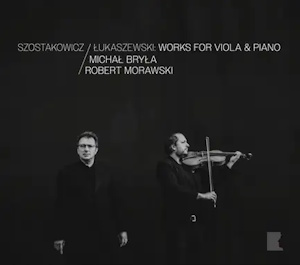
The programme has been recorded with great skill, with a refreshingly realistic balance that allows us to savour all the more the insightful and idiomatic playing of Robert Morawski. The presentation of the disc is sombre – black dominates – yet lavish, with a poster-size fold of photos of the performers. A useful insert note by Marta Dziewanowska-Pachowska is devoted to the programme alongside information about the performers.
William Hedley
Buying this recording via the link below generates revenue for MWI, which helps the site remain free














