
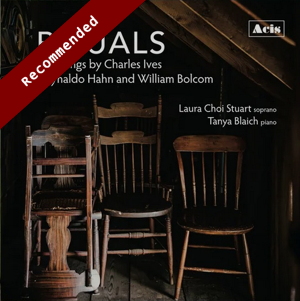
Rituals
Charles Ives (1874–1954)
Eight songs
Reynaldo Hahn (1874–1947)
Seven songs from Études latines (1900):
William Bolcom (b. 1938)
Waitin’ and Miracle Song from Cabaret Songs (1977-96)
Briefly It Enters (1997)
Laura Choi Stuart (soprano), Tanya Blaich (piano)
rec. 2025, Jordan Hall, New England Conservatory of Music, Boston, USA
Texts and translations included
Acis APL78383 [65]
Rituals is one of the most carefully argued song programmes I have encountered in a while. Its argument is there in the title. Laura Choi Stuart and Tanya Blaich propose that song, in the hands of all three of these very different composers, is a species of ritual: the communal remembering of Ives, the wine-soaked classical ceremonies of Hahn, and the small domestic sacraments of Bolcom’s Kenyon settings. What holds the disc together is not period or language but a shared conviction that a few concentrated minutes of words and music can stand in for something larger and repeated.
Before you listen to a note, you’re aware that the beautiful packaging of the CD is making a point. The sung texts occupy one sleeve and the notes another. Opening the former you see that the translations for the Hahn settings are Choi Stuart’s own. For a programme this preoccupied with words, that division feels less like a design flourish than a statement of priorities. The texts are not an afterthought placed at the end of the programme notes. Their placement suggests you should look at them before doing anything else.
‘Art song’, specifically mentioned on the album cover, has a very broad range of course. If you were in any doubt about that, this recital will disabuse you utterly. The Ives selections at the start sound like an audible attempt to break the mould of something precious in every meaning of that adjective. There’s not much ‘art’ in the aesthetic sense here. Choi Stuart’s notes argue that Ives chose his poets as carefully as he chose his borrowed tunes, and that the three Victorian Britons here (Matthew Arnold, John Bowring and Robert Browning) were selected as poets of reform, so that the texts carry the same populist charge as the hymns and parade tunes woven beneath them. It is an interesting thesis. Bowring was a Unitarian, an anti-slavery campaigner and a supporter of the suffrage; Arnold’s West London is a small parable of working-class dignity; Browning supplies his liberal credentials directly as a challenge to power in the extract from his epic Paracelsus. And Ives’s own politics, with their faith in the wisdom of the majority, make the reading plausible. If you’re slightly sceptical about the argument on paper (after all, Ives set a great many poets for a variety of reasons, and presenting these particular three as a bloc of reformers is a curational choice) then Blaich and Choi Stuart’s magnificent realisation will win you over, I’m sure. It’s advocacy of the best possible sort. There’s assurance powered by a sort of controlled fervour, in Choi Stuart’s delivery. She’s always highly musical and, crucially, her diction (as it is throughout) is flawless. Blaich is the most deft collaborator, never once making you question the coherence of Ives’s writing for piano.
It’s a typically bold move by this duo to have started with the Ives rather than the Hahn. A facile analysis might conclude that if Ives’s settings were seeking to break the mould, Hahn’s were trying to perfect it. It’s true that Hahn, born in the same year as Ives, could hardly have taken a more different route. Where Ives is forward-looking formally, musically and in the way he uses memory and experience, Hahn looks sideways and backward at once, into a blurred and perfumed antiquity. The seven Études latines heard here, settings of the Parnassian Leconte de Lisle, trace a loose erotic arc through the rituals of wine and desire. The conceit is a kind of exoticism in time rather than place. While Debussy and Ravel were spinning the globe, Hahn travelled into the past, dressing fin-de-siècle Paris in the robes of Horace and Pliny. The narrator is unusually a mature lover, comfortable and worldly, dragged once more into love’s old trials, and the recurring imagery of aged and noble wine carries the metaphor successfully. It is the lightest music on the disc and the most purely sensuous. That last point is important. I implied above that a reductive comparison might regard Hahn as someone who wanted to polish and prettify a beloved form. But all of these songs in the vivid performances they receive here immediately strike one as an exercise in challenge: how much sheer voluptuousness can an individual setting take before the listener is overwhelmed? And what is the cumulative effect? If there’s fervour in the duo’s performance of the Ives, there’s a racy fervidness to their Hahn, which is thrilling and appropriate. You’re also aware — in Choi Stuart’s ravishing singing particularly — that there’s a sort of learned emotion at play here, something almost synthetic which contrasts markedly with the two intensely interior bodies of song either side.
For how else to describe William Bolcom’s Briefly It Enters? This is a setting of nine poems by Jane Kenyon, who died of leukaemia in 1995 at the age of 47 (not 49, as the notes have it). The story behind the cycle is genuinely moving. Bolcom and his wife Joan Morris had been friends of Kenyon and her husband Donald Hall since their Michigan years, and during her final illness Kenyon corresponded with Bolcom about a set of poems taken from her oeuvre. A dying poet, in other words, chose the texts of her own elegy, and the poems she chose are a fascinating range. Only two of the nine, Man Eating and the unfinished The Sick Wife, are genuinely late poems. Four come from The Boat of Quiet Hours of 1986, nearly a decade before her death, including the very poem that gives the cycle its title. Otherwise, which lends its name to her posthumous volume, was published in Constance in 1993, before she was ill. The choices make for a deeply affecting cycle, reinforced by Bolcom’s imaginative and sensitive music. Briefly It Enters, and Briefly Speaks is a litany of self-definition built on the anaphora ‘I am’, that turns at its close to address the listener directly and promise a love that ‘overcomes you’. Sung last, it becomes a blessing pronounced by the poet over her own mourners, drawn from a self she had been. So, the cycle opens with a question (Who, also from 1986) and closes with that question answered.
Those two poems are on facing pages of the Collected Poems and form the cycle’s structural pillars. That is the angle that has stayed with me, and it is the disc’s quiet triumph: a meditation on mortality made almost entirely of the living. What’s striking about Bolcom’s music and Choi Stuart and Blaich’s performance is that it’s never sentimental and is entirely devoid of the sort of misplaced nostalgia or poignancy it would be easy to fall into. (I should say for avoidance of doubt that Kenyon’s poems themselves never reach for that easy register, and it’s irritated me ever since the Collected Poems were published in 2005 that the publishers decided to reproduce a cozy autumnal still life depicting a heaving table of wholesome faux New England produce on the cover!) The music has angular, clear lines, Kenyon’s words always given primacy, and the performances are superbly limpid. Choi Stuart writes in the notes of a moving visit she and Blaich made to Eagle Pond Farm (Hall and Kenyon’s New Hampshire home) and, after it, attempting again to tackle Briefly It Enters and Briefly Speaks, with which they’d been struggling, and being reduced to tears. It’s a tribute to the performance they recorded that it’s pervaded by the power and the warmth of Kenyon’s sensibility without being in any way mawkish.
There’s a final interesting curatorial point to make about the recital. The Kenyon settings are themselves framed by two of Bolcom’s dazzling Cabaret Songs, set to texts of self-proclaimed ‘theatre poet’ Arnold Weinstein. As Choi Stuart says, the songs draw a line of connection between Ives and Bolcom in their leaning on popular style, but I’d go further and argue their juxtaposition with the Kenyon is a fascinating creative act in itself. You’d think on reading Weinstein’s text ‘We wuz born to die!/…The news of the day’ that it would be a jarring footnote to the moving conclusion of Briefly It Enters, but it manifestly works here. Choi Stuart brings wryness and humour to Weinstein’s words, and Blaich balances Bolcom’s bluesy inflections to perfection. It’s not a crude upbeat ending but a wonderfully counterintuitive gesture that comes off triumphantly.
What a refreshing disc this is, unquestionably one of the best song recitals I’ve heard for a long time. It’s nice also to be able to report how much care Acis have taken with its presentation. I’ve already commented on the exemplary packaging of the song texts and Choi Stuart’s first class programme notes. There are also many beautiful photographs of the visit to Eagle Pond Farm which add real contextual value. To go back to where I started, you can see for yourself, as well as hear, some of those aspects of Kenyon’s day to day life which must have possessed the ritualistic appeal which gives the album its title. Any lover of art song will want to hear this: a genre alive and well in the hands of these profoundly accomplished performers.
Dominic Hartley
Availability: Acis
Contents
Charles Ives
The Things Our Fathers Loved
Watchman!
The See’r
Down East
West London
From Paracelsus
The Innate
Tom Sails Away
Reynaldo Hahn, from Études latines
Néère
Salinum
Lydé
Vile potabis
Tyndaris
Pholoé
Phyllis
William Bolcom
Waitin’, from Cabaret Songs
Briefly It Enters:
Who
The Clearing
Otherwise
February: Thinking of Flowers
Twilight: After Haying
Man Eating
The Sick Wife
Peonies at Dusk
Briefly It Enters, and Briefly Speaks
Miracle Song, from Cabaret Songs













