
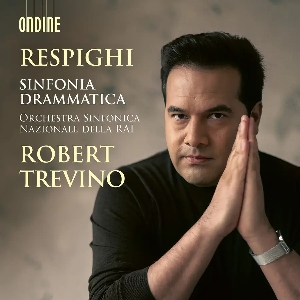
Ottorino Respighi (1879-1936)
Sinfonia Drammatica (1914)
Orchestra Sinfonica Nazionale della RAI / Robert Trevino
rec. 2025, RAI Auditorium, Turin, Italy
Ondine ODE1477-2 [64]
Ottorino Respighi’s Sinfonia Drammatica, his first large-scale purely orchestral work preceded the Fountains of Rome by some two years, so one can say it comes from his early maturity. Unlike its successor, the work has never reached popularity in the recording catalogue or on Italian Radio. In the booklet notes, conductor Robert Trevino declares that not a single member of his radio orchestra knew the work, nor could anyone recall it being performed.
I am aware of a few earlier recordings: Edward Downes with the BBC Philharmonic (on Chandos 9213), Daniel Nazareth with the Slovak Philharmonic (review) and John Neschling with the Liège Philharmonic (review).
The work took Respighi some 18 months to write. It clearly shows off his liking for large, sumptuous orchestration where he can display his talent for orchestral colour. The first of three movements is the longest, over 26 minutes. Like the other two, it has a distinct tendency to sprawl in a somewhat disorganised way. Its form is mainly notable for alternate swells and surges interspersed with quieter, more meditative passages. It opens with a short-lived dramatic passage in which Respighi emphasizes the drama by employing the bass drum to reinforce matters. It also introduces a rising and falling theme developed throughout the movement.
I found it difficult to follow the development. Respighi is so lavish with his ideas and tone painting that in the many quieter sections my attention began to wander. Eventually, the recapitulation begins with the main theme fully expressed on the violins. It rises to a passionate climax supported by repeated drum and tam-tam strokes that briefly remind me of the excitement he engenders in the last movement of the Pines of Rome. I was also briefly reminded of Richard Straus’s exultant horns in Don Juan. The movement does not on this grand climax. Instead, the sound dies away and a solo violin leads the music to a restful close – all passion spent, so to speak.
The second movement, Andante sostenuto, begins with a passionate theme on the strings, taken up by the woodwind. It soon becomes dominated by woodwind accompanied by high strings. Then we reach a climax for the full orchestra led by the trombones, but it soon dies away into a quieter section led by a solo violin. This portion persists with an occasional eruption on the brass, and gradually builds into a slow, impressive climax led by the passionate strings with drums at the peak. The sound then falls away with quiet beats on the timpani drifting into nothingness.
The last movement, Allegro impetuoso – Tempo di marcia triste, begins in an agitated manner; prominent timpani add to the rumbustiousness. There follows a quieter episode for solo clarinet and strings, which suddenly surges to a brass-dominated climax, in a manner familiar from the earlier movements. The tempo di marcia forms a lengthy coda in which melodic fragments heard earlier reappear, building to a mighty tam-tam- and timpani-capped climax.
I listened to the Chandos disc for comparison. Recorded some 33 years ago, it amply demonstrates why Chandos recordings were rightly admired for their technical excellence. Sonically, this release demonstrates little if any improvement. The mightily impressive Chandos sound, if anything, has more effect in the martial closing pages of the third movement. Both orchestras are on fine form and the performances are very similar. Edward Downes moves matters on more briskly, some 2 minutes in the second movement and 1.5 in the third. That is not a drawback, given Respighi’s tendency to be prolix.
I would be happy with either of these two recordings, but the new one does not displace the older disc in my affections. Ondine’s booklet, in English, contains biographical and musical details by Respighi biographer, Michael Webb (Ottorino Respighi, His Life and Times, 264 pp, Matador Publishing).
Jim Westhead
Buying this recording via the link below generates revenue for MWI, which helps the site remain free













