
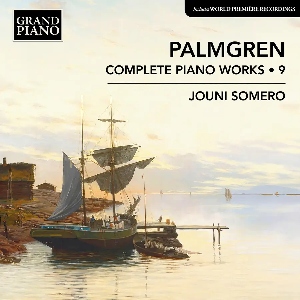
Selim Palmgren (1878-1951)
Complete Piano Works 9
Jouni Somero (piano)
rec. 2025, Kuusaa Hall, Kuusankoski, Finland
Grand Piano GP964 [76]
Jouni Somero is well into his task of recording the complete piano works of Selim Palmgren. Complete is definitely the word; every volume so far has included, alongside his many published piano works, a fair share of unpublished pieces or short works that were only published in magazines and this volume is no exception. Reviews of earlier volumes on Grand Piano Records can be found at GP867, GP939 and GP952.
The Humoresques op.26, three of twenty or so that he wrote, were dedicated to his teacher Ferruccio Busoni and written while he was touring Central Europe. They are all virtuoso works and the first two have a great deal of burlesque about them while the third is a, mostly, dark-hued concert waltz. Three earlier humoresques are also included, all without opus numbers. The first appeared in a music magazine in 1907 and then in a Finnish Christmas magazine in 1912; its cheerful scherzo captures the bustle of the holiday season effectively whether it was intended to or not. SP.89 and SP.88 were written by the teenage Palmgren and are a short rustic dance and a restless Brahms like piece respectively. Two other short pieces also date from this period; the scherzo which is actually a slow, syncopated waltz with some very Chopinesque decorative writing and the Schumann influenced Versöhnung, reconciliation, a delicate piece that is unfortunately unfinished. It has something of kinderscenen about it. The Intermezzo Valsant, an elegant and light hearted dance, was written around the same time as the four impromptus op.63 that appear on volume 7 of this series and like them it shows nothing of the turmoil that Finland was going through at the time. If it was indeed part of a piano suite as Palmgren suggested then its companions have not turned up. Spinnrocken, the spinning wheel, the last of the short individual pieces here is a dazzling little étude. It is certainly charming as the booklet suggests but doesn’t have that easy and immediate dazzle that makes another of his études, en route so popular.
Just after his studies with Liszt pupil Conrad Ansorge Palmgren composed his larger scale Fantasie – at eight and a half minutes it is one of his longer piano works. Its atmospheric grave opening belies the huge technical demands that are to come, some of which grow very effectively out of this introduction. Another slightly more lyrical theme, which begins molto tranquillo, appears after some faster passage work and plays alongside a restless chromatic chordal accompaniment in the left hand. For me the least effective section is where this music is played appassionata assai; it sounds heavy handed and one wonders if Palmgren would have thinned the texture had he returned to the piece later in life. This theme does work well when it is incorporated into the final march however.
Five collections of pieces complete the disc. It was only in the planning stage of this collection that Palmgren specialist Heikki Poroila discovered that three items, previously listed as SP.117, 51 and 299 were in fact intended to be published as op.108 – presumably now sharing that designation with the Ballade for orchestra; this is how Somero has gathered them together. It is not known what occasioned the first piece festive procession but it is at least clear that this informal work with folk elements was not intended for some grand, pompous affair. First butterfly is an wonderful little étude, full of cascading notes while Winter landscape is a simply textured and melancholy little song without words. The earliest collection here is The summer of the north, written between 1912 and 1914. Abendstück is based on a Finnish folk song and while it begins simply enough Palmgren develops the harmony with some exotic chromaticism and left hand dissonances. On the brook is no gentle little stream and develops into quite the tumult; it is full of whole tone and impressionist writing that perhaps echoes some of Debussy’s writing in the préludes, written not long before this, but the voice is Palmgren’s own. Another folk-song inspired piece is the short and energetic Tanzstück and the trend continues in little ballade, a dark and dramatic transcription of a Finnish folk-tune Taivas on sininen ja valkoinen – the sky is blue and white. The final Wedding March is very exuberant though one wonders if the wedding ensemble’s timpanist was a bit tipsy or obsessive – or both – and whether this colourful march was intended for the guests as the reception was in full swing rather than for the married couple demurely exiting the service.
From the other end of the first world war comes the suite Klanger och Rytmer, sounds and rhythms which Palmgren premiered in November 1918. It comprises a Venetian barcarole that grows rather passionate, a jaunty triple time Finnish folk dance, Midsummer game, and a gavotte that seems to get its inspiration from folk models rather than any baroque influence. It has some interestingly piquant harmony suggesting some odd folk instrumental tuning, especially in the middle section. The fourth piece Sounds in the night, remained unpublished and has not been traced so the set closes with another Finnish dance, West Finnish Polonaise, a flamboyant piece, full of octaves and intricate decoration. The two Graciösa Rytmer, graceful rhythms were published in 1920 and once again follow folk idioms though the richly flowing and rather beautiful ring play has something of the English pastoral tradition to it. It is paired with an attractive if unassuming minuet. At the end of 1920, a busy time for new compositions and year before he moved to America for five years Palmgren wrote his four pieces. The first three numbers were published as op.73 while the fourth Muratti, Ivy, was not published until 1945. It has been included here as part of this set though Petrucci lists it as op.64b no.1, a second set of Klanger och Rytmer along with a piece called bagpipes. The booklet does not shed any light on this. Romance, the opening number follows the pattern of many salon pieces with a slow melody singing over a gently syncopated accompaniment. Cortège gracieux is a toy march with a simple drone accompaniment and chromatically shifting harmony in its perky tune. A shimmering cascade of notes seems to promise more but the piece ends after this brief flurry. Palmgren’s most impressionist piece on the disc is the heartfelt Twilight Fantasy, hazy and evocative with a mournful theme given to the left hand. Ivy, the late addition to the set, is a swirl of whole tone arpeggios though the dynamic rarely peeps above piano and it ultimately ends on a solemn E minor cadence.
This is another valuable addition to this worthy series. Though primarily a miniaturist in his piano writing and seemingly able to write huge amounts of said miniatures there is always much to admire and occasionally to say this should be heard more often. The informative booklet agrees and also suggests that it is perhaps only due to being published in Finland that some of these pieces have escaped wider dissemination. While that may be the case it is also true that vast amounts of music, much of it published by international and respected publishing houses, languishes in obscurity through no fault of its own and is unlikely ever to see the light of day. Such is life and we can only be grateful to Grand piano and Jouni Somero that Palmgren’s neglected music is getting a well-deserved chance to escape that obscurity just for a while.
Rob Challinor
Contents
Trois Humoresques Op.26 (1908)
Fantasie Op.6 (1900)
Four Pieces Op.73 (1920-22)
Graciösa Rytmer SP.72 (1920 or earlier)
Humoreski SP.90 (1907 or earlier)
Humoreske SP.89 (1890s?)
Humoreske SP.88 (1896)
Hrjoitelmia ja Tunnelmia Op.108 (1948)
Versöhnung SP.332 (1894)
Scherzo SP.246 (1893)
Intermezzo Valsant Op.65 (1918)
Spinnrocken SP.276 (the spinning wheel) (1916 or earlier)
Klanger och Rytmer Op.64 excerpts (1918 or earlier)
Nordischer Sommer Op.39 (1912-14?)
Buying this recording via the link below generates revenue for MWI, which helps the site remain free













