
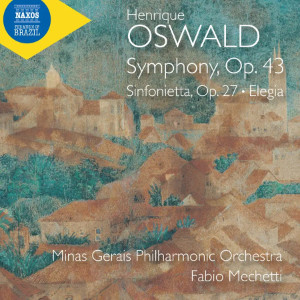
Henrique Oswald (1852-1931)
Elegia (1896-1897)
Symphony, op. 43 (1910)
Sinfonietta, op. 27 (1897)
Minas Gerais Philharmonic Orchestra/Fabio Mechetti
rec. 2024, Sala Minas Gerais, Belo Horizonte, Brazil
Naxos 8.574643 [69]
I was first alerted to Naxos’s enterprising series The Music of Brazil when, in 2019, my colleague Rob Barnett reviewed a collection of orchestral works by Alberto Nepomuceno. That release also made me aware, for the first time, of the Minas Gerais Philharmonic Orchestra and its conductor Fabio Mechetti.
One of three Brazilian orchestras participating in Naxos’s series (the others are the Goiás Philharmonic and the São Paulo Symphony), the MGPO has, over the last few years, released a series of recordings of music by Brazilian composers to which I and my colleagues have given uniformly warm welcomes. While Rob admired the “full measure of stir and soul” that the orchestra imparted to Nepomuceno’s scores, Richard Hanlon found that, as accompanists to pianist Sonia Rubinsky in concertos by José Antônio de Almeida Prado, its players formed “an impressive orchestral unit”. Reviewing a disc of orchestral music by Ronaldo Miranda, our colleague Paul R.W. Jackson drew attention to the orchestra’s “elegant well-rounded sound”. Meanwhile, Nick Barnard admired both the woodwinds’ “elegance and grace” and the brass section’s “bite and swagger” in performances of a pair of symphonies by Oscar Lorenzo Fernandez. I myself thought that the players demonstrated “enthusiasm, skill and flair” in a comprehensive survey of the opera overtures and preludes written by Carlos Gomes, while, earlier this year in reviewing another copy of the very disc of music by Henrique Oswald that’s now under consideration, my colleague David Barker summed it all up by concluding that the MGPO was altogether a “fine orchestra”.
Before the series The music of Brazil was launched, the names of some of the composers listed above were, it’s fair to say, hardly known at all outside their native country. The major exception is, of course, Gomes. Not only has one of his best-known operas, Lo Schiavo, been rather impressively filmed, but another, Il Guarany, was, in 1994, accorded a high profile recording starring no less than superstar Placido Domingo(Sony Classical S2K 66273). If, in recent years, Henrique Oswald has also found something of a place in the sun, albeit on a rather shadier and slightly less popular stretch of Copacabana beach, that’s largely thanks to the fact that there have been a couple of good recordings of his attractive G minor piano concerto. Twelve or so years ago a performance by Artur Pizzaro was included in volume 64 of Hyperion’s ground-breaking series The romantic piano concerto (and will therefore presumably be included in the forthcoming second box set, containing the original volumes from 45 onwards, that’s due to be issued later this year). Reviewing it, Rob Barnett was both surprised impressed. Delighting in its “warm disposition and… sunnily smiling Brahmsian path”, he especially enjoyed both the second movement (“quietly prepossessing – confident and sensitive in the manner of the Fauré Ballade”) and a finale that “skitters and glints with all the galloping glitter and wit of the famous Litolff Scherzo or the Saint-Saëns second piano concerto”. A few years later a second performance, featuring the Brazilian pianist Clélia Iruzun, showed up on the Somm Recordings label. Our reviewer Stephen Greenbank enjoyed the music’s characteristic style just as much as Rob had done, particularly singling out a “richness of orchestration which very much takes its lead from the German tradition”. As well as concurring that it brought Brahms, Fauré, Litolff and Saint-Saëns to mind, for good measure he also added Tchaikovsky to the list.
While the piano concerto dates from 1886, the three Oswald works on the Naxos disc under review were composed somewhat later. The Elegia and the sinfonietta both date from the years 1896-1897, while the symphony was written in 1910.
Originally written as a duet for cello and piano following the death of a friend, the Elegia is just a little over five minutes long. Oswald kept the piece relatively straightforward in that it was also intended as an exercise for his son’s cello lessons. In that spare, plaintive two-instrument form, I suspect that it would have worked very well. What we have here, however, is a much later expansion of the piece for full orchestra. Unfortunately, the composer seems to have failed to take the opportunity to reappraise the original version in that more ambitious context, so that, while it retains its suitably doleful air, the orchestral revision is insufficiently developed and too brief to carry the weight that it’s now expected to bear. Its midpoint transition from lightly applied delicacy to brief yet full scale nobilmente mode is, for example, rather too rushed to achieve its potential full effect. It would have been good if the disc’s producers had thought to include both the cello/piano and orchestral versions on the disc. Not only would that have made for a fascinating comparison, but it might also have offered a little insight into how Oswald worked as a composer.
Oddly enough, the compositional history of the four-movement op. 27 sinfonietta reflects the reverse process to that of Elegia, having begun its life as a work for full orchestra before being subsequently reworked into a chamber piece. Receiving its world premiere recording on this disc, it too was written during the long period (1868-1903, more than half his adult life) when Oswald lived, studied and composed primarily in Europe. In the main, it is a perfectly decent work, enjoyable to hear but not, for the most part, making any great impact. Even the writer of the very useful booklet notes, Susana Cecilia Igayara-Souza, cannot make much of a case for the lengthy opening movement and so, quite rightly, doesn’t attempt to do so. And, while she quite correctly characterises the third movement minuetto – just under three minutes of beautifully orchestrated courtliness – as a creation of some elegance, I’m not sure that the concluding fourth either lives up to its presto marking or justifies her description of it as dazzling and radiant. That leaves us with the second and most successfully executed movement, marked andante con moto, in which an original theme is followed by four variations, each of which is inventively scored to quite delightful effect.
At this point, you might be thinking that an interim conclusion might run as follows… Point 1: Oswald himself chose to rework his sinfonietta as a chamber piece. Point 2: it is at least arguable that Elegia might well have been better left as a cello/piano duet. Might we therefore infer that Henrique Oswald was simply better at working on a smaller musical scale?
However, in entertaining such a thought we come up short when confronted by the symphony op. 43, composed in 1910, for it turns out to be a rather more impressive work than those earlier, less ambitiously conceived and executed pieces might have encouraged us to expect. Had Oswald simply matured in some fashion as a composer in the intervening 13 years? Had he perhaps been influenced by some of the rapid, multifaceted developments taking place in music in the Late Romantic era? We might also surmise that his relocation to Brazil in 1903 could have been significant. Perhaps his new surroundings somehow re-energised his creativity or pointed it in new directions? Or maybe he was simply a personality who thrived better as a bigger fish in a smaller musical pond? Whatever the case may be, the symphony emerges as a distinct success.
The first movement presents an alternating sequence of moods. Delicately lyrical, almost pastoral moments are juxtaposed with relatively vigorous ones that are underpinned by prominent brass fanfares. In fact, Oswald’s skill combines the potentially disparate episodes together exceptionally well so that, as a whole, they generate a delightful effect that’s sometimes relaxed and sometimes quite busy. Back in February this year when he reviewed this same disc, David Barker characterised the symphony’s second movement as “radiant” and here, in a rather beautifully conceived adagio that’s almost ten minutes in length, it’s an entirely appropriate description. Attractive writing is also apparent in the succeeding allegro vivace scherzo, a markedly rhythmic romp that still finds time to pause for a prolonged, more relaxed and attractive interlude in which the MGPO’s woodwinds are given – and eagerly take – the opportunity to shine. More lavishly deployed brass fanfares both initiate and reappear throughout the finale allegro deciso. Even if that particular designation suggests an overall mood that’s direct and propulsive, Oswald is quite quick to introduce the first of some attractively flowing tunes (1:55 onwards). His self-evident skill lies in allowing the finale to develop on an appropriate scale and at its proper pace (cf. Elegia, above) before bringing it to a well-crafted conclusion that’s complete with returning fanfares. David once again uses the word “radiance” to describe that moment and he is quite right to do so. I may (pace Ms Igayara-Souza) have been hard put to detect much of that particular quality in the sinfonietta but, when it comes to the symphony, the composer deploys sonic sunlight – albeit often subtly dappled – both generously and effectively.
The CD’s rear cover proclaims that Henrique Oswald’s symphony “is regarded as [his] finest orchestral achievement and one of the most significant works in the Brazilian orchestral literature”. Perhaps that contention will ultimately be confirmed by the ongoing The music of Brazil series (which is, by the way, an initiative of the Brazilian Ministry of Foreign Affairs – would that all governments were as conscious of the value of culture!) In the meantime, the piece could hardly have hoped for better advocacy than that delivered here by the Minas Gerais Philharmonic and conductor Fabio Mechetti. Recorded for Naxos in first rate sound, it is a valuable discovery that deserves to be widely heard and appreciated.
Rob Maynard
Previous review: David Barker
Buying this recording via the link below generates revenue for MWI, which helps the site remain free













