
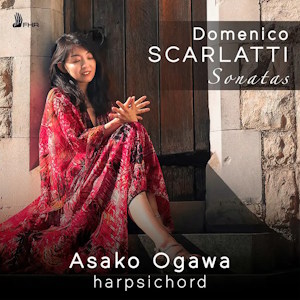
Domenico Scarlatti (1685-1757)
Sonatas
Asako Ogawa (harpsichord)
rec. 2025, Church of the Ascension, Plumstead, London, UK
First Hand Records FHR190 [75]
Asako Ogawa in her booklet notes for this recording.reminds us that Domenico Scarlatti is one of the few composers from the age of Bach and Handel to have enjoyed ongoing fame and performances of his keyboard music since his lifetime. “Charles Burney in 1789 described his harpsichord sonatas as ‘original and happy freaks’ (the last word here having the positive connotation of something boldly original).” By way of contrast with his secular and sacred vocal music, Scarlatti himself referred to his keyboard music as an “ingenious jesting with art”. It is the sheer brilliance and variety in his over 500 sonatas that has maintained interest in them to this day.
Asako Ogawa’s selection does not seem to have a particular aim beyond being “a varied and uplifting collection”, and her notes in the booklet refer to each sonata with useful texts. From the start, it is clear that not only the choice of sonatas is varied and uplifting. Ogawa’s variety of articulation from sustained legato at times layered with rhythmically bouncy staccato in K145 promises a colourful recital. Less well-known sonatas are presented alongside renowned works such as K27 with its octave leaps and hand-crossing virtuosity. The famous ‘Cat’s Fugue’ of K30, which Ogawa plays with a distinguished lack of pretension, points out the “powerfully tragic” quality in the piece that derives from Scarlatti’s use of “anguished” augmented and diminished intervals.
Ogawa’s technique and musicality are spectacular and subtle. Each sonata here is a highlight so I will not go through them all, but the manic repetitions and scrunchy tonalities of K124 are striking enough, followed by the deceptive banality of the opening of K86 that opens out into a stream of intricate explorations in C major. These kinds of juxtapositions are representative of a well-considered and nicely contrasted selection of works in a sequence that keeps us engaged and very well entertained throughout, right up to the stately final track of K144 that makes for a surprising but satisfying ‘Goldberg Variations’ kind of conclusion.
The harpsichord recorded here is a single-manual instrument from 1978 built by Clayson and Garrett, modelled on an example by Vincenzio Sodi from 1782 in Florence. This is a very fine-sounding instrument, with a crisp mid and upper register, and plenty of bass resonance. The recording is close and detailed but enjoyable, despite being more of a one-to-one perspective than with best-seat-in-the-house distance. Tuning by Weronika Janyst is very effective. The slightly edgy timbres of more remote keys such as B minor in K87 and K27 are all part of the individual character of each sonata, and the recording is superbly balanced.
Asako Ogawa has received much acclaim for previous albums: Handel’s The Eight Great Suites on First Hand Records (FHR142) and J.S. Bach’s Six Partitas (FHR92). This Scarlatti recording is a very fine addition to her discography and, come sunshine or rain, is a very nice thing to have around.
Dominy Clements
Buying this recording via the link below generates revenue for MWI, which helps the site remain free
Contents
Sonata in D major, K145 (L369/P105)
Sonata in B minor, K87 (L33/P43)
Sonata in B minor, K27 (L449/P83)
Sonata in G major, K146 (L349/P106)
Sonata in G minor, K30 (L499/P86)
Sonata in G major, K124 (L232/P110)
Sonata in C major, K86 (L403/P122)
Sonata in C major, K420 (LS2/P352)
Sonata in F minor, K466 (L118/P501)
Sonata in F minor, K467 (L476/P513)
Sonata in F major, K446 (L433/P177)
Sonata in D minor, K141 (L422/P271)
Sonata in A major, K208 (L238/P315)
Sonata in D major, K29 (L461/P85)
Sonata in G major, K144 (P316)













