
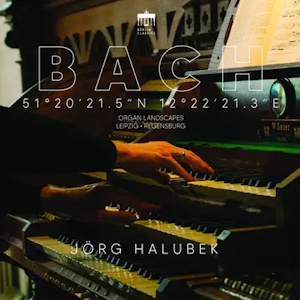
Johann Sebastian Bach (1685-1750)
Organ Landscapes X
Jörg Halubek (organ)
rec. 2024, St. Thomas’s Church, Leipzig, Germany; 2025, Trinity Church, Regensburg, Germany
Berlin Classics 0303620BC [71+64]
To paraphrase the advertising material: organist, harpsichordist and conductor Jörg Halubek’s Organ Landscapes were conceived as a long‑term artistic project (2017–2026), ten double albums and two vinyl editions. The cycle presents Bach’s organ music as a body of work shaped by instruments, buildings and changing artistic perspectives, rather than as a single interpretative concept. Each recording contributes to a broader musical and cultural picture. It documents selected repertoire and an ongoing engagement with questions of context, sound and interpretation across different acoustic environments.
The first disc in Volume 10 presents seven works by J. S. Bach in arrangements or adaptations for the late‑Romantic organ. Alongside original organ and harpsichord compositions, it includes pieces written for other media, notably the Chaconne from the Partita No. 2 in D minor for solo violin BWV1004 and the famous Air from the Orchestral Suite No. 3 in D major BWV1068. Halubek performs them on the Wilhelm Sauer organ of St Thomas’s Church in Leipzig, an instrument built in 1889 and remodelled in 1908.
Karl Straube (1873-1950) made several of these arrangements. Deeply influenced by Max Reger’s dense orchestral organ writing, Straube believed Bach’s music should be realised with the full expressive power of the modern organ. His approach was not antiquarian but devotional. He aimed to reveal its emotional depth by Romantic means, reimagining Bach rather than “correcting” him. Issued around 1913, his editions were inspired by the Wilhelm Sauer organs he championed. Those instruments boasted huge dynamic resources, complex stop‑changing mechanisms and widely contrasting divisions.
Straube’s editions became deeply influential in early 20th‑century German church and conservatory life, establishing an opulent, orchestral Bach as the prevailing norm. The historically informed performance movement later pushed back against this entrenched tradition. That left Straube’s arrangements to be valued today chiefly as documents of reception history. Even so, they remain invaluable for understanding how Bach was heard in the early 1900s. Straube overlaid the scores with dynamics Bach never imagined, introduced legato phrasing, and thickened textures to suit large Romantic instruments.
The other composers represented here are Max Reger, Wilhelm Middelschulte and Sigfrid Karg‑Elert. They also held a deep respect for Bach’s organ music, though their approaches differed. Reger valued orchestral registrations but prioritised contrapuntal density, expanding textures and adding chromatic inflections. Middelschulte’s Chaconne transcription transforms the violin masterpiece into a grand, symphonic structure. Karg‑Elert, by contrast, sought harmonic colour, exploiting delicate, often Impressionistic registrations. Those are evident in his arrangements of the Air (BWV1068) and the Pastoral Symphony (BWV 248).
Interestingly, Straube underwent a radical conversion in the 1920s. He abandoned his late‑Romantic aesthetic for a more Baroque‑authentic style influenced by the Orgelbewegung (Organ Reform Movement). Meanwhile, Reger and Middelschulte continued, for different reasons, to work within a fundamentally Romantic/symphonic conception of Bach’s music.
The second disc pivots to an entirely different interpretative world, presenting Bach’s Goldberg Variations BWV 988. My first encounter with the work came in the early 1970s via Karl Richter’s harpsichord recording for the Archiv Produktion Bach Edition. There followed pianist Glenn Gould’s 1981 account for CBS Masterworks, exquisitely played, if inevitably punctuated by his vocalising. These days, my preferred version is András Schiff’s 2003 ECM recording, once again for piano. Until this release, I had not heard it performed on the organ.
Bach’s Goldberg Variations form the fourth part of the Clavierübung (Keyboard Practice). He described it as “an aria with diverse variations for a two‑manual harpsichord, composed for the refreshment of music lovers”. Anecdotally, he wrote it for his pupil J. G. Goldberg to play to Count Keyserling as a remedy for the Count’s insomnia; this attestation has since been disputed.
The set opens with an ornamented aria built over a ground bass that underpins all thirty variations. These include a complete cycle of canons at increasing intervals before it closes with a playful quodlibet weaving together popular song melodies of the day.
Do the Goldberg Variations work on the organ? Halubek’s transcription suggests they do. He describes the composition as diary‑like, a sequence of episodes without a fixed goal. The historically styled Central German three‑manual organ at Trinity Church in Regensburg, dating from 2020, is sympathetic to Bach registrations. The thirty‑two sections invite register combinations that can sound novel to the ear. Though the fast movements call for crisp, articulate registrations, the organ’s wide range of stops lets the listener follow the shape of the whole cycle, from the French Overture of the 16th variation through the many canons to the final quodlibet. In doing so, it offers a persuasive alternative to the harpsichord or piano.
The well-illustrated booklet lacks detailed notes on these works and their arrangers. Organ specifications are given for both instruments, and there is the performer’s biography.
The tenth volume of Organ Landscapes serves as a fascinating study of Bach’s music as it was shaped and reshaped by the fashions of different eras. By contrasting the lush, orchestral devotion of the Straube era with his own lucid realisation of the Goldberg Variations, Jörg Halubek bridges the gap between Romantic enthusiasm and excess and modern clarity.
John France
Buying this recording via the link below generates revenue for MWI, which helps the site remain free
Contents
CD1
Arrangements of Bach’s Music
Wilhelm Middelschulte (1863-1943)
Chaconne from Partita No.2 in D minor BWV1004
Karl Straube (1873-1950)
Prelude in A major BWV536
Max Reger (1873-1916)
Chromatic Fantasia and Fugue BWV903
Sigfrid Karg-Elert (1877-1933)
Pastoral Symphony from Christmas Oratorio(BWV248)
Karl Straube
Prelude and Fugue in C major BWV547
Sigfrid Karg-Elert
Air célèbre from Suite No.3 in D major BWV1068
Karl Straube
Fantasia and Fugue in G minor BWV542
CD2
Goldberg Variations BWV988 (publ.1741)













