
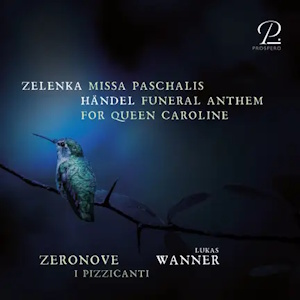
Jan Dismas Zelenka: Missa Paschalis & George Frideric Handel: Funeral Anthem for Queen Caroline
Jan Dismas Zelenka (1679-1745)
Missa Paschalis (ZWV 7)
George Frideric Handel (1685-1759)
Funeral Anthem for Queen Caroline (HWV 264)
Zeronove, I Pizzicanti/Lukas Wanner
rec. live May 2025, St Peter, Basel
Texts and translations included
Reviewed as a download
Prospero Classical PROSP0132 [82]
Sometimes when I see programmes of live concerts, I wonder how they have been put together; this concert that took place in Basel on 24 May 2025 is a good example. The two works by Zelenka and Handel respectively have little in common and the only connection between the two composers is that they were contemporaries. The liner-notes don’t attempt to connect them, although Johannes Ágústsson states that during his visit to Dresden in 1719 Handel undoubtedly got to know Zelenka “and that he came to hold him in the highest regard”. However, I have found no confirmation of this, either in the article on Handel in New Grove or in Christopher Hogwood’s Handel biography, or in Donald Burrows’ book on Handel in OUP’s Master Musicians Series.
There are other questionable statements in Lukas Wanner’s notes. He states that Zelenka’s mass has been “recently rediscovered”. I wonder what “recently” means: in my edition of New Grove (2001), this mass is included in Zelenka’s work-list, and in 2014 the Czech label Nibiru released a recording of this work under the direction of Adam Viktora (who also provided the orchestral material for this performance) – and his statement that these two works are little-known does not apply to Handel’s Funeral Anthem, which is regularly performed and recorded.
That is not the case with Zelenka’s mass. Given that his oeuvre is quite popular among performers, and a number of his masses have been recorded, some even more than once, it is a little surprising that the above-mentioned recording of the Missa Paschalis seems to be the only one to date. That makes the present performance all the more welcome, as it is a very fine work.
It dates from 1726 and was the result of a commission to write a work for Easter Monday, which fell on 22 April. The name of the mass has nothing to do with its content: it is the usual Ordinary, consisting of Kyrie, Gloria, Credo, Sanctus & Benedictus and Agnus Dei. Obviously it was performed within a liturgical framework, which means that also Propers were performed, and these undoubtedly were connected to Easter. The scoring reflects the festive character of the event; part of the orchestra are four trumpets (*) and timpani, which play a prominent role, right from the start. The tutti open the Kyrie I with one short statement, followed by an orchestral passage. In the baroque period, it was tradition to set the Christe eleison for solo voice(s), as is the case, for instance, in Bach’s B minor Mass. Here this section is scored for alto, with two violins and basso continuo. The Kyrie II is a repeat of the first half of Kyrie I. It is suggested that this repeat, like several others mentioned below, are motivated by a lack of time on the side of the composer.
It is not surprising that at the start of the Gloria the trumpets and timpani are again involved; the orchestra opens the first of in total six sections. The only one for a solo voice is the ‘Domine Deus’, scored for soprano, with two violins, viola and basso continuo. The first violin is given a solo passage; it is suggested this was intended for Johann Georg Pisendel, the leader of the Dresden court orchestra. That may be confirmed by the fact that a copy of this mass has been preserved in Pisendel’s handwriting. ‘Qui tollis peccata mundi’ is written in the stile antico, but Zelenka gives special attention to the word “miserere”, with tremolos in the high strings and harmonic means. Declamatory passages are part of ‘Quoniam tu solus sanctus’. This mass was performed at the Catholic chapel at the court, and the fact that the Elector of Saxony was also King of Poland, explains why Zelenka makes use here of a polonaise. The Gloria ends with a fugal Amen. Zelenka was known for his command of counterpoint, and this was one of the reasons he was admired by his Leipzig colleague Johann Sebastian Bach.
This mass is relatively modest in proportions; the Credo in particular is remarkably short: a little more than eight minutes. That is particularly due to the second half: from ‘Et resurrexit’ to the Amen is one section taking 1:47. The heart of the Mass – in the Catholic doctrine – is the passage on the incarnation; it is singled out here through a scoring for three solo voices. In ‘Et resurrexit’ the trumpets and timpani take part. The Amen is a repeat of the Amen which closes the Gloria.
The Sanctus is through-composed, and – again according to tradition – the Benedictus is a solo section, here for soprano with an unspecified instrument; that part is shared in this recording by oboe and violin, playing colla parte. In the Agnus Dei Zelenka again makes use of repetition: after the second Agnus Dei with chromaticism, the Dona nobis pacem is a repeat of the first half of Kyrie I.
Some performers express the view that Handel’s music lacks depth – for instance, in his treatment of counterpoint. There is certainly nothing wrong with this in his Funeral Anthem for Queen Caroline, the wife of King George II, who died on 20 November 1737. She was much loved, and was highly interested in the arts and in music. She was also a friend and patron to Handel, so it was no surprise that he was asked to compose an anthem for her funeral in Westminster Abbey on 17 December of that year. It is scored for four voices (solo and tutti) and an orchestra of two oboes, strings and basso continuo. The scoring is modest, but the performance was not: nearly 80 singers and 100 instrumentalists took part.
The text was written by the Anglican bishop Edward Willes, and is based on two Old Testament books: the Lamentations of Jeremiah and Job. Handel shows his command of counterpoint, especially in the choral sections. He also uses material from others: the opening section recalls the Lutheran chorales Handel had grown up with, and in the chorus ‘Their bodies are buried in peace’ he makes use of a motet for Passiontide by Jacob Handl-Gallus, Ecce quomodo moritur justus (which in Germany was part of Passion celebrations).
Charles Burney considered the Funeral Anthem the best of all Handel’s works. He must have loved it himself as well, as later he reused it – with a slightly altered text – as the first part of his oratorio Israel in Egypt.
The late masses by Zelenka are often performed but this mass is in no way inferior to them and this performance does it justice in every respect. The tutti are impressive; the vocal ensemble Zeronove, which I can’t remember having heard before, is excellent, producing a firm but transparent sound which results in a good intelligibility of the text. The solo episodes are sung by members of the choir, Carolin Franke and Jeanne-Marie Lelièvre (soprano), Camille Bordet (contralto) and Pascal Marti (tenor). They deliver outstanding performances. The orchestra is first class, and the playing of the trumpets is especially impressive. I don’t know the recording mentioned above, but if one wants to have this mass – which I urge anyone to investigate – this is a performance one will certainly enjoy.
I am less enthusiastic about the performance of Handel’s anthem. The singing of the choir and the playing of the orchestra are on the same level as in Zelenka, and the solo sections are again very well executed. However, I have two problems with this performance: the first is that the fifth section, ‘When the ear heard her’, is too fast: it takes 2:40, which gives it an almost joyful character. William Christie (Les Arts Florissants Editions, 2014) takes 4:07, which much better fits the text and the overall character of this work. The second issue is more problematic: in the third section, the chorus ‘How are the mighty fall’n’, Wanner decided to include timpani. It is true that according to tradition the participation of timpani was often not specified, but could be added when trumpets were playing. That is not the case here, and the sudden participation of timpani here is very odd, and not in accordance with the subdued nature of this anthem.
These two issues, especially the second, are blots on this production, but I still recommend this disc for the performance of Zelenka’s mass.
On a technical note, it is unfortunate that the production comes on two discs; one disc with 82 minutes’ playing time should have been no problem.
Johan van Veen
www.musica-dei-donum.org
twitter.com/johanvanveen
https://bsky.app/profile/musicadeidonum.bsky.social
(*) The booklet lists only three trumpeters.
Buying this recording via the link below generates revenue for MWI, which helps the site remain free













