
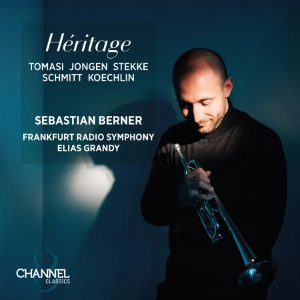
Héritage
Henri Tomasi (1901-1971)
Trumpet Concerto (1948)
Joseph Jongen (1871-1953)
Trumpet Concertino op. 41 (1913)
Léon Stekke (1901-1970)
Trumpet Concerto op. 17 (1937)
Florent Schmitt (1870-1958)
Suite en Trois Parties pour Trompette et Orchestre op. 133 (1956)
Charles Koechlin (1867-1950)
Les Chants de Kervéléan pour Trompette solo et Petit Orchestre (1940)
Sebastian Berner (trumpet)
Frankfurt Radio Symphony Orchestra/Elias Grandy
rec. 2023-24, Hessische Rundfunk, HR Sendesaal, Germany
Channel Classics CCS49826 [58]
Here is a useful collection of French – or Francophile – trumpet concertos. The genre is not that often catered for. By contrast, assemblages of Gallic saxophone concertos are fairly common. To add to the improbability and utility factor, these concertos for trumpet are played by a German soloist and a German orchestra and conductor. Five concertos in about an hour spells brevity if not necessarily succinctness. Each is tracked movement by movement. A meticulous eye and hand are well and truly engaged. After all, 18 tracks across just short of 60 minutes is quite remarkable for a ‘recital’ for virtuoso and orchestra.
Tomasi is one member of my many-peopled league of admired/loved composers. His 1940s symphonies really should be recorded commercially and the same goes for the South Pacific- and Vietnamese-inspired works. The most clamant among these are the profoundly exotic Noa-Noa and Tam-Tam (each for voices and orchestra). In any event, this supple and seductive single-movement trumpet concerto flashes and serenades most seductively. It is somewhat distantly in the manner adopted by Malcolm Arnold in his host of compact concertos. The music is melodic, tuneful but subtle and not in the least banal or simple-minded. What we hear is sufficiently free-spirited to accommodate a bit of buffoonery in a work which is predominantly poetic. The first and second movements bid farewell in a style ’rounded with a sleep’ and with a contented sigh. The finale struts out like a good-natured jackanapes or Till Eulenspiegel.
Belgium swings into view with the Jongen Concertino. This is of a warm, romantic disposition as perhaps befits a three-movement work written one year before the Great War. It speaks of a high noon confidence (it seems to say “can this ever fade?”) and of a smoothly curvaceous melodic compulsion. The final ‘Impulse’ movement swaggers along with an agreeable good-natured grin: a feel-good work if ever there was one.
I had never previously heard of the Belgian, Léon Stekke. His 1937 Concerto, again in three short movements, had to be exhumed from a very poorly preserved handwritten full score in the archives of Belgian Radio. Again, it is quite a discovery – sleazily smooth jazz souses its pages, as does cheeky music-hall humour and braggartry.
Back to France for the Suite by Vaughan Williams’ contemporary and friend Florent Schmitt. This 1956 suite treads a nice line between virtuosity and poetic substance. The central ‘Lent sans excès’ – the longest movement, at more than five minutes – plies the Whitmanesque mysteries of a night sky at peace with humanity and itself. The incautiously brief finale boasts a lovely melody and some uppity virtuosity: sadly, the music is over almost before it starts.
Thatintriguing Breton, Koechlin is a composer whose music holds the attention. His segmented Songs of Kervéléan is delectable; each movement is concise and haiku-like. Often the music aspires to the stuff of dreams. It’s a very intimate, poetic work with never a bow or curtsey to trumpet circus-ring-ery. All credit to Berner for placing this last in the programme. It’s a real discovery but its awe-inducing aspects are to be found in its poetry. This is just the sort of work to essay in a competition to show the trumpeter’s insight and skill in a field outside gasp-inducing showiness. The Songs are heard here in the orchestrated version by none other than Robert Orledge, Koechin’s only English language biographer and documenter of his deep trove of works. Well done Mr Orledge. His book on Koechlin is a great rarity and should be reissued in a new edition. This composer is waiting to be discovered afresh. Do try to hear his Vers la Voute étoilée – a most impressively poetic work.
The playing throughout is superb. Breath control, embouchure and orchestral support are satin smooth in the case of all these concertos.
I had not heard of the soloist before this disc appeared but that is my problem, not his. Let’s hope that unlike a certain celebrity cellist who pretty much began his career by recording a rare and treasurable concerto in premiere and then moved on to the accustomed classics, bright lights and safely trendy, that Berner will delve deep into the trumpet-and-orchestra repertoire of the Franco-Belgians and then venture into the trumpet concertos of the Russians (a deep silvery vein), the British, the Americans and others.
This trumpet-player stands in the elite tradition of a Maurice André or an Eric Aubier.
Rob Barnett
Buying this recording via the link below generates revenue for MWI, which helps the site remain free













