
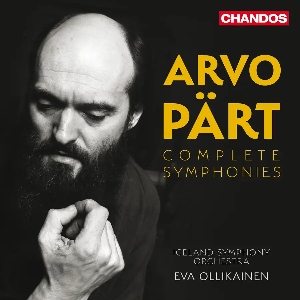
Arvo Pärt (b. 1935)
Symphony No. 1, ‘Polyphonic’ (1963)
Symphony No. 2 (1966)
Symphony No. 3 (1971)
Symphony No. 4, ‘Los Angeles’ (2008)
Iceland Symphony Orchestra/Eva Ollikainen
rec. 2025, Eldborg, Harpa. Reykjavik, Iceland
Chandos CHSA5372 SACD [76]
Arvo Pärt celebrated his 90th birthday in September of last year. This disc presents his symphonies complete, composed over some 45 years. All four works were new to me.
My first encounter with the music of Arvo Pärt was probably his Cantus in Memory of Benjamin Britten of 1977, a dignified and moving homage to a fellow composer. It was one of his earliest works composed in the tintinnabuli style by which many of us have come to recognise him. The term, used by the composer himself, evokes the sounding of bells, and the path to its creation was forged during a lengthy period of creative silence in which Pärt immersed himself in the study of early music. The style is constructed using the simplest of elements: scales or fragments of scales, unadorned triads, and melodies that move stepwise in regular rhythm. Even the notes are pared down to a minimum, but in the later choral works, the repertoire I know best, those notes, few though they are, are horribly difficult to get perform well.
These four symphonies are endlessly fascinating works, and very different both one from another and from my experience of Pärt’s music up to now. Thinking that many might be in the same position I will try to give an impression of how they might come over to similarly unprepared listeners. For those like me who are most accustomed to Pärt’s music post-1977, the opening of the First Symphony will probably come as a profound shock, and which may indeed be the first of many. A regular timpani pulse underpins a fanfare-like passage which begins with repeated simultaneous semitones – perhaps the harshest dissonance possible. The music is atonal, and freely exploits the serial technique developed by Schoenberg. There is also much use of canons, but a keen and practised ear is needed to pick them out. The first movement dies away in regular pizzicato notes, and the second, ‘Preludio e fuga’, opens with a solo violin in its high register. The busy fugue theme is easily identified, beginning a couple of minutes in, but is quickly exhausted, and gives way to a striking passage of held notes over a rhythmic background of strings. One has subsequent glimpses of the fugue, but it is a relentless motto of five rapidly repeated notes that brings the work to an brilliant and exciting close.
The First Symphony, in two movements, runs for some 16 minutes, whereas the Second, in three movements, has a duration of little more than 12. It opens with a disjointed, arhythmic passage from pizzicato strings, complete with squeaky toy noises and, a little later, creaking cellophane. (Would I have recognised these unusual instruments without Paul Griffiths’s helpful booklet note?) There is neither rhythm nor melody here, only tiny fragments too short to be called motifs, even when the oboes provide quacking noises that might remind some listeners of Vaughan Williams’s Antarctic penguins. The strings take up their bows, then a harp glissando and harsh dissonant brass chords presage a sudden major chord that is immediately adulterated.
Rapid jittering figures also dominate the second movement, frequently alongside longer held notes which are then transformed into a series of highly dissonant sustained chords. A calm, repeated two-note figure from the timpani launches the finale. After brief and intense interruptions from the strings the music subsides into an extraordinary passage, a transcription, complete with romantic orchestration, of a short extract from Tchaikovsky’s Op. 39 album of piano pieces for children. A solo clarinet uses this music to close the work in idyllic sweetness, but even this is interrupted once by a series of grotesque dissonant chords which only serve to confirm the surprising dominance of strident, disruptive violence in both these symphonies.
The unforgiving musical language employed, plus the extra ingredient of a puzzling dose of irony in No. 2, precede a radical change heralded by the tonal oboe melody that opens the Third Symphony. If the composer now seems to reject tiny motivic fragments in favour of extended melodic lines, those melodies often seem to have little relation to each other. Nor is there much in the way of forward movement or organic growth. Instead we have one block of music after another, frequently scored for alternating small sections of the orchestra. I hear echoes of Nielsen, and even of Tchaikovsky, in this first movement, though the sensibility is quite different. The movement ends with a question mark, and the second, which follows without a break, might be searching for an answer. Bare two-part counterpoint seems to exist outside human experience, and even more so when a single-line melody is picked out, unaccompanied, by the celesta. A rhythmic acceleration/deceleration from the timpani leads into the third movement which broadly continues the trend. If this work seems to have its roots in Pärt’s study of early music, passages given to the brass choir in this final movement are perhaps the only tangible signs. Pinning down the composer’s aims and means is otherwise tantalisingly out of reach, though Griffiths quotes Pärt’s statement that this symphony represents ‘a bridge within myself between yesterday and today’.
The Fourth Symphony is scored only for strings, harp and percussion. The opening brings profound calm in music that at last begins to approach Pärt’s tintinnabuli style. Much of this movement is made up of a long, slow descent from the top of the register to the bottom, before timpani usher in and accompany something more violent. This is short-lived, however, and a chant-like theme follows, desolate, like an elegy. The second movement maintains this sombre and contemplative mood, verging at times on the edge of silence. In the finale a solo violin in its upper register gradually weaves its way into the depths, before bells announce the extraordinary coda, a kind of march that begins in the double basses and rises gradually through the orchestra. Griffiths describes this as a ‘sacred march’, but others may hear it differently. The ending is very strange: gradually the low voices drop out, leaving, at the end, only the highest violins. There is no slowing down, no sense of arrival or conclusion, only a short silence then a single closing gesture from harp and bells.
Even without access to the scores I am in no doubt as to the quality of these performances. Passages requiring virtuosity are few, but the excellence of the playing is evident; and in the absence of comparative versions one has to have faith in the readings of Eva Ollikainen. The quality of the sound is superb, rich and deep, allowing all the idiosyncrasies of the instrumentation to come through. This release will undoubtedly enrich listeners’ appreciation of the composer, especially, perhaps, if their prior knowledge and appreciation of his music is limited.
William Hedley
Buying this recording via the link below generates revenue for MWI, which helps the site remain free













