
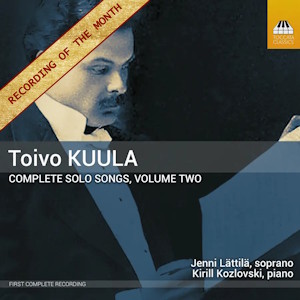
Toivo Kuula (1883-1918)
Complete Solo Songs Volume Two
Jenni Lättilä (soprano)
Kirill Kozlovski (piano)
rec. 2018, Kokkokangas Hall, Kempele, and Snellman Hall, Kokkola, Finland
Toccata Classics TOCC0781 [58]
Jenni Lättilä writes in her excellent notes that her mentor, the Finnish conductor Errki Pullinen, told her: “if Kuula had lived longer, [the Sibelius Academy] would be called Kuula Academy”. (Lättilä also translated the Finnish texts into English.) While we can never know if things might have turned out that way, two things are certain. Kuula only lived to be 34; and wrote some of the best Finnish music of the early twentieth century.
In my review of Volume One of Kuula’s complete songs, I said that I greatly looked forward to the second half of the set. Let me say that Lättilä and pianist Kirill Kozlovski have lived up to expectations. By 1911, the date of the earliest item on this disc, Kuula had already established himself as the most important Finnish composer after Sibelius. He wrote in almost every musical form, but he was best known for his vocal works: songs and cantatas. The first item here, The Maiden and Son of a Boyar, fits both categories; it started as a scena for voice and orchestra, but was immediately arranged for voice and piano. Those familiar with Kuula’s other large vocal works such as Orjan poika (Son of a Slave) and Kuolemattomuuden toivo (Hope for Immortality) will find this just as exciting, but with the advantage of a more mature expression and greater harmonic experimentation. (For further biographical information, see the review of Volume One.)
As Jenni Lättilä points out, 1912 and 1913 were the composer’s ‘song years’. The four songs of Op.23 were all inspired by the voice of his future wife Alma Silventoinen. In 1912, he was still stuck in his unhappy first marriage. At least three of these songs are influenced by this uncertain situation. The Ave Maria is the composer’s only song to a religious text. It is an interesting combination of Italianate elements (Kuula had visited Italy in 1912) and his typical vocal line. Kuula referred to Alma as his “Blue Maiden”; the song of this title shows his devotion but also his gloom at their still ambiguous situation.
The gloom continues in Fate, another work in which emotions or situations expressed in earlier works are now treated with greater profundity. The gem of Op.23 is Treading on Flowers. The text, a poem by Eino Leino, has been set by a number of Finnish composers, including Oskar Merikanto and Leevi Madetoja – but I was reminded a little of Hugo Alfvén’s from about that time. Treading on Flowers is both a beautiful song and probably Kuula’s most demonstrative of his devotion to Alma.
The four songs of Op. 24 continue Kuula’s mastery of the Finnish song. In 1913, Kuula had finally become engaged to Alma, so there is a wider range of subject matter in his songs. The first song, Saturday Night, describes the only night of the week when Finnish workers in 1913 had to relax. It features a sense of peace and serenity comparably rare in the composer’s songs. More modern is Ice Flowers, where the turn of the seasons is used to portray the passage of time through one’s life. It is one of the composer’s most perfectly realized songs. Old Autumn Song subject is similar to that of Ice Flowers, but Kuula’s treatment of this text is more flowing and serene, with none of the drama of Ice Flowers. Kuula’s only German-language song, Heathland Allure, may have been an engagement present for Alma; never mind the language, it is pure Kuula.
Vocalise is an outlier in a number of ways. Kuula wrote it as an exercise for Alma to expand her vocal range, so it has no text. It is also among the longest of the composer’s vocal productions. He said that it would be impossible for both sopranos and contraltos, but Jenni Lättilä handles it without difficulty. The three songs of Op.29A include The Bird Protecting Her Nest, a charming song written for children as a way to encourage them to love animals. Come, My Love is yet another song of devotion to Alma. It makes one wonder what Kuula could have done if he had another ten years or more. In spite of its pastoral title, Herder Boys is another of the composer’s essays into the supernatural, and into Impressionism. Again, one wonders where Kuula would have gone if he had lived longer.
In the last two years of his life, partly for financial reasons, Kuula wrote incidental music for four plays. Two songs from these plays are included here, Imandra’s Song and Spring Song (not to be confused with Sibelius’s work of the same title). The first is lugubrious but convincing, while the second, like the Ave Maria, is a blend of Italianate colors and elements of the composer’s mature style. Again, he totally succeeds in this undertaking.
Kuula’s last two songs are quite a contrast. The first, Sailing in the Moonlight, reminded me again of Alfvén, this time of the second Natt (Night) of his Skärgårdsbilder Op.17 for piano (1901-1902). It has the same stormy qualities, but with an additional haunting, almost spectral, quality. Without a doubt, it is his most mature song. Finally, there is the delightful In the Cattle-yard, one of the composer’s lightest songs.
No higher praise could be given this disc than to say that it is completely worthy of its predecessor. Jenni Lättilä handles every vocal difficulty in these songs with complete skill, but it is her ability to bring out the emotional complexities that really stands out. Kirill Kozlovski is equally sensitive in his accompaniments, ranging from the lightest of touches to piano parts that are like mini-Strauss tone poems. This is a fine disc in all regards.
William Kreindler
Contents
The Maiden and the Son of a Boyar, Op.18, No.2 (1911)*
Four Songs, Op.23 (1912)
No.1 The Blue Maiden
No.2 Ave Maria
No.3 Treading on Flowers
No.4 Fate
Four Songs, Op.24 (1913)
No.1 Saturday Night
No.2 Ice Flowers
No.3 Old Autumn Song
No.4 Heathland Allure
Vocalise (Mélodie Lugubre), Op.17c, No.2 (1909/1911)*
Three Songs, Op.29A (1915)
No.1 Come, My Love
No.2 The Bird Protecting its Nest (1914)
No.3 The Herder Boys
Imandra’s Song, Op.30c, No.4 (1916)
Spring Song (1917)
Two Songs, Op.31a (1917)
No.1 Sailing in the Moonlight
No.2 In the Cattle-yard
* First recordings in this version
Buying this recording via the link below generates revenue for MWI, which helps the site remain free













