
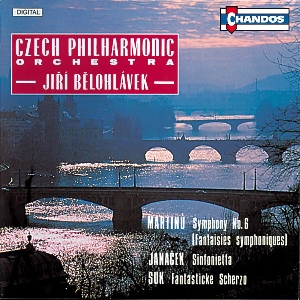
Leoš Janáček (1854-1928)
Sinfonietta (1926)
Bohuslav Martinů (1890-1959)
Symphony no. 6 (Fantaisies symphoniques) (1921)
Josef Suk (1874-1935)
Fantastické Scherzo, Op. 25 (1903)
Czech Philharmonic Orchestra/Jiri Bělohlávek
rec. 1990, Smetana Hall, Prague
Presto CD
Chandos CHAN8897 [65]
One wonders how many times in his career the late and greatly lamented Jiri Bělohlávek conducted Janáček’s sublime Sinfonietta. He recorded it at least twice, both times with the Czech Philharmonic Orchestra, the present performance first and then again for Decca in February 2017. It is an extraordinary work in many respects, owing quite a lot of its cumulative power to the fact that so many of its phrases are immediately repeated. The fanfares are said to have been inspired by a municipal band the composer heard in Brno, but no municipal band that I have ever listened to has been able to produce music like this. It is not a work that lends itself to much in the way of ‘interpretation’. The conductor’s role, I think, apart from keeping the whole thing together – in the second movement there are bars in 13/8 time to contend with, the only score I know to feature this – is to inspire the players to give of their all, let their hair down, and let rip. The timings of each of the five movements of Bělohlávek’s two performances are uncannily close, and since both performances are absolutely superb there is little or nothing to choose between them. Any differences are both minor and incidental. The Chandos recording, for instance, is sumptuous and typical of the house, whereas the Decca is marginally more analytical, allowing more individual instrumental strands to be heard. The opening movement is slightly more exciting in 2017, but at what seems like a marginally slower tempo the earlier performance has more swing. The work requires punishing virtuosity from all concerned, and gets it in both performances, even if the violins seem marginally less secure in the more challenging passages in the later, Decca, performance. The bells, too, in their momentary appearance, are rather feeble in 2017. Listening to two performances of this work one after the other is a thrilling if rather exhausting experience, but in this case I came down in favour, if not firmly in favour, of the performance under review. As in all Janáček there is considerable wildness in the music, and as the opening fanfares return in the second half of the finale Bělohlávek manages to motivate his players into communicating something that has nothing at all of the municipal about it, but rather a truly extraordinary sense of jubilation and joy.
What a wonderful and fascinating composer Martinů was! In spite of spending most of his adult life in exile his Czech origins, or at least signs of them, are to be found pretty much everywhere in his prolific output. The last of his six symphonies, subtitled ‘Fantaisies symphoniques’, was composed to celebrate the Boston Symphony Orchestra’s 75th anniversary, but was also a homage to Charles Münch, a conductor who had been a faithful supporter of Martinů and who directed the first performance. There is certainly plenty of ‘fantasy’ in the work, from the opening trumpet motif – basically a single note – that emerges over a bubbling orchestral background, to a lengthy passage featuring a solo violin where the composer’s national origins are unmistakeable. The second movement scherzo might, like the corresponding movement in Walton’s first symphony, have been marked ‘with malice’, though as its final pages approach the music becomes more lyrical and is transformed into something like triumph. The finale begins with slow, questioning music, and there are stormier passages. A long, rapid passage then ensues, which eventually subsides into woodwind figures that soften and sweeten the mood. The return of the faster music, exultant now, leads into the noble yet restrained chorale that ends the work. Bělohlávek’s performance of this wonderful symphony strikes me as even finer than his performance of the Janáček. He paces perfectly all three movements, and captures seamlessly the constantly changing nature of music. His reading of the scherzo is even more malicious than Neeme Järvi’s with the Bamberg Symphony Orchestra (Bis, recorded 1988), though Václav Neumann’s performance with the Czech Philharmonic on Supraphon (1976) is incendiary, a classic of the gramophone.
The programme is completed by a short work by Josef Suk. He was a pupil of Dvořák, whose daughter he married in 1898, though she died in 1905, barely a year after her father. The wonderful Czech violinist, also called Josef Suk (1929-2011), was his grandson. In its 13-minute span the Fantastické Scherzo progresses through many different moods and emotions, beginning with a delightful and melodious waltz. This is transformed at the end into something much wilder, similar in intention, I think, to Ravel in La valse, though very different in spirit and musical vocabulary. It makes for an exhilarating close to this collection which is a pleasure to welcome back to the catalogue.
William Hedley
Buying this recording via the link below generates revenue for MWI, which helps the site remain free














Just for accuracy, Jiri Belohlavek recorded the Janacek Sinfonietta at least THREE times, the earliest a studio recording with the Brno State Philharmonic in 1977, released by Panton on LP together with the Taras Bulba Rhapsody. Supraphon released those recordings on CD in 2018 in the collection, Jiri Belohlavek – Recollection (on disc 4). MusicWeb International published a review of the Supraphon collection by Jonathan Woolf ( https://www.musicweb-international.com/classrev/2018/Jul/Recollection_SU42502.htm ).