
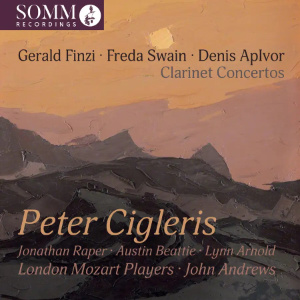
Denis ApIvor (1916-2004)
Concertante for clarinet, piano and percussion, Op.7a (c.1947)
Freda Swain (1902-1985)
Lumine naturi, Concertino for clarinet with string orchestra and (one) horn (1948)
Gerald Finzi (1901-1956)
Concerto for clarinet and strings, Op.31 (1949)
Peter Cigleris (clarinet)
Jonathan Raper (timpani), Austin Beattie (percussion), Lynn Arnold (piano)
London Mozart Players/John Andrews
rec. 2025, St George’s Headstone, Harrow, London
SOMM Recordings SOMMCD0722 [71]
Intelligent and imaginative programming powers this disc as all three works were written in successive years, so far as is known – Denis ApIvor’s in c.1947, Freda Swain’s in 1948 and Gerald Finzi’s in 1949. Finzi’s Concerto has long since become an established repertoire piece, at least on CD and for British clarinettists, but the other two pieces, a Concertante and a Concertino respectively, are making premiere appearances on disc.
ApIvor’s Concertante is written for clarinet, piano and percussion and was premiered by Frederick Thurston, Kyla Greenbaum with James (timpani) and Thomas Blades (percussion), in an ensemble directed by the composer. Robert Matthew-Walker suggests in his booklet notes that this unusual combination of instruments was inspired by Bartók – either the Sonata for two pianos and percussion or Contrasts for clarinet, violin and piano, which seems a just assumption. It’s a work that generates plenty of drive, the piano limpid and refined but the percussion militant – especially in its dynamic punctuation – and the clarinet vivacious. These elements are most audible in the central slow movement where the expressive states of the various instruments are at their most pronounced. The piano’s beguiling writing is broken up by the percussion, whilst the clarinet’s fluidity has a very singular atmosphere – it’s not exactly lyrical but has a real sense of texture and colour. The finale is bustling though lines remain clearly delineated, the music getting increasingly vibrant and heated, terse and animated, the whole work ending with a startling percussive bang. I think it will require several hearings for you to try to get inside ApIvor’s Concertante, which is neither ingratiating nor forbidding, but a Bartókian affinity will help.
In 1948 Freda Swain, whose music is increasingly being recorded, wrote her ‘Lumine naturi’; Concertino for clarinet with string orchestra and (one) horn. If ApIvor’s chamber work proves a slightly tough nut, Swain’s offers broadly more lyric and effusive wring, each movement bearing a quotation from the works of Algernon Blackwood. These are examples of the more humanist and nature-cleaving Blackwood, rather than those of Blackwood the occultist and ghost story writer. Consequently, Swain draws on the clarinet’s ability to evoke arcadian and romantic warmth, conveyed energetically. As with ApIvor’s work, the longest of the three movement is the central slow one, where there are hints of folklore amongst the long lyrical lines though the most open-hearted writing comes in the unbridled finale which ends in a gentle, wistful way.
Peter Cigerlis has done much on disc and in concert to explore and promote the cause of British clarinet music so it’s good that he has had the opportunity to promote these two previously unrecorded works alongside the Finzi in which he finds songful beauty as well as giocoso frolics, through fine tone, perceptive use of dynamics and well-judged tempi. Conductor John Andrews and the London Mozart Players are attentive to the animating pizzicati in the Rondo finale and provide plenty of rich support despite being chamber-sized – they line up 6-5-4-3-2. Cigerlis favours an Adagio that’s a touch, but only a touch, faster than major competitors, such as, say, John Denman or Michael Collins.
This is an invigorating release with two unknown works supporting a mid-century classic.
Jonathan Woolf
Other review: Nick Barnard
Buying this recording via the link below generates revenue for MWI, which helps the site remain free














