
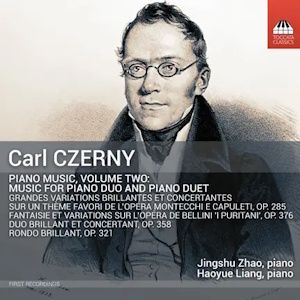
Carl Czerny (1791-1857) Piano Music, Volume Two
Grandes Variations brillantes et concertantes pour deux Pianofortes sur un Thème favori de l’Opéra Montecchi e Capuleti, op.285 (1833)
Rondo Brillant in B-Flat Major, op.321, for piano duet (1837)
Duo Brillant et Concertant pour Deux Pianos in B flat, op.358 (1835)
Fantaisie et Variations à Quatre Mains sur l’Opéra de Bellini ‘I Puritani,’ op.376 (1837)
Jingshu Zhao (piano), Haoyue Liang (piano)
rec. July and September 2025, West Road Concert Hall, Cambridge, England
Toccata Classics TOCC0791 [76]
There can be few aspiring pianists who have not encountered Carl Czerny’s pedagogical albums. Whether it is The School for Velocity, op.299, or the Art of Finger Dexterity, op. 740, his studies have become a rite of passage for generations of students. He produced a vast quantity of music, more than 860 opus numbers and much without formal designation. Most of this corpus was written for pianoforte – either solo or four hands. Any record company wishing to issue a collected edition has its work cut out, potentially requiring decades of subsequent releases. That does not mean that Czerny should be ignored. Presto Music currently lists more than two hundred recordings dedicated to or featuring pieces by him. This new disc is a valuable and welcome addition to his discography.
A few words about the composer may be of interest. Carl Czerny was born in Vienna to a musical family. A precocious talent, he was already performing major keyboard music from memory by the age of ten. Introduced to Beethoven by the violinist Wenzel Krumpholz, he became the elder man’s devoted pupil and protégé, later absorbing influences from Hummel and Clementi. Though often in demand as a performer, Czerny avoided public concerts and devoted himself to teaching, composition and the arrangement of classical works. His pupils included the young Liszt, whose talent he immediately recognised. A tireless creator, Czerny wrote nearly a thousand published compositions and left vast manuscript holdings, from masses and symphonies to chamber music and the above-mentioned studies. Gentle, modest and reclusive, he lived simply, travelled rarely, and bequeathed his considerable fortune to charitable purposes.
There are two pieces for two pianos here, and two for piano four hands. They were no doubt devised to dazzle the salons of Biedermeier Vienna. Three of them have “brilliant” in the titles as a testament to their dazzling and extroverted character.
The recital begins with the operatic virtuosity of the Grandes Variations brillantes et concertantes pour deux Pianofortes sur un Thème favori de l’Opéra Montecchi e Capuleti. Thisis based on melodies from Vincenzo Bellini’s 1830 opera reworking the Romeo and Juliet story. Czerny published the Variations justthree years after the opera’s premiere. The work exists in multiple versions, including solo piano, string quartet and full orchestra, but the two-piano arrangement is particularly striking.
As the detailed analysis in the liner notes explains, the piece opens with a slow introduction with dramatic runs and hemidemisemiquavers (64th notes) followed by a filigree cadenza. A naïve B-flat major theme from Romeo’s Act 1 aria gives way to six variations. They traverse a wide landscape of textures and tempi: rapid scales, arpeggios, broken octaves, swift sextuplets and triplets, polyrhythms and brilliant cadenzas. A moment of calm appears with a lyrical, almost Chopinesque Andante. The Grandes Variations conclude with a Finale, a blazing Molto allegro and a powerful finish in the “home key”. How the two soloists hold all this together is nothing short of a miracle.
The Rondeau brillant for piano duet has been described as a sparkling, extended and busy salon piece. Not as over the top as the preceding work, it is full of attractive pianism. This is in classic rondo form but dispenses with a slow introduction. The principal theme is a relaxed Allegretto con vivacità succeeded byepisodes that are “taut” and then playful. It concludes with a vivacious coda.
For all intents and purposes, Czerny’s Duo Brillant et Concertant pour Deux Pianos is a piano concerto without the band. It was dedicated to his pupil, the German pianist and composer, Theodor Döhler. The opening movement, Allegro con brio, is presented in a loose sonata form; the first subject is lyrical and the second trill-laden. These are developed with considerable interest. The Andante con moto is a set of variations. They advance well beyond a typical slow movement: lots of rapid piano figuration, chromatic scales and arpeggios. The Duo Brillant et Concertant concludes with a cheerful Allegro vivace that swings through a series of keys and some lovely melodic digressions, ending in a riotous conclusion. The liner notes quote the musicologist Maurice Hinson’s comment that this Duo Brillant is “In a conservative Romantic vein but requires a healthy dose of virtuoso fireworks.” Great stuff.
The programme closes with the Fantaisie et Variations à Quatre Mains sur l’Opéra de Bellini ‘I Puritani’, a four‑hand tribute to Bellini’s final masterpiece from 1835. I Puritani, set in English Civil War Plymouth, explores the trials of the Royalist lovers Elvira and Arturo, whose ordeal of war, betrayal and madness is finally resolved when a last‑minute pardon restores Elvira’s reason and happiness.
Czerny builds his Fantaisie around Elvira’s Act II aria Vien, diletto, è in ciel la luna! sung in her delirium after Arturo’s disappearance. A gloomy introduction, coloured by a few dramatic detours, leads to the poised statement of the theme. Four variations develop, each more elaborate than the last, save for the third, which relaxes into a lyrical, song-like mood. After an energetic Allegro vivace and a more inward Andante espressivo – effectively the fourth variation – the music presses on to its Finale. Here Czerny unleashes buoyant, dance‑like ideas and bright, trumpet‑like calls, all driving toward a spirited Presto codetta that brings matters home in the key of the original theme.
Jingshu Zhao, born in Wuhan in 1991, trained at the Shanghai and San Francisco Conservatories before completing her DMA at the University of North Texas. She has performed widely across China and the United States, and has earned prizes in a range of national and international competitions. Her debut recording for Toccata Classics, Volume 1 of Czerny’s piano music (review) was warmly received by critics. She currently teaches at Huaibei Normal University.
Haoyue Liang likewise holds a DMA from the University of North Texas, following earlier studies in Shanghai and San Francisco. Active as a soloist and chamber musician, he performed regularly with the University of North Texas Wind Symphony and appeared at major Texas venues. A recipient of several international competition awards, he has taught extensively, serving as a festival adjudicator and teaching at the Irving Fine Arts Academy. His research interests also include Performing Arts Health, a field in which he has presented conference work.
The recording is ideal; it complements a superb performance revealing all the intricate detail of the piano figurations. The liner notes are in two parts: An Overview by Martin Eastwick and a closer look at the music provided by William Melton. The latter section is particularly useful, because these are all premiere recordings with little information available otherwise to listeners. Resumes of the performers are included.
In summary, this disc offers vibrant performances of Czerny’s brilliant duets. Zhao and Liang have the requisite healthy dose of virtuoso fireworks to bring these lost delights to life, and are supported by an excellent sound. It rewarding hour or so of music proves Czerny was far more than a pedagogue; he was a master of the salon and a composer of genuine charm.
John France
Buying this recording via the link below generates revenue for MWI, which helps the site remain free













