
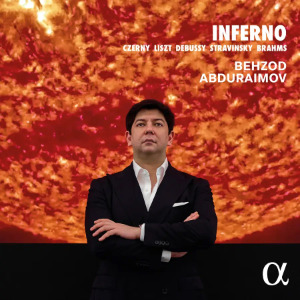
Inferno
Behzod Abduraimov (piano)
rec. 2025, Teldex Studio, Berlin, Germany
Alpha Classics 1219 [66]
I am not sure why this album has been entitled Inferno. To be sure, featuring Franz Liszt’sAprès une lecture de Dante may give the listener a clue. But how are some of the other offerings demonic?
Carl Czerny may be best known for his didactic piano studies, yet his fascinating Variations on a Theme by Rode, La Ricordanza expose a more engaging musical talent. The work is based on a now‑forgotten melody by the equally neglected violinist and composer Pierre Rode (1774-1830). It unfolds from a poised, understated theme into a sequence of increasingly brilliant variations. Behzod Abduraimov manipulates the music with lots of sparkle. He reveals a meticulously crafted piece that deserves far wider currency – and reminds us how much of Czerny’s vast catalogue remains unexplored.
Walter Beckett wrote in Master Musicians, his study of Franz Liszt, that Après une lecture de Dante: Fantasia quasi-Sonata “is rather impractical. A great technical expertise is called for, and the player must vitalise the music with [their] own personality, otherwise one is left wondering what the whole thing is about.” Beckett insinuates that the work is a blank canvas for the performer to fill in the gaps. Other critics see it as a masterclass in narrative structure and Lisztian thematic transformation – a metamorphosis of a few core motifs including the tritone, or diabolus in musica. I would contend that the score presents a sophisticated, self-contained musical drama.
What is the piece about? Liszt’s Dante Sonata traces a spiritual journey from the horror of Hell towards a vision of Heaven. ‘Infernal’ chromaticism confronts radiant, Beatrice‑like themes. The culmination is a hard‑won transfiguration of the soul emerging from despair into an illuminating grace. I followed Abduraimov’s pyrotechnics in the score. This is amazing.
Claude Debussy’s Suite Bergamasque needs little introduction. The third movement, Clair de Lune, is a lollipop and long-time favourite with recitalists. The others – Prelude, Menuet and Passepied – are less often heard, yet make up a stylistically cohesive set that bridges the gap between Baroque form and Impressionist colour. To pull it off, one cannot just rely on the celebrity of Clair de Lune. The entire Suite needs a light, flexible touch, and finely judged pedalling to create the right atmosphere. As the liner notes suggest, it shows the “secret […] of emotion without stress”. For me, this is a fine account of one of Debussy’s most attractive works.
I enjoyed the Three Movements from Petrushka, a suite Igor Stravinsky transcribed from his own revolutionary 1911 ballet. It portrays the tragic love triangle of three puppets, Petrushka, the Ballerina and the Moor, set against the vibrant chaos of a St. Petersburg Shrovetide Fair. The movements are Danse Russe (Russian Dance), Chez Pétrouchka (Petrushka’s Room) and La Semaine grasse (The Shrovetide Fair). They serve as a brilliant distillation of the ballet’s power.
Stravinsky wrote that he “did not at all wish to use the piano to represent the orchestra […] On the contrary, I did my best to transform it into an essentially pianistic piece, using all the idiomatic resources of the instrument.” The result is a work of staggering virtuosity that pushes the boundaries of the keyboard’s capabilities. Fittingly, this formidable transcription was dedicated to the legendary pianist Artur Rubinstein. It gets a remarkable account here.
The last track is a sympathetic performance of Johannes Brahms’s Intermezzo in B Minor. There is no ‘Inferno’ here; rather, it is a study in late‑Romantic introspection and melancholy. Brahms famously described its pervasive dissonances as “exceedingly sweet”, a reminder that it requires the most delicate touch. This opening number in his final set of piano works serves as a bittersweet farewell to the instrument.
Behzod Abduraimov, born in Tashkent, Uzbekistan in 1990, first attracted international attention after winning the 2009 London International Piano Competition with Prokofiev’s Piano Concerto No.3. A former student of the pianist and educator Stanislav Ioudenitch at the International Center for Music in Kansas City, he quickly established himself through high‑profile appearances with leading orchestras and a series of well-received recordings.
The title Inferno remains a marketing enigma. Yes, Liszt’s and Stravinsky’s works certainly bring the heat, one through diabolical drama and the other through sheer, mechanical fire. The remainder of the recital feels more like a scenic detour than a descent into the abyss. Czerny’s elegance and Brahms’s “exceedingly sweet” melancholy have little to do with eternal damnation. Perhaps the title is meant to suggest the performer’s trial by fire. If so, then Abduraimov emerges unscathed. He navigates these wildly different emotional landscapes with such poise that – even if the thematic thread is thin – the musical journey is undeniably compelling.
John France
Buying this recording via the link below generates revenue for MWI, which helps the site remain free
Contents
Carl Czerny (1791-1857)
Variations on a Theme by Rode, op.33 (1820s)
Franz Liszt (1811-1886)
Après une lecture de Dante: Fantasia quasi-Sonata
(No.7 from Années de pèlerinage, Deuxième Année: Italie, S.161) (1846-1849)
Claude Debussy (1862-1918)
Suite Bergamasque, L.75 (1890)
Igor Stravinsky (1882-1971)
Three Movements from Petrushka (1911/1921)
Johannes Brahms (1833-1897)
Vier Klavierstücke, op.119, No.1 Intermezzo (1893)













