
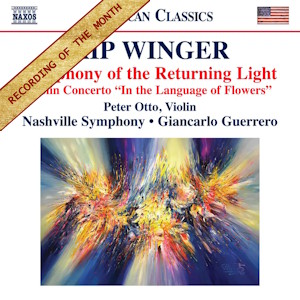
Kip Winger (b. 1961)
Violin Concerto “In the Language of Flowers” (2024/25)
Symphony of the Returning Light (2018-20)
Peter Otto (violin)
Nashville Symphony/Giancarlo Guerrero
rec. live, 18–20 March 2023 (symphony), 10–11 May 2025 (concerto), Laura Turner Concert Hall, Nashville, USA
Reviewed as lossless download
Naxos 8.559921 [58]
Who would have thought that on the august pages of MusicWeb International, one would find a review of music by the bass player in Alice Cooper’s band. Yes, that Alice Cooper, the shock rock star who infamously was supposed to have bitten the head off a live chicken on stage (he didn’t).
Most of Kip Winger’s career in rock music, in fact, was not with Alice Cooper, with whom he played for a couple of years in the mid-1980s. The majority of his career was in a band of his own, firstly Sahara and then the eponymous Winger. However, he came from a non-pop/rock background, with jazz musician parents and he studied classical music seriously in his teens. Nevertheless, it must have been somewhat out of the blue that he was commissioned to write a score for the San Francisco Ballet in 2009. This was Ghosts, and it was followed in 2017 by Conversations with Nijinsky, which received a Grammy nomination. During that time, he had been taking private lessons in composition with Richard Danielpour, who said of Winger “You’re a classical composer disguised as a metal guy”. The Nashville Symphony and Giancarlo Guerrero performed the Nijinsky score in 2017, and this led to Winger being asked to compose a symphony and concerto for the orchestra.
The track record of pop/rock musicians attempting to write classical music is rather patchy: high profile musicians such as Billy Joel (Etudes), Paul McCartney (Liverpool Oratorio) and Sting (Dowland songs) come to mind. All were done very seriously and earnestly, but had mixed (at best) reviews. Naxos has released three albums of orchestral music by Tony Banks of Genesis, and our reviewers were moderately positive. Perhaps the most successful has been Jon Lord, the keyboardist from Deep Purple, whose Durham Concerto and other works, gained quite a few plaudits.
I am a great admirer of the Australian composer Graeme Koehne, whose musical ethos is to entertain, but still engage the intellect. Winger clearly has the same outlook: contemporary classical music can still have tunes and be considered serious. He has a distinctly lower profile than the musicians mentioned above, but I feel these two works are great successes.
The four movements of the violin concerto are given the names of flowers, and the music is apparently (according to Winger) reflective of the symbolic meaning of these flowers in art and culture. He doesn’t elaborate on this, so I simply listened to the music in absolute terms. The four movements are suffused with lyricism and dance rhythms, together with a virtuosic solo part, for which Winger acknowledges the help of its dedicatee, Peter Otto, who is the Nashville concertmaster. Winger regards the slow movement – Ambrosia – as having his “all-time best melody”, and without knowing any of his other music, it is certainly quite beautiful in the manner of the Barber concerto (one of Winger’s influences).
The Symphony has a connecting theme of Morse code rhythms, but how this relates to the title of the work is not made obvious in the notes. It is nevertheless very effective (the theme from the TV series Morse certainly comes to mind). There is much drama throughout the work, but the four movements are well contrasted, and the orchestral writing is colourful, luminous and very skilled. Winger has sensibly kept each movement to a manageable duration – none is more than eight minutes – so that there is no sense of him running out of inspiration; the same can be said of the concerto for the most part, though the finale perhaps does go on a little long.
These are live recordings, but you cannot tell. The sound quality is excellent, and the audience totally silent. I have mentioned that the booklet notes, which are interesting, unfortunately don’t provide adequate explanations of the musical significance of the works’ titles. This is Peter Otto’s first recording as a soloist – he was concert master in Cleveland so certainly will have appeared on many recordings – and his virtuosity and musicality in the concerto were very impressive. The orchestra is outstanding; the Grand Ole Opry is definitely not the only show in town.
This has been such a delightful surprise, and I am very keen to hear more from Winger’s pen; sadly his two ballet scores do not appear to have been recorded (Naxos, hint, hint). If you, like me, value – no, insist on – melody and rhythm in your contemporary classical music, this recording will make your day. It is certain to figure in my deliberations for my Recordings of the Year selections.
David Barker
Buying this recording via the link below generates revenue for MWI, which helps the site remain free













