
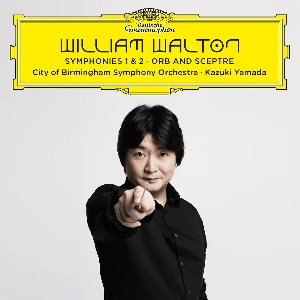
Sir William Walton (1902-1983)
Orb and Sceptre, Coronation March (1952/53)
Symphony No. 1 in B flat minor (1932-35)
Symphony No. 2 (1957-60)
City of Birmingham Symphony Orchestra/Kazuki Yamada
rec. live, December 2024 (Orb and Sceptre & Symphony 2); November 2025 (Symphony 1), Symphony Hall, Birmingham
Deutsche Grammophon 486 8227 [83]
I used to go quite regularly to Birmingham’s wonderful Symphony Hall to review concerts for Seen and Heard International. Many of those concerts were given by the City of Birmingham Symphony Orchestra and I experienced some thrilling evenings, especially during the years when Andris Nelsons was their Music Director. Sadly, I’ve not returned since the disruption caused by the Covid pandemic – as I grow older, the prospect of driving a round trip of more than 100 miles even to hear great music excellently performed is not quite as attractive a proposition as was once the case. Unfortunately, that means that I’ve not experienced live the partnership between the CBSO and Kazuki Yamada since he took up his post as Music Director in 2024 (and before that, Chief Conductor from 2023). However, immediately prior to that appointment, he was the orchestra’s Principal Guest Conductor and during that time I attended a couple of memorable concerts that he conducted: a thrilling account of Mendelssohn’s Elijah in November 2019 (review) and a tremendous performance of Tchaikovsky’s Manfred Symphony a few months earlier (review). This CD, their first together, was a welcome opportunity, therefore, to experience the partnership between Yamada and the CBSO, as evidenced in two concerts. given in 2024 and 2025.
Jessica Duchen’s booklet essay focusses on Yamada’s relationship with both the orchestra and the music they perform together on this disc. As a Japanese conductor, albeit one who has had quite an exposure to music-making in Europe, he is able to view British music from a refreshingly different perspective. I was particularly fascinated by his view of the First symphony. It’s been suggested that Walton’s volatile personal life in the early 1930s lay behind the turbulence of much of the symphony and that it also accounts for the lengthy struggle that the composer had before he was able to complete the finale. However, Yamada focusses instead on Walton’s frequent international travels during the period 1932-35; these travels, he feels, had an important part in shaping the symphony. “He travelled all over the world, and of course he was going by sea. This music has all the drama of a sea voyage. It’s dramatic, sunny and full of colour”. I’m not sure that Yamada has persuaded me from the traditional view of the symphony but it’s most interesting to read his different take on the music.
The first movement is, for my money, one of the most intense, compelling movements in all British symphonic music. It opens with a very soft timpani roll before the horns enter, one at a time. I should warn readers that Yamada has his timpanist play so softly that even when I listened through headphones, the drum roll was all-but inaudible and the first sound that truly registered with me was the first horn note that we hear. Of course, this is fine in concert where we can also see the timpanist begin to play but on an audio recording I think we need a bit more help. Simon Rattle’s 1990 EMI recording, also with the CBSO, is slightly better in this respect. André Previn has a much better solution in his 1966 LSO recording: his timpanist starts the roll with a slight accent and listeners know we’re under way. Once launched, Yamada’s account of the first movement has an awful lot to commend it. Walton’s dotted rhythms are strongly articulated and the CBSO plays very well indeed. Yamada conveys the intensity of the music very successfully throughout the movement; the climaxes are always powerfully projected. At 5:34, a plaintive bassoon solo ushers in a slower, melancholic episode. Yamada does this very well and then when the forward momentum picks up again at around 8:30, he builds the music convincingly to the huge climax (around 11:00). From that point on, the remainder of the movement sounds terrific; I bet it made a great impact on the audience in Symphony Hall. All that said, each time I’ve listened to the disc I’ve found that, for all its merits, I was looking for a bit more in this first movement. When eventually I took down the classic Previn version (review) from my shelves and made some comparisons, I found what I was looking for. Previn is biting and thrusting right from the start of this movement. The tempo marking is Allegro assai and I feel that Previn takes more note of the “assai” instruction than Yamada does. Just to give an idea, Previn reaches the aforementioned bassoon solo at 5:02. He’s no less gripping in the slower episode. Previn’s is a white-hot account of the movement, which leaves the listener breathless by the end. For once, the clock is a good guide: Yamada’s first movement takes 15:00 but Previn takes a compelling 13:50. I greatly admire Yamada’s performance but Previn’s still, after all these years, knocks me sideways.
The scherzo, marked (uniquely in my experience) Presto, con malizia, is precise, pointed and full of energy in Yamada’s hands; I really admired the precision that the CBSO players bring to the music and DG’s excellent recording lets you hear every detail. I have to record, though, that Previn is noticeably quicker. His edge-of-the-seat rendition of this movement remains the gold standard, some sixty years after it was set down; no conductor that I can think of has quite matched him. From the malice of the scherzo, Walton switches to melancholy in the third movement, marking it Andante con malinconia. From here on, I felt no need to make comparisons: Yamada is completely convincing, as, indeed, he is in the finale. In the opening pages of the third movement, I greatly admired the delicacy with which the CBSO plays the music; the woodwind solos are especially persuasive. The performance is intense, as it should be, but very wisely, Yamada doesn’t overplay his hand. Instead, he builds the music incrementally so that by the time the extended climax arrives (from around 8:30) it has an air of inevitability to it. This performance is very eloquent.
Famously, Walton hit a brick wall when it came to finishing his symphony. He simply couldn’t get going on the composition of his finale. Probably, the breakdown of his relationship with Imma Doernberg in 1933 was a key factor (though he still dedicated the finished work to her) but in addition, he was ill for a time. As Michael Stenberg has written perceptively of the symphony as a whole, it “is the culmination of Walton’s conquest of maturity”. Hamilton Harty had announced the premiere as part of his first season with the LSO in 1934; eventually, Walton was persuaded to allow the completed three movements to be played. The partial premiere was a great success and perhaps that’s why when the complete symphony was finally unveiled, the finale was deemed by some to be an ill-fitting anticlimax to the music which had preceded it. I’ve never really shared that view, though it has to be said that in the closing pages it does seem as if Walton is trying just a bit too hard. (Spoiler alert: the conclusion sounds terrific here.) Yamada brings off this finale very successfully. The Maestoso start is suitably imposing. The main body of the movement is marked Brioso ed ardentemente; Yamada ensures that this is just how the music sounds. The fugue (from 2:50) is full of life and throughout this movement Walton’s vigorous contrapuntal music is always delivered with great clarity and purpose. The big climax (from 8:50), with the two timpanists pounding away, makes a great impression and then Walton’s big, rhetorical ending is loud and proud. There’s no applause preserved on the disc but I bet this performance was rapturously received in Symphony Hall.
If it was enterprising of Kazuki Yamada to take the First symphony into his repertoire, he’s even more to be commended for taking up the Second symphony. This is something of a Cinderella piece and live performances are quite rare. It has fared better on disc, though. Both Martyn Brabbins (review) and Kirill Karabits (review) have not only recorded the work but also have, like Yamada, paired the symphony with its predecessor. The symphony was long in gestation. I believe I’m right in saying that the Liverpool Philharmonic Society commissioned it with the intention that it should be premiered in 1957 in celebration of the 750th anniversary of Liverpool’s Royal Charter. In fact, it was not until 1960 that Walton finished the score and the first performance was given in September of that year, not in Liverpool but in Edinburgh. As my colleague, Nick Barnard justly observed when reviewing Edward Gardner’s fine recording of the Second, “Contemporary critics seemed startled and disappointed that Walton had not written a Symphony No.1 Mark II”. In truth, I don’t think the work has ever been able to escape the shadows of the First but such a view overlooks the fact that by the late 1950s Walton had moved on – considerably – from the 1930s, though it must be admitted that the Second is peppered with Waltonian stylistic fingerprints. In terms of duration, the Second is on a smaller scale than the First: it has three movements, rather than four and it is considerably shorter in duration; whereas Yamad takes 46:08 over the First, his account of the Second lasts for 29:29. Ironically, though, Walton employed a larger orchestra in the later symphony, albeit the scoring is less full-on than the First is in places; among instruments that appear in the later symphony are piano, celesta and vibraphone.
The symphony has had a number of excellent recordings over the years, dating right back to the first one, made by George Szell and the Cleveland Orchestra in 1959 (review). Having heard many of those recordings, I can say that Yamada’s version can more than hold its own against the competition. As with the First symphony, he makes an interesting observation about the Second in the booklet, suggesting that the work sounds more “English” than the First. In support of his argument, he cites the fact that by the late 1950s Walton was living in Ischia and, he believes that as a result “he could write modern British music every day. I feel a similar way about Japan. I’m living in Europe, so I can see the country from a distance, with another attitude, maybe more clearly”. I must say I’ve never thought of the Second as being more British than the First but I find Yamada’s perception of the music fascinating.
His performance of the first movement is nimble, sharply pointed and very positively projected. It’s evident that this conductor has an excellent ear for detail and precision. In his 1989 book Portrait of Walton, Michael Kennedy says of the second movement (Lento assai) that it “belongs to the sound-world of Troilus and Cressida and might almost be an orchestral portrait of Cressida”. For me, the movement contains the finest music in the symphony; it’s full of Walton’s trademark bitter-sweet melodies and melancholy. I think Yamada’s account of this, marvellously played by the CBSO, is highly convincing. If the slow movement contains the best music in the score in terms of eloquence and emotion, the finale is the most technically dazzling. It’s a passacaglia which is cast in the form of a theme, variations, fugato and coda. There are ten variations and to call them compressed risks understatement; in this performance, which is certainly no outlier in terms of tempi and timing, Yamada gets to the fugato (having played the theme and all the variations) at 5:12. This is a significant, albeit truncated display of compositional virtuosity. At the very end of the symphony, Walton revisits, Maestoso, the twelve-note theme with which the movement began less than nine minutes before. This is an excellent performance of the Second symphony, which reflects great credit on Yamada and his fine orchestra.
Not content with the two symphonies, DG and Yamada add a most welcome bonus (which actually comes at the very start of the programme). Walton composed two superb coronation marches: Crown Imperial for the 1937 Coronation of King George VI, and Orb and Sceptre which was played at the Coronation of Queen Elizabeth II in 1953. Crown Imperial is probably the more celebrated of the two but I’ve long regarded the dazzlingly scored Orb and Sceptre as at least its equal. Both marches prove in spades that Walton could give the Elgar of Pomp and Circumstance a run for his money. Here, Yamada gives us Orb and Sceptre. The CBSO audibly relish Walton’s flamboyant scoring and the splendid recorded sound allows us to hear a plethora of detail. In the first section of the march, Yamada achieves excellent impetus. Then comes the ‘Big Tune’ – my goodness, what a fine tune it is. In this performance I love the fact that when the tune is unveiled with quiet solemnity, the skill of the musicians and engineers allows us to hear clearly the noteworthy bassoon counter melody. Then we hear the tune again in all its majesty, though Yamada sensibly doesn’t allow it to be overblown. After another opportunity to hear the quick march, the reprise of the big tune is heard in splendid panoply. What a way to welcome a new reign! One of my favourite versions of this splendid march was also set down in Birmingham by the CBSO of 1978 in their old home, the city’s Town Hall. Then, they were led by one of Yamada’s distinguished predecessors, Louis Frémaux. It’s noteworthy that the Frenchman is a bit quicker than Yamada in his playing of the big tune. I like Frémaux’s fresh approach to the tune but I prefer Yamada’s way with it. Of course, the 1978 EMI sound isn’t as glowing as the 2024 DG sonics but I was pleased to find that the Frémaux performance is by no means put in the shade. It’s a good reminder that the CBSO was a pretty good orchestra even before Simon Rattle came on the scene. I’m glad still to have Frémaux’s excellent Walton disc in my collection, even if it must now yield to Yamada and the CBSO class of 2024.
It’s time to sum up. Whilst Kazuki Yamada’s account of the First symphony may not eclipse the Previn recording, he’s far from alone in that; frankly, I’ve never heard a better version than Previn’s. Yamada’s version is very impressive though. I enjoyed it very much and I greatly admired the playing of the CBSO. His performance of the Second symphony is very fine and Orb and Sceptre is much more than a makeweight in this programme. On the evidence of this disc, it’s obvious that the partnership between Yamada and the CBSO is already a very fine one. And it’s a cause for rejoicing that they should choose Walton’s music for their debut disc together. This disc has an awful lot going for it and I hope that DG will be back in Birmingham to make more recordings with this team very soon.
As I’ve already indicated, the recorded sound is excellent throughout; Phil Rowlands’ engineering lets us hear an abundance of inner detail while the overall sound picture has presence and impact. In short, the recorded sound is ideal for music such as this. Jessica Duchen’s notes are useful, not least in allowing us to learn what Kazuki Yamada thinks about the music he’s conducting.
John Quinn
Buying this recording via the link below generates revenue for MWI, which helps the site remain free













