
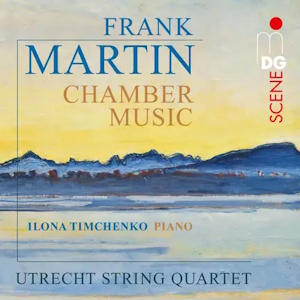
Frank Martin (1890-1974)
Piano Quintet (1919)
String Trio (1936)
String Quartet (1966/1967)
Ilona Timchenko (piano), Utrecht String Quartet
rec. 2025, Konzerthaus der Abtei Marienmünster, Germany
MDG6032388-2 [60]
Frank Martin is well known as a composer of orchestral music (Petite symphonie concertante, Les quatre éléments) and substantial concertos (for violin, cello, piano, harpsichord) but – mainly, I think – for large-scale choral-orchestral works (In Terra Pax, Golgotha, the rather overlooked Mystère de la Nativité, and the equally neglected Pilate), and his two masterpieces for voice and orchestra (Sechs Monologe aus Jedermann and Der Cornet). He may be less readily associated with chamber music but, besides the works here, he composed two violin sonatas, the fairly well-known Huit préludes for piano, and more.
These three works have already been recorded before but, to the best of my knowledge, this is the first time they are usefully and revealingly grouped on one disc. This is a nice opportunity to appreciate Martin’s musical and stylistic progress over almost fifty years, and the pieces represent the bulk of his chamber output.
The substantial Piano Quintet is a long way from the mature Frank Martin. The music is still cast in a late-Romantic mould even if peppered with mild dissonance and Ravelian turns of phrase. Yet it already show stylistic progress when compared to the earlier, more lushly scored Trois poèmes paiens (1910/1911, for baritone and orchestra), once recorded by the late and much lamented José Van Dam.
The Quintet is laid out in four movements. The opening Andante con moto is launched with a beautiful theme played by the cello, soon joined by the other strings and discreetly accompanied by the piano. There follows the Tempo di Minuetto of almost classic profile, though slightly spiced up by mild dissonance. The ensuing Adagio ma non troppo, somewhat more austere, already briefly looks forward to what will later become a typical Martin trademark in the form of a solemn processional. The final Presto concludes the quintet in an almost folk-inflected, light-hearted mood. Again, the music only momentarily points to the mature Frank Martin but already displays a considerable formal mastery which will soon become his hallmark.
Frank Martin was a relatively late starter. He found what he later considered his true voice rather late in his career. One generally admits that he achieved full maturity with Le Vin herbé (1938/1941). With hindsight, one can say that certain works signposted his progress and illustrated his stylistic quest – which led him to Schönberg and twelve-tone music. Martin soon realised, however, that Schönberg’s theoretical point of view did not completely satisfy him. He valued harmony and enlarged tonality all his life as an essential component of his art. Schönberg still proved an important influence on Martin’s later development: twelve-tone theories helped Martin keep a firm hand on his musical structures without endangering his lyrical nature.
One of such signal works is the concise, tightly-argued String Trio. It may be one of Martin’s most austere pieces, although the music never fails to impress: Martin’s musical experiments were not just for experiment’s sake. The String Trio is the best illustration of his use of a system without strictly adhering to it. The Trio is in three movements. The outer Grave and Très lent are the weightiest, and stylistically point to the music of, say, the Passacaille for organ from 1944. The tense mood of the outer movements strongly contrasts with that of the central Très vif et soulant, quicker but nonetheless stringent. (The word soulant here may be hard to explain even for a French speaker like as the undersigned; it could be roughly translated as “inebriating” to suit the rather capricious, almost angry mood of the music.) The String Trio is not a crowd-pleaser but I find this strongly expressive music hard to resist.
The String Quartet is one of Frank Martin’s last chamber works, succeeded only by Poèmes de la Mort and Fantaisie sur des rhythmes flamenco. He wrote it at the request of the Tonhalle-Gesellschaft Zürich which had witnessed the première of his Piano Quintet almost sixty years earlier. So, at the age of 75, he started work on a string quartet. He confided to his life-long friend, composer Bernard Reichel, that tackling a string quartet was not an easy task. One can never believe it when one hears this marvellous piece. Martin always insisted that the String Quartet was absolute music with no subliminal programme, so there was very little to say about it. In his introduction reissued in Commentaires de Frank Martin sur ses œuvres (Les Editions de la Baconnière, Neuchâtel 1984), he comments mostly on the quartet’s structure.
The first movement Lento is built mainly on two elements, a long melody played by the viola followed by a lighter second element punctuated by the cello playing pizzicato. The rest of the movement plays on these elements in various guises. The second movement Prestissimo is a short, often capricious, rather energetic Scherzo. The inward-looking Larghetto in Lied form leads into the final Allegretto leggero; according to the composer, it was inspired by a dream in which semi-human creatures were dancing in the air. It may not be too fanciful to imagine that this vision gave way to the ethereal character of the music.
The Utrecht String Quartet and pianist Ilona Timchenko play these three important chamber works from Frank Martin’s oeuvre with assurance and commitment, and are well recorded. This release, therefore, is an absolute must for all Frank Martin admirers. I am sure that others would – will – find much to cherish here.
Hubert Culot
Other review: Stephen Barber
Buying this recording via the link below generates revenue for MWI, which helps the site remain free













