
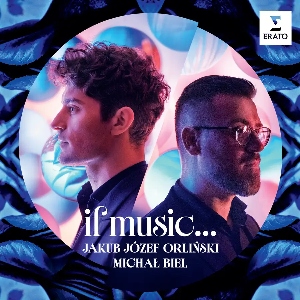
If Music
Jakub Józef Orliński (countertenor), Michał Biel (piano)
rec. 2024, Teldex Studios, Berlin
Texts and translations included
Erato 2173298531 [76]
You may have come across booklets like the one for this disc. It’s modish and colourful, features both musicians doing strange things with balloon-like balls in an environment vaguely extraterrestrial but certainly in shades of blue and pink. I would have said its target is the younger market, but the younger market doesn’t buy CDs, so it must reflect a non-traditional, undoctrinaire approach to the repertory performed.
If your primary interest is Purcell and Handel then you’ll have to content yourself with the most cursory introduction, and explanation, for this unusual recording. Everything is heard in arrangements for voice and piano but, as no arranger is noted, I assume that pianist Michał Biel is responsible. This is certainly not, from the perspective of the accompanying instrument, a historically-informed recital. Nor is it a recital in which a certain joie de vivre – the kind of ‘cleverness’ that infects the booklet – destabilises the music. Rather it’s quite a modest and relatively discreet exercise in effective transcription and arrangement that usually works in foregrounding the core elements of the music.
Much of the recital is well-known. Purcell’s Music for a While is a test case. Biel decorates the piano line as Jakub Józef Orliński does the vocal. Both men’s ornaments are apposite and discreet. Biel’s use of rolled chords in Fairest Isle is notable and so too is the fact that my ear was drawn as much to the pianist – or even more so – than the countertenor. Biel modulates from baroque-leaning to more romantic performance. My problem with What Power Art Thou? from King Arthur isn’t so much the nature of the accompaniment, it’s more to do with an inappropriate voice. I know countertenors have sung this on disc before, but I have never found it convincing. Their lack of any kind of vocal depth is fatal.
Conversely, my objection to Strike the Viol is the oddly frivolous and hyperactive nature of the accompaniment which succeeds only in acting directly against the voice. This is all inelegant and unattractive. They include the first and third versions of If Music Be the Food of Love, the first of which is more persuasive with no attempt at a ‘lute’ accompaniment, such as one occasionally finds in piano-accompanied Purcell songs. Technically, Orliński hits the divisions of Your Awful Voice (from The Tempest) securely, though the piano part here is decidedly Old School to the extent of richly rolled chords to end. This is one of the most successful of the Purcell songs, largely, I suspect, because it’s one of the least well-known.
There is an interlude before Handel in the shape of Johann Fux’s Non t’amo per il ciel, a very lovely, lyric piece in the course of which, during his brief solo, Biel thickens the texture of the accompaniment. Biel can be rather brusque in the first of the arias from Agrippina whilst in the second both men evoke limpid generosity and unaffectedness. The singer has opportunities for flashy divisions and for some forcing of tone in Un zeffiro spirò from Rodelinda but he deigns to take either. Instead, he prefers, as indeed he does throughout this recital, a certain refined elegance which is not vocal or interpretative neutrality but a rarer virtue. He reprises it in Ombra mai fu, the only popular Handel piece in the selection: clarity, directness, and purity of tone.
His aria from Rinaldo – naturally phrased, tonally pure – is contrasted with the fast aria that follows it, Furibondo spira il vento from Partenope, a most accomplished piece of singing within certain expressive limits, once again graced by Biel’s use (overuse?) of rolled chords.The only Handel piece that didn’t convince me was Where’er You Walk where Orliński’s lack of body and variety are noticeable, however sweetly he puts it over. In the end, it lacks theatrical warmth. The disc ends with a solo piano performance of Jesu, Joy of Man’s Desiring in Myra Hess’ arrangement.
I’ve heard Orliński before and he impresses me again as a singer whose ethos is set against the showy, the florid and the more vacuously decorative – though unashamedly exciting – elements of the countertenor repertoire. Here, taking on music of other voice types (in the main), he is direct and unshowy. Biel is sometimes capricious and strains at the bit to vest the music with the kind of colour and variety it doesn’t receive in more ‘authentic’ accompaniments. To that extent it generates tensions between the voice and piano. I enjoyed the recital, though I can imagine sterner critics than I will recoil at some of it. That’s to say nothing of the gaudy booklet.
Jonathan Woolf
Contents
Henry Purcell (1659-1695)
Oedipus, Z. 583: No. 2, Song. “Music for a While”
King Arthur, Z. 628, Act 5: The Final Masque. “Fairest Isle”
King Arthur, Z. 628, Act 3: Cold Song. “What Power Art Thou?”
Come, Ye Sons of Art Away, Z. 323: No. 5, Ritornello. “Strike the Viol”
If Music Be the Food of Love, Z. 379 (Third Version)
Pausanius, Z. 585: Song. “Sweeter Than Roses”
If Music Be the Food of Love, Z. 379 (First Version)
Bonduca, Z. 574, Act 5: Solo. “O, Lead Me”
The Tempest, Z. 631, Act 5: Recitative and Song. “Your Awful Voice”
Johann Joseph Fux (1660-1741)
Il fonte della salute, aperto dalla grazia nel calvario, K. 293: “Non t’amo per il ciel”
Georg Frideric Handel (1685-1759)
Agrippina, HWV 6, Act 2 Recitativo. “Otton, qual portentoso fulmine è questi?” and Aria. “Voi che udite” (Ottone)
Rodelinda, regina de’ Longobardi, HWV 19, Act 3: Aria. “Un zeffiro spirò”
Serse, HWV 40, Act 1: Largo. “Ombra mai fu”
Rinaldo, HWV 7, Act 2: Aria. “Siam prossimi al porto” (Eustazio)
Partenope, HWV 27, Act 2: Aria. “Furibondo spira il vento” (Arsace)
Semele, HWV 58, Act 2: Aria. “Where’er You Walk” (Jupiter)
Johann Sebastian Bach (1685-1750)
Herz und Mund und Tat und Leben, BWV147 arr Myra Hess as ‘Jesu, Joy of Man’s Desiring’
Buying this recording via the link below generates revenue for MWI, which helps the site remain free













