
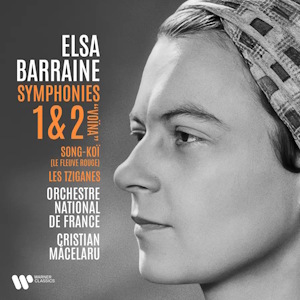
Elsa Barraine (1910-1999)
Song-Koï; Le Fleuve rouge. Variations for Orchestra (1945)
Symphony No. 1 (1931)
Symphony No. 2 ‘Voïna’ (1938)
Les Tziganes (1959)
Orchestre National de France/Cristian Măcelaru
rec. 2024, Auditorium de Radio France, Maison de la Radio et de la Musique, Paris
Warner Classics 2173255519 [67]
I asked to review this disc because Elsa Barraine is a composer whose music was unknown to me and I was curious to investigate. Her music is not very well represented on disc. Apart from recordings of one or two small individual pieces, I’ve been able to track down only a couple of discs. The two symphonies and a couple of orchestral works, Illustration symphonique pour Pogromes d’Andre Spire and Musique funèbre pour la Mise au tombeau du Titien are on a cpo disc (review) and Radio France has issued a disc of her organ music (TEM316076).
She was a most interesting person, as I learned from the notes accompanying this CD (by Cécile Quesney and Mariette Thom). The authors have provided a good introduction to Barraine and the pieces here recorded, but I wish Warner Classics had allowed them more space to write about her because I’m sure that, like me, many people who investigate this disc will know little of her. In brief, she was born in Paris and studied at the city’s Conservatoire, where she was a composition pupil of Paul Dukas. According to the notes, she became very close to Dukas and was strongly influenced by him. In 1929 she became only the fourth woman to win the coveted Prix de Rome. She moved towards left-wing politics; Quesney and Thom state that by 1938 when her Second symphony was premiered, she was “poised to join the Communist party”. Whether or not that became a lifelong affiliation, I don’t know, but, as we shall see, her Communist sympathies are certainly relevant to the Variations for Orchestra to which she gave the title Song-Koï; Le Fleuve rouge. Courageously, Elsa Barraine was active in the Resistance during the War, narrowly escaping arrest on two occasions. From the article about her on Wikipedia, I learned that after the War she worked for the record label Le Chant du Monde (1944-47) and between 1953 and 1972 she taught analysis and sightreading at the Paris Conservatoire. After that she served as the French Culture Ministry’s Director of Music, though I don’t know for how long she held that post.
I’m going to consider the four works chronologically, rather than in the order in which they are placed on the disc. Barraine’s First symphony was one of the envois which winners of the Prix de Rome were required to send back to France during their Italian sojourn. It’s the longest piece on Cristian Măcelaru’s programme, here playing for 28:14; it’s cast in three movements. In their notes, Quesney and Thom usefully include some quotations from the programme note for the work’s first performance, which they are sure Barraine herself compiled. The symphony begins with an Andante introduction which Barraine described as “grimacing”; that’s a good adjective for music that is dark, tense and texturally stark. As the introduction proceeded, I had the sense of a coiled spring which is released when the main Vivace begins (2:02). Thereafter, much of the music is quite spiky, although this by no means precludes melodious writing. The middle movement is the longest. Initially, the tempo marking is Adagio; the movement begins with an extended expressive theme for strings playing in their lower registers. Eventually, the arrival of a solo flute brightens the texture. Everything changes at 3:40 when a Vivace section begins. Most of this section (to 7:14) contains spirited, somewhat angular music; this eventually subsides and Barraine takes us back to the music with which she began her movement. In this section, which, it transpires, runs to the end of the movement, the music is once again dark and expressive; the movement eventually subsides to an uneasy conclusion. I have to confess that I don’t quite ‘get’ how the Vivace episode fits in, but the Adagio sections are impressive. The finale has a short, anticipatory introduction (Adagio). The main body of the movement (from 1:34) is marked Allegro giocoso e leggerio and is largely buoyant and positive in nature. However, Barraine springs something of a surprise at 7:01, when this spirited music comes to an abrupt halt. At this point, Barraine reverts to the music from the movement’s introduction; with this she brings her debut symphony to a subdued, uneasy conclusion. Elsa Barraine’s First symphony is a confident, interesting composition and it receives an excellent performance from Cristian Măcelaru and the Orchestre National de France.
The Second symphony dates from 1938 and, as the notes make clear, was composed as the shadows of war were gathering; indeed, Barraine gave the work the title ‘Voïna’, which is the Russian word for war. Again, she favoured a three-movement form. The symphony is quite a bit shorter than its predecessor, playing here for 17:32. The first movement (Adagio – Allegro moderato) has what the annotators describe as “a menacing, sonata-form Allegro” after the introduction. This music has a very troubled character, both in terms of its thematic material and its rhythms. Even without reading the notes, the listener can clearly discern the apprehension in the music. The middle movement (Marche funèbre. Lento) is a highly charged, impressive funeral march. These first two movements definitely don’t make for comfortable listening but, in that context, the finale (Allegretto) is something of a surprise. Here, the music is bustling and cheerful. Quesney and Thom refer to “the guise of a folk dance” and state that the music “carries the sense of rebirth”. Given the troubled nature of the preceding music, this finale rather takes one aback. Sadly, events were to prove unfounded the optimism that Barraine expressed in concluding her symphony.
Cristian Măcelaru opens his programme with the Variations for Orchestra to which Barraine gave the title Song-Koï; Le Fleuve rouge. Though I’m considering it third, since it was composed after both of the symphonies, I think the positioning of the piece at the start of the programme is very shrewd; it’s a colourful, attractive and inventive composition which will draw in listeners who may be new to Barraine’s music. The work is quite political in inspiration. Cécile Quesney and Mariette Thom explain that the work, commissioned by French National Radio, “was inspired by the beginnings of the independence struggle in Indochina, most likely the revolution led by the Viet Minh in Hanoi in August 1945”. The Red River of the title refers to “a long, silky, reddish-brown river” that rises in China’s Yunan Province and runs down to the sea near Hanoi.
Barraine’s composition, which takes some sixteen minutes to play, consists of eight short movements. The first ‘La Source’ represents both the source of the river and also the thematic source of seven variations which follow. Throughout the piece, the music is most attractive and colourful. Barraine makes skilful use of Eastern effects in the orchestration; the scoring is often exotic. At one point in the fourth movement. ‘La Ville de Son-Phong’ the music is vigorous and punchy and I was briefly put in mind of a passage in the Turangalîla-Symphonie by Messiaen, who was, like Barraine, a pupil of Dukas. However, that must be pure coincidence since Messiaen’s masterpiece post-dates Barraine’s work. The penultimate movement is entitled ‘Le Fleuve rouge reçoit la rivière Noire’, referring to the point in the river’s course where it meets another river, The Black River; here, Barraine’s powerful music is strongly suggestive of confluence. That variation is followed by ‘L’Arrivée à la mer et la mort’, which furnishes the piece with a fine conclusion. Strongly affirmative at first – the might of the river as it runs into the sea, I presume – the music then winds down to a tranquil close as the strength of the river is absorbed into the sea itself and dissipates. I think this is a most interesting and resourceful piece. It’s also a highly successful example of East-meets-West in music.
The concluding piece, Les Tziganes is quite short; it takes less than five minutes to play. Quesney and Thom believe it was probably composed as background or incidental music for a programme or a radio play. The music is vibrant and colourful. Midway through there’s a prominent role for a solo violin, playing in the Roma folk-fiddling style.
Throughout this programme, Cristian Măcelaru obtains committed and skilful playing from the Orchestre National de France; conductor and players are persuasive advocates for Elsa Barraine’s music. They have been recorded in very good sound. The notes by Cécile Quesney and Mariette Thom are helpful but a bit too brief; Warner should have allowed them more space to provide a fuller introduction to the composer and her pieces. There are two other presentational issues. One is that the notes, which are in French with English and German translations, are printed in white type on a black background; this is very difficult to read. Much more seriously, Warner have not given sufficient space between the various movements of the symphonies and, crucially, between the end of Symphony No 1 and the start of the Second symphony; a gap of a mere six seconds is ludicrous.
Elsa Barraine’s music deserves to be better known. I found this disc was a very good introduction to her music.
John Quinn













