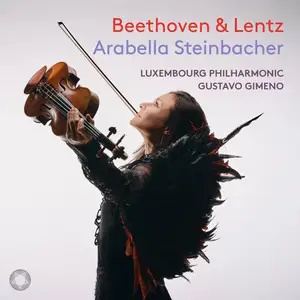
Ludwig van Beethoven (1770-1827)
Violin Concerto in D, Op. 61 (1806)
Georges Lentz (b. 1965)
“…to beam in distant heavens…” – Violin Concerto (2023)
Arabella Steinbacher (violin)
Luxembourg Philharmonic/Gustavo Gimeno
rec. 2023/24, Philharmonie Luxembourg
Pentatone PTC5187240 [80]
Beethoven’s Violin Concerto is generally regarded – deservedly so, I think – as one of the most moving and beautiful concertos in the repertoire. It abounds with splendid, richly lyrical themes, is well loved by violinists and audiences alike, and is regularly recorded. But, curiously enough, it seems to appear more rarely in concerts than most other more virtuosic concertos. My own point of reference is that it was very rarely played at the finals of the Queen Elisabeth Competition in Brussels; more technically demanding concertos such as Sibelius’s almost ubiquitous work were chosen much more regularly. I think that Beethoven’s Violin Concerto, though far from technically easy, is considerably warmer in feeling. I for one find its uplifting lyricism hard to resist, more so when it is played with such impeccable technique and warmth as here.
Luxembourger and Australian resident Georges Lentz has already been reviewed here on several occasions. The backbone of his output is the large-scale work in progress Caeli enarrant… (the Heavens declare), of which the violin concerto is but one part. The complete title of Lentz’s violin concerto is “…to beam in distant heavens…”from Mysterium (Caeli enarrant… VII). He composed the work at the request of the present soloist Arabella Steinbacher. The seeds were sowed in 2018; the concerto was completed in 2023 and first performed in Sydney in Spring 2023.
The work is structured in a large-scale single movement, albeit with several sections. Played without break, the sections trace a long journey in time and space. The work opens with a Big Bang (on the bass drum), launching a long, rather nervous, almost hectic cadenza played off-stage that goes on when the soloist comes into focus. From then on, as the music unfolds, the soloist is rarely silent. The large orchestra, including an electric guitar, is actually very sparsely used, although it asserts itself more forcefully from time to time. The overall mood of much of the piece is contemplative.
After a purely magical section (track 6), the music becomes more animated and moves into the longest and mostly energetic section of the entire work. It is full of contrasts and quite taxing for the soloist and for some orchestral players. This section includes yet another cadenza, at times accompanied by percussion. A long crescendo suddenly subsides into the achingly beautiful Elegy for our Grand-children’s Planet; that eventually leads into the final section for which the composer wanted to write “a good old throw away finale”. Yet the very conclusion of the work remains unresolved and open to questions that each has to think for themselves.
In his notes on the violin concerto, the composer says: “the memory of sitting alone with my own violin in the middle of the Australian outback at night, improvising and trying some ideas […] was top of my mind throughout the writing of the new work. The focus on that lonely violin under the vast starry night sky became important [to me].” That feeling reflects rather well the global idea sustaining the entire work and – in some way – its subtitle, actually a few words from William Blake’s vast visionary poem Jerusalem. Quoting the composer again: “The words …to beam in distant heavens… seemed to capture the spiritual yearning and journey I was trying to express.”
Georges Lentz’s violin concerto is, no doubt about it, a quite demanding and taxing piece but it nevertheless communicates deeply. A tough nut to crack, it is well worth cracking. Arabella Steinbacher plays with impeccable technique and imbues the work with endearing commitment. She gets the unfailing support of the Luxembourg Philharmonic throughout the piece. In short, Georges Lentz’s violin concerto “…to beam in distant heavens…” is a marvellous piece of music that needs – but amply repays – repeated hearing.
I was at first a bit puzzled by the coupling: indeed, Beethoven and Lentz may seem strange bedfellows. But I think that their violin concertos have much more in common that one might assume. Beethoven’s work may be less demanding than the repertoire’s warhorses but a sluggish performance can ruin it irremediably. On the other hand, both Beethoven’s and Lentz’s concertos are deeply lyrical, each in its own way. In conclusion, do not be deterred by the coupling but rather stick to it, for the rewards are plentiful indeed.
Hubert Culot
Previous review: Simon Thompson (May 2025)
Buying this recording via a link below generates revenue for MWI, which helps the site remain free