
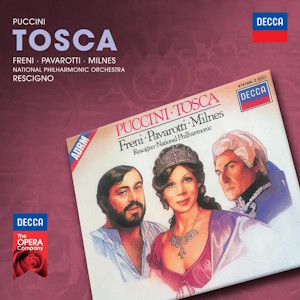
Giacomo Puccini (1858-1924)
Tosca (1900)
Floria Tosca – Mirella Freni (soprano)
Mario Cavaradossi – Luciano Pavarotti (tenor)
Scarpia – Sherril Milnes (baritone)
London Opera Chorus & Wandsworth School Boys’ Choir
National Philharmonic Orchestra/Nicola Rescigno
rec. 1978, Kingsway Hall & Henry Wood Hall, London
Reviewed as download
Decca 4783054 [115]
Once upon a time, probably long before many of you were born, I had the privilege of encountering Giacomo Puccini’s most famous four operas for the first time on record. These would have been La Bohème in the Decca recording conducted by Serafin, with Renata Tebaldi and Carlo Bergonzi; Madama Butterfly with Renata Scotto and Bergonzi (again) with Sir John Barbirolli, while the Turandot featured Sutherland and Pavarotti with the London Philharmonic on top form under Zubin Mehta; Tosca would have been the current recording under consideration. My younger self was enchanted by the sparkle and charm of the Bohemians in Paris at Christmas time, as well as the intoxicating beauty and exoticism of Japan at the end of the nineteenth century with its geishas and cherry-blossom, while at the same time being bowled over by the sheer spectacle and grandeur of the Forbidden City in Ancient China. However, the revolutionaries and evil police chiefs of Rome during the Napoleonic era left me cold and it wasn’t until several years later, with different recordings, that the full magic of Tosca revealed itself to me, leading to the inevitable conclusion that, maybe, it was this recording that was to blame for my early ambivalence. So, when the chance came to re-assess this set for MWI, currently available as a download only, the chance was too good to miss.
To be frank, although my younger self’s conclusions were correct and this set will never displace any established favourite Tosca recordings, the calibre of its participants would indicate that it is not one to be immediately dismissed out of hand, either. In the first instance, the sound is fabulously rich, a real tribute to the Decca engineers of the time – on this occasion, Colin Moorfoot and Kenneth Wilkinson. The orchestra – a pick-up one, of course, but one made up of some of London’s finest musicians – plays wonderfully. The supporting cast is more than up to the usual high standards of this label at the time, featuring such stellar names as Richard van Allan as Angelotti, Michel Sénéchal as Spoletta and the young John Tomlinson as the gaoler. Add to all this the power-house recordings Decca had made just a handful of years earlier of La Bohème and Madama Butterfly, both with two of the principals featured on this recording, as well as the aforementioned and still-yet-to-be-bettered Turandot, once again with Pavarotti, but this time with Dame Joan Sutherland in the titular role and Montserrat Caballé as Liú, along with the most extraordinary supporting cast, then it is understandable that expectations for this later recording would be high.
However ….
Cavaradossi was one of Luciano Pavarotti’s signature roles and the one he chose for his final stage performance at The Met in 2004, even if he did perform it sitting down virtually the entire time. On this recording his voice is at its youngest, sappiest, most supple and vibrant best. He dispatches ‘Recondita armonia’ with a devil-may-care charm that is infectious and later in Act III, ‘E lucevan le stelle’ with as much intensity and gravitas as anyone could want. However, in between, he does sing rather loudly – all the time. There’s little variety and virtually no subtlety to his singing and so, by his own high standards, I consider him on this set to be disappointing, especially after his superb portrayals of Rodolfo, Pinkerton and Calaf on those aforementioned recordings.
He is partnered here, as he was so often, by Mirella Freni, essaying the role of Tosca – a part she never took onstage. She is undoubtedly one of the finest sopranos from the second-half of the twentieth century and I admire her tremendously in a huge range of repertoire, from her Susanna in the Ponnelle film of Le nozze di Figaro, to perhaps the purest sung Madama Butterfly on record of all with her assumption on the Karajan set. Freni though, shy, charming and innocent, isn’t Tosca and great singer though she is, she fails to persuade me otherwise in this recording; too often, she merely forces her tone in an attempt to sound more imposing, but it just doesn’t work. She would give a more subtle – and more intelligently sung – rendering for Sinopoli later in her career, but on this occasion she just sounds miscast.
It is therefore left to Sherrill Milnes’ Scarpia to steal the show – which he does triumphantly – surprisingly, the best thing about this set. He gives a commanding, aristocratic portrayal of the police chief that is worthy to stand alongside the very best, as evil as Taddei, just as subtle as Gobbi, but sounding more sinisterly suave than both. His contribution to this recording is the reason why you should hear it, the only element of this set that can stand comparison to those other great Decca Puccini recordings made earlier in that decade.
It was long rumoured that Herbert von Karajan had been originally lined up to conduct this recording and if that was the case, it is to this set’s eternal loss, for Nicola Rescigno on the podium really doesn’t bring much to the party. Yes, he directs the traffic competently and no, he doesn’t do anything outlandish or vulgar, but at the same time nor does he vary the tension; and that is what undermines the whole venture. The emotional climaxes just do not tug at the heartstrings as they should; the Te Deum merely gets louder and louder instead of building to a climax of overwhelming grandeur, reflecting the terrifying, omnipresent power of Scarpia; the torture scene just sounds like a tricky job interview, rather than turning into something so awful that Tosca is forced to betray all her principles and loyalties. Competency on the podium is fine, but when you are up against de Sabata, Karajan, Sinopoli, Prêtre and Pappano, it just isn’t enough in this opera – and the consequences for this recording are hugely significant. With the limp, generalised conducting producing a dramatic tension that rarely approaches simmering point, let alone one that boils over with the revolutionary fervour, lust and murder this music requires, Pavarotti is only inspired enough to phone-in a similarly tepid interpretation, making Freni’s efforts to inject the necessary fire into her voice, that was never really there anyway, sound even more hopelessly out of place. All of this causes the dramatic arc of the action to be caught up in the slipstream of indifference from the podium, only to crash on the rocks of ignominy; no wonder this opera didn’t make much of a first impression upon me all those years ago.
Lee Denham
Buying this recording via a link below generates revenue for MWI, which helps the site remain free


Other cast
Cesare Angelotti – Richard van Allan (bass)
Spoletta – Michel Sénéchal (tenor)
Il sagrestano – Italo Tajo (bass)
Sciarrone, gendarme – Paul Hudson (baritone)
Un carceriere – John Tomlinson (bass)
Un pastore –Walter Baratti (treble)













