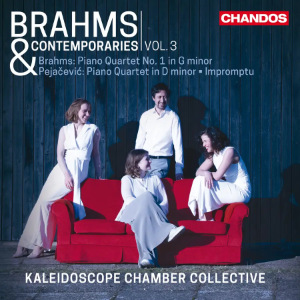
Brahms and Contemporaries Volume 3
Dora Pejačević (1885-1923)
Quartet in D minor for piano, violin, viola and cello, Op.25 (1908)
Impromptu, Op.9b (1903)
Johannes Brahms (1833-1897)
Quartet No. 1, Op.25 in G minor for piano, violin, viola and cello
Kaleidoscope Chamber Collective
rec. 2025, Potton Hall, Dunwich, UK
Chandos CHAN20364 [64]
This is the third – but, the booklet note says, not the last – volume in the Kaleidoscope Chamber Collective’s exploration of the works of Brahms in conversation with the lesser-known works of his contemporaries. In the booklet, pianist Tom Poster acknowledges that some will see it as a stretch to classify Dora Pejačević as a contemporary of Brahms. Yet musically there is certainly a lot of overlap, and you can sense that the older composer had a big influence on the younger.
There is, therefore, a lot to be gained by hearing their Piano Quartets in close proximity, and Pejačević’s Quartet is a hugely impressive work. It surges with drama but is held in check by a classically informed restraint. The first movement is full of dark, Brahmsian (yes!) drama. Its swirling, forward-marching main theme draws a marvellous variety of colour from the four performers. The piano often feels like it is the first among equals, but the strings frequently swap places in their prominence, and it is a very satisfying listening experience altogether. The slow movement is calm and beautifully balanced, while the third movement feels like a cross between a witty Scherzo and a genteel Menuet. The finale has a spry, elfin quality, almost Mendelssohnian in its lightness and in the delicate bounce that takes place between the instruments. There is busyness and weight here too, and Pejačević sends the piece across the finish line with a healthy dose of adrenaline flowing through its veins.
Anyone who has encountered the Kaleidoscope Chamber Collective before will know to expect an exquisite colour of sound, with dark, chocolaty strings balanced by Poster’s active, percussive piano. These are people who know each other well and who know how to make music together, and they pay every piece the compliment of taking it seriously. That applies also to the gorgeous, mahogany warmth of Pejačević’s Impromptu. It moves steadily forwards with silky beauty and fluid textures, and all four instruments fit into one another perfectly.
Not for the first time in this series, however, Brahms upstages the special guest. There is just so much more in his first Piano Quartet, and you sense that with the molten, rippling energy that courses through every bar of its first movement. What’s more, the Kaleidoscopes even seem to recognise that themselves. There is an extra level of intensity to their playing that, coupled with the depth of the writing, lifts their Brahms quite far above the head of their Pejačević. The insight seems deeper, the quality of their mutual listening more intense, and it is an altogether more involving listen than Pejačević’s quartet is. Put that down to my patriarchal prejudice, if you will, or to the fact that this work is so much more familiar and has more comparative performances. Whatever: this Brahms is really great.
It is not just the first movement, either. The slow movement flows like it is unearthing worlds, and the famous “gypsy” finale begins hard-driven and then only develops in intensity as it proceeds. Poster’s fingers positively scamper during the quickfire sections, and the whole thing pauses for breath only in the disarmingly thoughtful central section. The coda will raise you to your feet, however, and it is a firecracker ending to the quartet. Bring on the next volume!
Simon Thompson
Buying this recording via the link below generates revenue for MWI, which helps the site remain free
Performers
Elena Urioste (violin), Rosalind Ventris (viola), Laura van der Heijden (cello), Tom Poster (piano)