
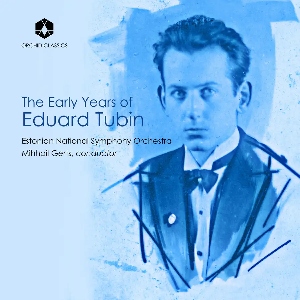
Eduard Tubin (1905-1982)
The Early Years
Suite on Estonian Motifs (1931)
Symphony No. 2 in B minor ‘Legendary’ (1937)
Preludes Nos. 1 and 2 for solo piano (1930s?)
Estonian National Symphony Orchestra/Mihhail Gerts (piano)
rec. 2025, Estonian Concert Hall; 2026, Berlin (Preludes)
Orchid Classics ORC100455 [62]
While paying richly merited, extravagant homage to BIS (also Alba and Forte) who have recorded all the symphonies etc., we can welcome this disc as a generous-hearted indication that Tubin’s music pulses onwards into new generations.
This collection centres on the young Estonian composer’s emergence in the 1930s. The four-movement Suite might easily register as a work of serious symphonic ‘geist’. The first movement is notably atmospheric while the third is endearingly illuminated by the major serenading role played by the Leader’s solo violin (think Julius Harrison’s Bredon Hill). The finale is gaudily celebratory in much the same way as the finales of Glazunov’s Sixth and Eighth symphonies; not that it sounds like the Russian composer. In terms of sheer duration the suite is about the same length as the Second Symphony.
The three-movement Second Symphony has a title that recalls the almost contemporary last symphony by Bax, which has as its central movement a lento titled ‘In Legendary Mood’. While the Bax is a shade slack and discursive, the Tubin is serious. The first movement, entitled ‘Legendaire’, is fairly gritty, bleak and whirls the shredded storm clouds, with supernatural creatures and forces perhaps an extension of the mood of Delius’s Eventyr and of Grieg’s Peer Gynt (a hybrid of the Mountain King and the Bøyg). It’s no surprise that the central ‘Sostenuto’ is subtitled ‘grave e funebre’. The music moves like the Biblical pillar of cloud and fire – dark and irresistible in remorseless motion. A piano and a solo violin are embedded in the orchestral texture. The finale is a ‘Tempestoso’ and is as long as the other two movements put together. It opens in a decisive break from the middle movement’s impassive funeral march with a quick march that is ruthlessly forward-driven and combatively tense. It makes much of a reiterated lashing motif quite devoid of mercy. That said, the work ultimately finds calm, with prominence given to imploring solos from violin (inevitably recalling the third movement of the Suite) and piano. The Second Symphony has found its epilogue.
The two ever-so brief dreamy solo piano preludes, played by conductor Mihhail Gerts, take the temperature and pressure curving downwards.
The Tubin experience is furthered by Gerts’s extensive booklet essay. The music is presented in lively excellent sound which manages to bring us the more inward soloistic moments as well as the horizon-sweeping climactic stuff. It’s a measure of Orchid’s excellence that the booklet has been designed to be several millimetres smaller than the card pocket into which it snugly and easily fits.
Nice work Orchid! I hope there will be more in this series. Why not some, as yet unrecorded Ivanovs?
Rob Barnett
Buying this recording via the link below generates revenue for MWI, which helps the site remain free













