
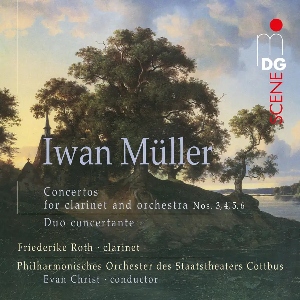
Iwan Müller(1786-1854)
Clarinet Concerto No. 6 in G minor (1820s?)
Clarinet Concerto No. 5 in E-flat (1820s?)
Clarinet Concerto No. 4 in A minor (1820s?)
Clarinet Concerto No. 3 in B-flat (1820)
Duo concertante, Op. 23 (1820s?)
Friederike Roth (clarinet)
Johannes Gmeinder (2nd clarinet)
Philharmonisches Orchester des Staatstheatrers Cottbus/Evan Christ
rec. 2013, Cottbus, Germany
MDG 901 1846-6 SACD [66]
As my reviews here and elsewhere may suggest, I’m a fan of Classical clarinet music. Mozart’s two masterpieces – the Concerto and the Quintet – represent the summit, but I can also enjoy Cimarosa’s unfolding lyric warmth, Krommer’s sheer melodic joy (or Krommer-Kramř, to be utterly pedantic about it), and even the restrained, down-to-earth intonations of Crusell. Based on the present disc, however, I’m not sure that Iwan Müller – born in what is now Tallinn – quite earns a spot alongside them.
In these brief concerti – the slow movement of No. 6 runs under three minutes – Müller’s writing doesn’t fully exploit the clarinet’s range or coloristic resources. The instrument rarely dips into the rich chalumeau range; the two-octave drops and leaps that Mozart used to particular advantage are mostly in abeyance. The solo lines are outfitted with the requisite embellishments and decorative squibs, but some, in the Fifth and Sixth Concerti, are poorly considered: the estimable soloist, Friederike Roth, is forced into awkward adjustments to accommodate them.
That said, the scores are otherwise graceful, and tuneful, with the music, and the soloist, occasionally striking an unexpected tone of melancholy – yes, even through the figurations. Roth executes the A minor’s unbroken string of trills to lovely, fluid effect. In the E-flat concerto, Müller condenses the standard fast-slow-fast format into a single twelve-minute movement, no doubt innovative for the time; he also opens it with mysterious pizzicatos that will become the foundation for the clarinet’s second theme.
That G minor concerto, although last in the sequence – the booklet’s dating is ambiguous – sounds the weakest score. Conversely, rather more interest inheres in the Duo concertante, at least once past the arthritic opening chord. Roth and Gmeinder play against each other, sometimes registrally, to good effect.
Under Evan Christ, the Philharmonisches Orchester des Staatstheatrers Cottbus – thank heaven for copy-and-paste – plays acceptably, no more. The ritornelli sound suitably classical, but turn static when they should be building tension; the sonorities are a bit soft-edged, and I kept wanting a few more desks of strings. At least he finishes off that G minor concerto with a no-nonsense polacca.
I’m afraid this one is for specialists and scholars, rather than the casual listener.
Stephen Francis Vasta
stevedisque.wordpress.com/blog
Other review: Jonathan Woolf
Buying this recording via the link below generates revenue for MWI, which helps the site remain free













