
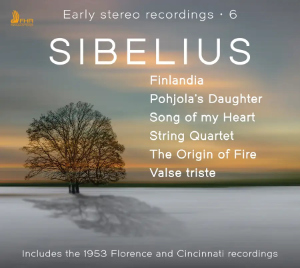
Jean Sibelius (1865-1957)
Early Stereo Recordings Volume 6
rec. 1953-57
First Hand Records FHR85 [82]
These recordings – and there are a lot (83 minutes) of them on this disc – date from the last decade of the Finnish composer’s life. He could actually have heard them, even if he had fallen creatively into a largely silent period since the late 1920s. I wonder if the composer did hear any of these and what he thought of them.
What we hear on this disc are transfers from analogue sources stored at the Archive of Recorded Sound. We are assured that these are high-resolution outcomes from 24bit 96 KHz. They were made in 2024. Well done Paul Bailey of First Hand Records for communicating to us a good strong signal: not at all papery.
Given the mono work of Kajanus, Schneevoight, Koussevitsky, Beecham and others these are not first flowerings of Sibelius, nor are they claimed as such. These are early stereo recordings from FHR’s diligent series of that name and can stand alongside Anthony Collins’ cycle (on Beulah). If only Sibelius himself had recorded the tone poems; as it is we have only Andante Festivo.
Sibelius and few others from the chilled North idolised the Mediterranean. The Italian opera specialist Vittorio Gui (1885-1975) gives of his all in Finlandia: timps assertively forward; steady and secure sound (no wow) and richly upholstered strings. Listening now to the superb, yet 50+ years old FFRS sound of Horst Stein on a Decca SXL in the early 1970s we know what we are missing. The ‘chamfered’ brass ‘bark’ has only a skim of Decca’s grittily seductive abrasion … even so. Gui’s Valse Triste is again blessed with a richly upholstered acoustic even if it seems a shade more misty than it does in Finlandia. The score hums with log-fire affectionate warmth – and unhurriedly reaches the cockles of all tender hearts. George Weldon’s Finlandia sound (from 1956) is emotionally distanced by comparison with Gui. I am glad it is here but the original engineering is not such as to yield the lucid sharp-focus results to be heard in the Johnson tracks. Give Weldon his due: he is exceptionally good at the singing cantilena of the hymn section.
These transfers have wrung the ‘juice’ out of the originals. If they had ‘juice’, you will hear it. Try the hymn sung by the Helsinki University singers. They give it weight and differentiation of volume and sound. There is no distortion when it comes to the fff at 1:47 and they let everything rip at 2:10. The singers then go for Song of my Heart. There’s palpable coordination – no raggedness – just precision, yet with a humming glow. Nothing precious here: musculature imbued with word-meaning.
When it comes to the Thor Johnson ‘pair’ I wonder if this Scandinavian conductor had initially intended to add other Sibelius orchestral works. Who knows? Whatever, Mr Bailey has done his pilgrim transfer work well. It’s certainly far better than my clumsy amateur attempts to transfer these two works from the Varese-Sarabande-Remington original LP via a trusty Tascam CD recorder.
The Origin of Fire: Sulo Saarits (baritone) recounts the Kalevala tale like a veritable seannachaidh. The vocal contribution all-round is notable and a noble communicative tone is breathed into the first mention of the god, Ukko. It’s a pity that Johnson was not given leave also to record Kullervo (someone needs to fish out and harvest Jalas’s 1950s recording which pre-dates the Berglund). The choir’s part (males only, remember) delivers singing of real fresh flesh with furious attack reserved for the full complement at 5:15. The strings of the Cincinnati Symphony Orchestra may come across as a shade shrill when close-up but there is much to please: for example, the woodwind bird-calls around 4:40 and before. Lend an ear also to the bells in the background; Mussorgskian in its massy iron weight of delivery; most impressive.
Pohjola’s Daughter is a favoured work in my book; has been ever since that ‘Hall of Fame’ Horst Stein LP. Johnson judges tempo changes and sustains and does so winningly and with excitement articulated. At 3:00 he grabs you by the scruff of the neck and drives onward fast. The many solo instrumental ‘images’ are solicitously and eloquently recorded. There’s a nice open sound for the harp figuration at 4:02 and real attack in the strings at 7:10 and 7:34. Time and again, we witness a vertiginous pressing ahead with the devil-may-care feel of a live performance. The stereo effects are natural rather than a contrived curtsey to ‘new tech’. Do listen out for the stereo piquancy at 4:35 and the pizz at 4:55. Time and again, Johnson is treated to lovely sound and cheapskate stereo tricks are abjured. Magnificent.
The Johnson tracks are not from anything as crass as vintage vinyl. No: they are from a 7.5 ips commercial tape reel (AV Tape Libraries AV-15088).
The mature years’ String Quartet comes next in a recording by the Pascal Quartet. I have always felt it to be an enigmatic piece and I am not sure that that the Pascals make the best of it. There’s good advocacy here but despite some headlong and tender work, skitteringly precise but lively, I find this problematic in terms of likeability. The CD’s origins here lie with a Concert Hall Society stereo reel. I wonder why no one was tempted to orchestrate the work as was done for the Walton (the mature years quartet) and the Smetana (No. 1 From My Life).
The admirably well-targeted booklet notes are by foremost names in the transfer business: Peter Bromley and Tully Potter.
This disc would have made, and still can make, a wonderful complement to EMI’s historical set. Also bear in mind the SNO/Alexander Gibson 3 and 7 on a Saga LP (XID5284 – previously Waverley) recorded with funding from the Peter Stuyvesant Foundation. The latter – a 1965 entry – to be heard on CRQ Editions (review).
Rob Barnett
Previous review: Jonathan Woolf
Buying this recording via the link below generates revenue for MWI, which helps the site remain free

Please note that Presto Classical is not able to sell this recording to the USA & Canada. An alternative link is First Hand Records.
Contents
Finlandia, Op. 26 (1899)
Orchestra del Maggio Musicale Fiorentino/Vittorio Gui
Finlandia – Hymn (version for male choir: sung in Finnish) (1939)
Helsinki University Chorus/Martti Turunen
Six Part Songs, Op. 18: No. 6. Sydameini laulu (‘Song of my Heart’) (sung in Finnish) (1900)
Helsinki University Chorus/Martti Turunen
Tulen synty (‘The Origin of Fire’), Op. 32 (sung in Finnish) (1902 rev 1910)
Sulo Saarits (baritone)/Helsinki University Chorus/Martti Turunen/Cincinnati Symphony Orchestra/Thor Johnson
Pohjola’s Daughter, Op. 49 (1906)
Cincinnati Symphony Orchestra/Thor Johnson
Valse triste, Op. 44, No. 1 (1904)
Orchestra del Maggio Musicale Fiorentino / Vittorio Gui
String Quartet in D minor, Op. 56 ‘Voces intimae’ (1909)
Pascal Quartet
Finlandia, Op. 26 (1899)
Philharmonia Orchestra/George Weldon
rec. 1956 (Weldon’s Finlandia), before July 1957 (String Quartet), October-November 1953 (others)














I hate to be pernickety with a much-valued colleague, but my hackles tend to rise when I see an Italian conductor automatically described as an “opera specialist”. Vittorio Gui was an “opera specialist” to the same extent that Toscanini and De Sabata were – that is to say, he conducted opera but also dedicated much of his time to promoting the symphonic literature in a country that tended to favour opera over other musical forms. If he must be labelled a specialist, he was also a specialist in Bach Cantatas, Handel Oratorios (which he translated into Italian himself), symphonies by Haydn, Mozart, Beethoven, Schubert and (especially) Brahms, symphonic poems by R. Strauss and orchestral music by Debussy and Ravel. In prewar years he introduced several Sibelius symphonies to Italy. The recording companies typecast him inevitably so we have little evidence of this. Off-air tapes from Italian Radio circulate among collectors. This is not to say that he did not conduct opera very well, his Rossini in particular remain classics of the gramophone.