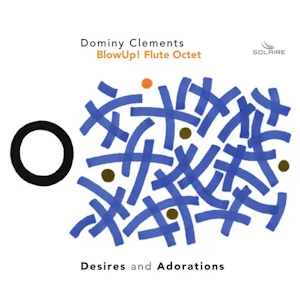
Dominy Clements (b.1964)
Les fines herbes de Erik Satie (2016)
Desires and Adorations (2023)
Six Standing Figures (2019)
Bamboo Split (2012)
A Farewell to 2016 (2016)
BlowUp! Flute Octet with Wim Voogd (piano)
rec. 13 and 14 July 2025, Heilige Antonius Abtkerk, Den Haag, The Netherlands
Solaire SOL1020 [67]
Dominy Clements is a long-standing Musicweb contributor and colleague. I felt his disc should be reviewed, with that fact noted. I knew that he plays subcontrabass flute in the ensemble on this disc, and that he studied the flute with Gareth Morris and composition with Edward Gregson, later with Louis Andriessen, Gilius van Bergeijka and Frederic Rzewski. He has lived in The Hague for many years. That’s the mini biography, now what about the music? And, pertinently, how does one tread the dividing line between soft-soaping a colleague and heaping unnatural amounts of praise? Neither works. As always, just speak as you find.
Let’s start with Six Standing Figures, composed in 2019; its title derives from Henry Moore’s drawings which are ‘ideas for sculptures’ dating from 1954. The drawings are of four single people and one couple, the man with his arm around the woman. Each of Clements’s brief character pieces – only one breaches three minutes – has its own compressed sense of itself. They function on expression and contrasts – he cites Schumann’s Eusebius and Florestan as relevant in the use of titles and exploration of character – and they are, to my ear, wonderfully vivid examples of writing for flute ensemble. The sinuous jazz infusions of the second piece seem influenced by the colouristic precision of texture of Gil Evans whilst the following one pulses with chorale-like melodic distinction – simultaneously amazingly concise and strangely moving. Clements calls ‘Urestan’, the fifth movement, ‘Mahlerian’ – this is the three-movement movement and it’s suffused with the most serious lyricism. In immediate contrast ‘Singrain’ offers a colourful, vivacious close. No soft-soap needed, then, as this is uplifting, sonically attractive, haunting music, brilliantly performed.
Desires and Adorations was composed to create a ‘new Canto Ostinato’ for Simeon ten Holt’s centenary in 2023. Now I am not much of a fan of Simeon ten Holt, whose traditional tonality tended to be employed in using tiny cells, repeated endlessly. This is a procedure Clements has also employed so that the fifty sections of his piece are sub-divided into handy tracks between 5 and 8 minutes in length – and there are 7 tracks so you can do the mathematical division. You really have to be able to surrender yourself to a composer’s shifting sense of colour, to the subtle textural lightening and to the crux moments in minimalist music of this kind. I’m not a surrendering kind of chap so I am enormously resistant to it but I did appreciate Clements’s control of the music’s expansion and contraction and its pulsation. Still not a fan, though.
The disc actually opens with Les fines herbes de Erik Satie, once part of a set but here used in concert as a warm-up to give ‘guest musicians an intro to the sound of the ensemble’. Over a single repeating piano note (Wim Voogd is the pianist) a chorale emerges, one that grows in amplitude and density of sound and has, like ‘Datufringe’ in Six Standing Figures, a calming, transfiguring beauty. Clements’s booklet notes are no-nonsense and quietly droll and he describes the tangy and vivacious Bamboo Split as a ‘Hawaiian Hula dance’. Who am I to disagree with the composer, but do I not detect hints here of Simon Jeffes and his immortal Penguin Cafe Orchestra? To finish there is A Farewell to 2016, a warmly poignant envoi, full of a folkloric weave of winds, the title of which plays on Peter Maxwell Davies’ Farewell to Stromness.
I hope I’ve given a fair enough summary of Clements’s clever, expressive music to encourage listeners to take a punt on it. Where I felt least engaged was when he seemed shackled by precedent, but you may very well think differently. What I think we’ll agree on is the superb performance of the ensemble, the clarity of the recording (Dirk Fischer) and the life-enhancing variety and flair of his best music.
Jonathan Woolf
Buying this recording via the link below generates revenue for MWI, which helps the site remain free