
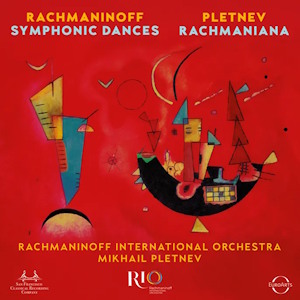
Sergei Rachmaninoff (1873-1943)
Symphonic Dances Op.40 (1940)
Mikhail Pletnev (b. 1957)
Rachmaniana (2024)
Mikhail Pletnev (piano, conductor), Rachmaninoff International Orchestra
rec. January 2025, Moyzes Hall, Bratislava, Slovakia
Euroarts 2011142 SACD [67]
Mikhail Pletnev made his conducting recording debut in 1991 with a hand-picked Russian National Orchestra in a blazing account of Tchaikovsky’s Pathetique Symphony. It really seemed that here was a ensemble for the post-Cold-War age; it combined the passion and technical brilliance of Soviet orchestras with the recording and instrumental sophistication of the West. Over the years, Pletnev and his orchestra made many well-received recordings, initially mainly for DG. The orchestra’s sheer skill was never in doubt but personally, after initial enthusiasm, I have not been so convinced by Pletnev the conductor. His interpretations were generally far less interesting or individual than his piano recordings. The orchestral playing, however, was genuinely brilliant.
In late 2022, the Russian National Orchestra officially terminated its contract with Pletnev, although apparently the working relationship had deteriorated before that. It is not completely clear if the split was on purely artistic grounds or related to Russia’s invasion of Ukraine and general political pressure. Soon afterwards, Pletnev founded the Rachmaninoff International Orchestra. According to online sources, it draws players from Slovakia, Austria and Ukraine, plus eighteen former members of the RNO. The name shows Pletnev’s enduring commitment to this composer’s music. This is the orchestra’s first recording I have heard.
I find the new recording to be a mixed bag at best. The actual playing is again very fine, and some individual contributions and passages are outstanding. The top issues are a rather disappointing recording and – at least in the main work – yet another interpretation that is perfectly good and sensible but never revelatory. The disc is recorded as an SACD but nothing says whether it has a multi-channel layer. (I listened to the stereo SACD layer.) To combat the considerable resonance of the Moyzes Hall in Bratislava, the engineers chose close microphone placements; sniffs and woodwind key clatters are clearly audible. The result is clarity in quieter passages but a vivid impression of “front-desk-strings” and a rather cluttered sound-stage at the fullest climaxes. At the same time, the sound becomes glassy but acoustically clouded. This is less of an problem in the more lightly scored Rachmaniana,but it is a significant drawback in the Symphonic Dances.
In the main work, Pletnev’s approach is unaffected and unmannered. There are faster tempi at the slower end of the ‘normal’ range, and the slower passages are often quite languorous. The latter can be to good effect: there is a lovely sensuous saxophone solo in the opening movement with the filigree accompanying woodwind writing. Elsewhere, though, the neurotic drama of the work seems underplayed. The recording again does not help. The contra-bassoon struggles to register, and the upper strings lack weight and sonority.
General comparisons of mood and timings reveal Pletnev to be at the generally slower end of performance timings. This also translates into a wider avoidance of impetuosity; transitions can feel quite calculated and guarded. Compare that to old favourites such as Svetlanov back in the day of brazen Soviet orchestral playing. Or even consider Western orchestras led by the likes of Petrenko or Järvi, let alone the famous Ashkenazy recording on Decca with the Concertgebouw.
Isabel Herzfeld’s note in German and English – rather gushingly translated, it must be said – suggests why the original movement titles of Midday, Twilight and Midnight were dropped: “the music should speak for itself, allowing the listener to develop their own ideas and feelings” and “the listener experiences a rollercoaster of emotions and conflicts of transcendent validity”. Quite what “transcendent validity” is, I am waiting to find out. The basic premise might be valid but if an original thought behind the music was somehow linked to the times and changing moods of the day, then I feel this can effectively be reflected in performance.
The central movement’s slow waltz can be a ghostly sensuous almost delirious experience. In Pletnev’s hands, it is oddly literal. The very close of the work when the horns hurl out Dies irae motif – Rachmaninoff fixated about it from his earliest works on – suffers most from the acoustic flattening of the engineering. Even so, it remains a wonderful ending to a glorious work. Pletnev allows the tam-tam to ring on, which is always preferable in my book, but the instrument is rather puny and the resonance is cut off too soon. So, here is a perfectly adequate performance of a great work that is unlikely to displace preferred favourites in performing or recording terms.
The main interest in this disc is not the Symphonic Dances but rather Pletnev’s own composition, intriguingly titled Rachmaniana. To say “Pletnev’s composition” is inaccurate: most of the eight movements are in fact his respectful orchestrations of Rachmaninoff’s piano works. Black mark to the note writer who seems to be under the impression that the opening movement, titled Dance, is original. In fact, it is the Étude-Tableaux Op.33 No.1 in F minor; one need not be a Rachmaninoff expert to recognise it. Nocturne is thePrelude Op.23 No.10 in G flat Major: Largo. Serenade is another orchestration of a missed piano piece, Morceaux de fantasie, Op.3 No.5 Sérénade in B flat Minor.Another orchestration is Landscape, actually the Prelude Op.32 No.5 in G Major: Moderato; again it summons up a rather beautiful pastoral vision. This is a more obviously pianistic work, so credit goes to the Rachmaninoff International Orchestra players as they navigate the keyboard figurations as well as they do. The fifth movement is Prelude Op.32 No. 11 in B Major: Allegretto.
The longest movement that the note suggests is original is Melody. It certainly occupies a world of melancholy nostalgia that characterises much of Rachmaninoff’s music. Pletnev’s doubling of horns and cellos in the main yearning melody is hardly original but as always effective. But surely this is another piano work: the Morceaux de fantasie, Op.3 No.3, Mélodie in E Major. In this instance, it appears to be a reworking and development of the melodic material of the original rather than a straight orchestration. I have not done a slavish bar-by-bar comparison to work out how Pletnev has treated the source material. Isabel Herzfeld chooses to hear “evocations of bygone worlds”.
The penultimate piece, Farewell, is an orchestration of the Moments Musicaux, Op.16 No.3 in B Minor: Andante cantabile. It is broodingly effective and nicely played here. Does that leave the closing Hungarian Dance as original Pletnev? I am now assuming that digging through the less familiar Rachmaninoff piano works might reveal its source, too. Certainly it has echoes of the dances from Aleko and the early Caprice bohémien(Capriccio on Gypsy Themes) Op.12. This is the only energetic number in the suite. It has to be said that the upper strings are a little bit thin and scrappy.
It is very curious how the notes strongly imply that the suite is mainly an original work, an homage of the older composer. Even the title listing gives Pletnev as the composer, with no mention that any of the movements are arrangements. Yet at least seven of the eight movements seem to be direct transcriptions or close reworkings for orchestra of existing piano works. Quite how this confusion has arisen I do not know. The online references to this work regurgitate the erroneous liner note. The Euroarts website is a little more forthright: “In Rachmaniana, [Pletnev] draws on and transforms existing material, reworking earlier pieces and reimagining characteristic gestures in a new orchestral context, so that familiar elements appear in a subtly altered, personal form.”
I must admit I did not realise that Pletnev had composed as much original music as he has. Here, the spirit is very much one of homage. The style of orchestration is essentially pastiche. The orchestral palette is kept simpler and leaner than the late orchestral works. It might have been more interesting if Pletnev tried a more radical reworking of the originals. Do not expect the flash and glamour of Respighi’s orchestrations of five of the Étude-Tableaux. Pletnev by contrast is effective and tasteful. Personally I enjoy effective orchestrations, and Pletnev knows all these works intimately from a keyboard player’s perspective. The complete suite plays for just short of 30 minutes, so it is a substantial addition to catalogue of Rachmaninoff orchestral works. It could be useful for an orchestra looking for an easily appealing alternative to the standard fare.
All in all, this is a rather underwhelming disc: a routine set of Symphonic Dances and a confusing companion work which seems to be a set of orchestrations not listed as such. Average recording, probably one of the least impressive SACD discs I have heard, and an inaccurate liner note compound the issues.
Nick Barnard
Buying this recording via the link below generates revenue for MWI, which helps the site remain free














