
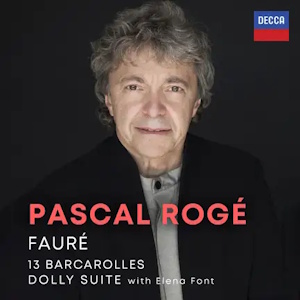
Gabriel Urbain Fauré (1845-1921)
13 Barcarolles
Dolly Suite Op.56
Pascal Rogé (piano), Elena Font (piano, Dolly Suite)
rec. 2025, Saint-Pierre Lutheran Church, Paris, France
Decca Classics 487 1913 [82]
This year marks the 75th birthday of the eminent French pianist Pascal Rogé. In his long career, he has made magisterial recordings of the complete piano works of Debussy, Ravel and Poulenc, but only released one disc of Fauré’s music. According to the notes for this disc, he wanted to celebrate his 75th year by recording Barcarolles – along with the 13 Nocturnes, the core of Fauré’s piano music. His wife, the Spanish pianist Elena Font, joins him in the four-hand Dolly Suite.
Like the Nocturnes, the Barcarolles extend over forty years of Fauré’s career. Chopin and Mendelssohn established the form, originally a Venetian boatman’s song. Fauré started in this tradition but over time bent the form to his own uses. He expanded it from lyricism and melodic beauty (Nos.1-4) to structural experimentation (Nos.5-8); the last five, along with his other late music, demonstrate the introspection and the isolation perhaps caused by his increasing deafness.
The first Barcarolle is indebted to Chopin, although it has many of the attractive features of other works of that time, such as the Piano Quartet No.1 and the songs to texts by Armand Sylvestre. More imaginative are the next three Barcarolles. The second, with more chromaticism than the first, is a set of mini-variations. The third shows Fauré’s unique use of harmony, and is almost like a symphonic poem in its sense of drama. While No.4 seems dreamy at first, it soon becomes clear that the composer is already puting the basic form to new uses.
Fauré did not return to the Barcarolle for almost ten years. The next two show how much his music had developed in that time. For comparison, we may mention Pelleas and Melisande, La Bonne Chanson, and the Piano Quintet No.1, roughly contemporaneous with the two piano works. The fifth Barcarolle continues the harmonic and melodic expansion already seen in the fourth, while showcasing thematic development at its peak. In the sixth, we find great harmonic exploration and the beginning of the melodic austerity that would eventually become a salient feature of the composer’s later music.
After another ten years, the composer wrote two more Barcarolles. He was about to embark on his opera Pénélope. In the seventh Barcarolle, at first one will notice how attenuated the melody is, but even so one finds the same charm and almost whimsy as in No.1. The eighth is one of the richest emotionally, yet there is also uneasiness, perhaps an indication of the deafness which began that year.
From 1908, Fauré produced Barcarolles (as he did Nocturnes) more frequensly. He wrote five until 1921. Those were also the years when Fauré’s deafness increased until he could not hear at all; listening to music actually became a torment for him. His general health was also in decline, but none of this sapped his musical vitality. Those years saw the further development of his austere and distant style, in which he wrote some of his greatest works.
The ninth Barcarolle has an overall feeling of sadness; structurally, it is one of the finest of all 13. In the tenth Barcarolle, we find the qualities of its predecessor even more fully developed. The harmonic and rhythmic ambiguity creates a sense that the composer has come a long way from the works of the 1890s. The new tragic undercurrent is quite moving. No.11, from the same year, is far more enigmatic, and the melody is almost stretched beyond recognition. It is as if the composer was writing only for himself.
When Fauré wrote the twelfth Barcarolle, he was feeling more isolated, yet the piece is more straightforward than its three predecessors. It is slightly gentler in mood, but with the development at the same high level.
The year 1921 saw the creation of the composer’s last two piano works, the Barcarolle No.13 and the Nocturne No.13. Like No.12, the Barcarolle No.13 has a sense of gentleness, but also even more austerity and a degree of retrospection.
The Dolly Suite is one of Fauré’s most beloved works. He was in a long-term relationship with the singer and salon hostess Emma Bardac (later the wife of Debussy). Dolly was the family name for Emma Bardac’s daughter Régina-Hélène. Fauré would write little four-hand works for Dolly’s birthdays and other occasions. Font and Rogé’s performance is a delight from first to last (she is the primo in this recording). Especially well-done are the second movement, Mi-a-ou, Dolly’s name for her brother Raoul, and the third, Le jardin de Dolly, with its lovely main theme. Kitty, Dolly’s dog, scampers around in her movement as much as Raoul does in his. I thought Tendresse could have been a little better articulated. I have no reservations about the last movement, with an almost orchestral sound.
Pascal Rogé demonstrates his usual skill and sensitivity, and brings us the fruit of his late-life reflections on this music. Is it too much to ask that he also record the Nocturnes or even the complete piano music? Several other notable sets of the complete Barcarolles are available, but Rogé’s set definitely should be considered.
William Kreindler
Buying this recording via the link below generates revenue for MWI, which helps the site remain free
Contents
Barcarolle No.1 in A Minor, Op.26 (1880-1881)
Barcarolle No.2 in G Major, Op.41 (1885)
Barcarolle No.3 in G Flat Major, Op.42 (1885)
Barcarolle No.4 in A Flat Major, Op.44 (1886)
Barcarolle No.5 in F Sharp Minor, Op.66 (1894)
Barcarolle No.6 in E Flat Major, Op.70 (1895)
Barcarolle No.7 in D Minor, Op.90 (1905)
Barcarolle No.8 in D Flat Major, Op.96 (1906)
Barcarolle No.9 in A Minor, Op.101 (1908-1909)
Barcarolle No.10 in A Minor, Op.104 No.2 (1913)
Barcarolle No.11 in G minor, Op.105 (1913)
Barcarolle No.12 in E Flat Major, Op.106A (1915)
Barcarolle No.13 in C Major, Op.116 (1921)
Dolly Suite, Op.56 (1893-1896)
I. Berceuse
II. Mi-a-ou
III. Le jardin de Dolly
IV. Kitty-valse
V. Tendresse
VI. Le pas espagnole













