
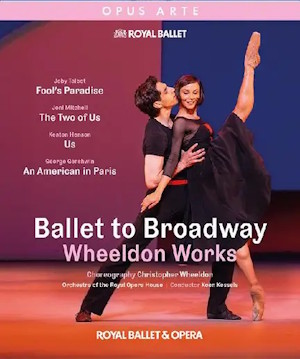
Ballet to Broadway. Wheeldon Works
Choreography by Christopher Wheeldon
Fool’s paradise (2007)
Music by Joby Talbot
The two of us (2020)
Music by Joni Mitchell, orch. Gordon Hamilton
Us (2017)
Music by Keaton Henson
An American in Paris (2014)
Music by George Gershwin
Julia Fordham (singer, The two of us)
Orchestra of the Royal Opera House/Koen Kessels
Directed for the screen by Ross MacGibbon
rec. live, 16 & 22 May 2025, Royal Opera House, Covent Garden, London, UK
Opus Arte OABD7332D Blu-ray [96]
Go onto the Royal Ballet’s website and, with just a click or two, you can navigate to a page entitled Guide to contemporary ballet and dance. Rather helpfully, you might think, the first issue it tackles is “What is the difference between classical ballet and contemporary ballet?”Then, however, things begin to get a little less straightforward, for it seems that the easiest way to answer that question – or, at least, to begin to do so – is to explain what contemporary ballet is not.
Classical ballet, the author points out, is an art form with which we are familiar and that has recognisable characteristics. Some of those may be best appreciated by those in the trade (“[t]he movements… [are] primarily favour pointed feet, externally rotated legs and upright, elongated lines of the body”). Others, however, are more easily understood. Thus, the author explains that in classical ballet we should expect to be watching dance that is usually set to classical music and that features a strong storyline. We can, moreover, expect to see period costumes and grand settings on stage. To help us picture it all, an example is provided: “Think of the quintessential classical ballet Swan Lake and the iconic image of the Swan Princess on pointe, in pointe shoes and a classic white tutu. The choreography is entirely balletic including classical steps such as arabesques, jetés and fouettés; the ballet is set to Tchaikovsky’s sublime music, and the corps de ballet perform in symmetrical formations usually against a magnificent palace setting”.
Given that it turns out to be everything else left in the modern era once classical ballet has been excluded, contemporary ballet is inevitably much more wide-ranging. The author nevertheless makes an attempt to pin it down more precisely by identifying its distinctive and commonly shared elements. Once again, there are one or two technical points for those in the know (“the feet are flexed and in parallel, with the body moving in more fluid or angular shapes, and the dancers wearing flat canvas ballet shoes or no shoes at all”). Once again, an illustrative example is used to clarify the point for the rest of us. In choreographer Crystal Pite’s The statement, we are told, “[the] movements are very far from the pointed feet and elongated lines of Swan Lake, the quality is more fluid and naturalistic”. Just as in the case of its classical counterpart, however, it seems that there’s more to contemporary ballet than just the footwork: “[n]otice too, how The statement is staged in the more familiar pedestrian setting of a boardroom, while the dancers’ costumes could have come from everyday wardrobes”.
Setting to one side the fact that most of us these days, what with our weekend trips to National Trust stately homes, are probably more familiar with magnificent palace settings than with company boardrooms, let’s move quickly on to consider our author’s next and concluding point. He or she observes that, while it’s true that contemporary ballets may share those few aforementioned technical and cultural characteristics, they are in other respects incredibly diverse. Their creators can, and do, variously pick’n’mix from a great range of artistic options – in form and style, in the manner in which the dancers’ bodies are used, in the choice of how the stage is set, in adopting or rejecting narrative and in setting their choreography to a hugely wide range of music. That sheer eclecticism thus makes it virtually impossible to come up with an all-encompassing umbrella definition of the form. While that may not seem a particularly helpful conclusion for the punter in the front stalls, let me reassure you that, if you are at all familiar with the conventions of classical ballet, there’s no need to worry. Once you see its contemporary equivalent, you will certainly be able to recognise it at the proverbial drop of a tutu.
This new Blu-ray disc, also available in DVD format (OA1397D), offers us four contemporary ballets choreographed by Christopher Wheeldon, who has been the Royal Ballet’s Artistic Associate since 2012. They are a pretty wide-ranging quartet, taking us, as the programme’s overall title puts it, From ballet to Broadway. The first and last segments employ multiple dancers on stage, while the middle two are more intimate creations that are each performed by just two individuals. Because at least three of them will not, I suspect, be at all familiar to most readers, I will explore their content in somewhat more detail than I might normally do.
The first, Fool’s paradise, was created in 2007 and has been in the Royal Ballet’s repertoire since 2012. The phrase employed in the title is, of course, most commonly used when describing people who are blindly failing to appreciate the fragility of their personal situation. In the regrettable absence of guidance from this release’s accompanying booklet, I have therefore assumed that the ballet wants us to consider a real or timeless circumstance where the dancers are oblivious to some sort of impending calamity. What is actually happening is therefore less important than conveying to the audience an appropriately edgy and relentless atmosphere of tension and suspense. In that respect, the score, composed by Joby Talbot, with whom the choreographer has since devised a succession of better-known full-length productions including Alice’s adventures in wonderland (2011), The winter’s tale (2014) and Like water for chocolate (2022), is a particular success. With important parts for solo piano, violin and cello, it often communicates a haunting atmosphere appropriate to the mood of the piece. Moreover, given that only nine dancers or less are on stage at any one time, it is appropriately small-scale and restrained. There are, however, other elements in the mix. At some points, dramatic intensity is emphasised by extending the score’s dynamic range; at a few others, the music increases in tempo to showcase more extrovert, lively dancing. At all times, however, the music conveys a nervy, unsettling, slightly off-balance atmosphere that’s entirely appropriate to Wheeldon’s choreography and his overall concept of the piece.
Fool’s paradise utilises those nine dancers in various permutations. Six of them tend to dance as three individual pairs, as listed below, though quite often we will find more than one couple on stage at any one time. The remaining dancers frequently appear as a trio. At other times, all nine dancers may be seen on stage simultaneously. As with most contemporary ballets, including the other three on this programme, there is little, if any, performance tradition that might allow us to assess this particular production/performance of Fool’s paradise using any longstanding objective standards. Given, however, Christopher Wheeldon’s lengthy and ongoing association with the Royal Ballet, we can, I think, assume that it has his imprimatur. All the dancers, headed by some of the company’s leading principals, perform not only with the requisite degree of sensitivity to the score but also with authority and assurance. The spare stage, bathed in a golden glow and with visual interest added by glittering “petals” floating down intermittently from the flies, provides a flattering setting that, together with the simple costumes, allows us to appreciate the dancers’ movements to the fullest extent.
The second of Ballet to Broadway’s constituent elements, The two of us, was created in 2020 and, at its first performance, was danced by no less than superstar David Hallberg. The dancers in this 2025 performance are Lauren Cuthbertson and Calvin Richardson.
A common trope in classical ballet is the flighty boyfriend whose temporary infatuation with a third party imperils an existing relationship. You will find such storylines in, for instance, Coppélia, Swan lake and The two pigeons. Wheeldon’s The two of us is essentially a brief pas de deux that depicts the various phases of a couple’s similarly on-off-or-is-it-back-on-again? relationship. It is set to an evocative sequence of Joni Mitchell songs that are performed live on stage by Julia Fordham. Meanwhile, Koen Kessels and the orchestra, having left the Royal Opera House pit and taken up position in half-light at the rear of the stage, let their hair down and clearly enjoy themselves as they play Gordon Hamilton’s effective re-orchestrations.
As the curtain rises, we see a girl and a boy, but something seems to be emotionally amiss between them. After he leaves the stage, the girl, a visual embodiment of the Haight-Ashbury counter-culture in her orange trouser suit, expresses her emotional confusion to I don’t know where I stand. As she exits, the boy returns, his lively physicality alerting us to the fact that he’s got itchy feet and an Urge for going that can’t be assuaged even when the girl briefly rejoins him. Left alone once more, the girl plays her cards to best advantage. She eschews the self-pity that one might have expected and instead reinvents herself as a sort of hippy vamp, exploiting her glamorous side and implicitly promising carnal delight as she reminds the boy that You turn me on I’m a radio. The ending, with both characters now back on stage and dancing to Joni Mitchell’s best-known song, is, however, somewhat ambiguous. Has the boy, having had the chance to weigh up life from Both sides now, realised that (garden) grass isn’t always greener on the other side? Has he now come to appreciate the meaning of true love? For a few moments it seems so – but then a bittersweet ending means that we will never be really sure…
Lauren Cuthbertson and Calvin Richardson give winning performances. Of the two, Richardson delivers, I think, the more obviously striking one, for the boy’s relatively undeveloped, one-dimensional persona is well suited for a short piece that will not bear the weight of much in the way of psychological complexity. Ms Cuthbertson, on the other hand, is given the hugely difficult task of quickly establishing an initial characterisation that is, on paper, intentionally rather vague. How, after all, in just a few minutes, can you put across the emotional ambivalence of a phrase like “I don’t know where I stand”? It’s not until she dances to You turn me on I’m a radio that the girl comes across as a strongly motivated and hence more easily relatable character.
Simultaneously, the brevity of the first three songs – and thus of the piece as a whole – offers only a limited opportunity to develop the real emotional thrust that this story-based piece calls for. Is the undoubted success of the beautifully executed final Both sides now segment enough to make The two of us into a coherent whole? On the whole, I think not. One more song, placed first in the sequence and showing the couple bickering in some way, might establish a more easily appreciated characterisation for the girl and give us, the audience, more emotional investment in her subsequent predicament of not knowing where she stands. It would, of course, also give the male dancer something more of a substantially worthwhile role in the whole piece. I have no idea whether Joni Mitchell has ever written a song called Shut up, I’m fed up with you! but, if she has done, it might offer an ideal way to open a revised version.
There is one other issue worth mentioning. In an extra feature included on the disc, Lauren Cuthbertson and Calvin Richardson mention that their dance movements on stage are quite deliberately more closely related to the meaning of the specific lyrics being sung at any particular point rather than to the musical line. It’s therefore very important for us, the audience, to be aware of exactly what’s being sung, but I imagine I am not the only person who isn’t familiar with the exact words of every Joni Mitchell song. Quite understandably and, indeed, rightly, Julia Fordham delivers each one entirely idiomatically, in a style reminiscent of Ms Mitchell herself, rather than in precisely enunciated King’s English. Unfortunately, therefore, I wasn’t always able to make out the words. Did Covent Garden include the lyrics in its programmes, I wonder, or utilise its surtitles function to help out any equally puzzled audience members? With absolutely no disrespect to the talented Ms Fordham, their inclusion in the disc’s accompanying booklet or even the addition of (perhaps optional) subtitles on the disc might have helped me understand and appreciate The two of us just a little more.
The third of the programme’s constituent elements – and one that, at about eight or nine minutes in length, is even shorter than The two of us – is Us, a story-less piece set to music by Keaton Henson. Originally produced for just two dancers in 2017, it was later expanded into a new work, Them/Us, that put more dancers on the stage. Here we see the original version with its tight focus on the interaction of just two males. That’s not often seen and, as Alison Roberts-Tse, quoted on Christopher Wheeldon’s own website, observes, “[i]t’s a rare treat to see two men dancing together in a piece that’s not simply a choreographed fight scene or a dance-off contest of one-upmanship”.
Keaton Henson’s mother Marguerite Porter has danced leading roles at both the Royal Ballet and English National Ballet and is now a choreographer. Perhaps that family background proved useful in offering him a special insight into the task in hand? Whatever the case, here Henson has produced an attractive, dancer-friendly score that, like Fool’s paradise, is unconstrained by the requirement to buttress a specific narrative and can, instead, concentrate on establishing and exploiting mood and atmosphere. It does so via a constantly repeated musical motif, delivered initially by just a violin and cello and then elaborated as other strings and, at times, a piano, are added or subtracted from the overall mix.
Henson’s music, once again performed at the rear of the stage, makes for a very appropriate match to Wheeldon’s choreography. Although we are once again in ostensibly story-less territory, there are more than a few clues here as to how we might interpret (assuming that we are supposed to) what we are watching. Call me an old romantic if you like, but I took this to be the choreographer’s take on the universally experienced and very familiar story of the way in which love – whether gay or straight – can develop over time. Thus, two strangers meet and enjoy a purely physical relationship, before realising that it means something more to them. They go on to develop a new emotional side to their union before finally emerging as a fully formed couple.
Matthew Ball and Joseph Sissens come on stage from different directions. They seem not to know each other but, after a very brief interaction, touch fingers and immediately pull them away, as if a spark of electricity had passed between them, suggesting some sort of initial physical attraction. After that, the pair begin to dance together more closely, although at this stage they hardly look at each other – or, if one is momentarily doing so, the other isn’t. Perhaps they are simply shy, or else unequally attracted, or maybe wary of forming an emotional connection. Whatever the case, while there is plenty of physicality, there is little indication of anything deeper. Then, however, their eyes momentarily meet and it appears that, at that point, each realises that something more significant is coming into play. Subsequently, the men increasingly dance as a unified pair, beginning to mirror each other’s movements and making greater use of the stage’s space, almost as if they are growing – and even, perhaps, coming out – as a couple. Towards the end of this increasingly impassioned passage, they touch fingers twice more and the same electric-shock effect appears to definitively confirm their relationship. They then settle into relaxed, comfortable positions on the floor.
The dancers have to express that journey from simple physicality to genuinely shared love in less than ten minutes, using, moreover, just the movements of their bodies and their facial expressions to convey all its necessary subtleties and nuances. As the Covent Garden audience’s very enthusiastic response indicates, Messrs Ball and Sissens manage the task superbly and demonstrate what a finely conceived and crafted piece Us is. One can easily see why Wheeldon might have thought it worthwhile expanding it – but also why the original version works so well as a showcase for two dancers who are both able to express themselves at the highest level of artistry.
The final item on the programme will probably be more familiar to many people. It will resonate especially with anyone who recalls the 1951 Gene Kelly film An American in Paris, the climax to which, you may remember, was an elaborately filmed 17 minutes long dance episode set to George Gershwin’s orchestral piece of the same name, originally composed in 1928.
Wheeldon’s involvement with An American in Paris stretched over several years. Having first re-choreographed the film’s climactic dance sequence for theatrical presentation in 2005, nearly a decade later and much more ambitiously he revisited and revised the 1951 film’s complete storyline and script. The outcome was an award-winning full length theatrical musical, produced and directed by Wheeldon himself, that won stellar reviews in Paris (2014), on Broadway (2015) and in London (2017). Just for the sake of clarity, it is not the 2005 version but, rather, the ballet scene taken from that full length musical production, slightly lengthened and expanded in size, that is included in the programme under review. The choreographer, interviewed for one of the extra features on this disc, describes it as less of a narrative piece than “a big, beautiful, bright Broadway-inspired abstract ballet”.
You will need to bear with me, I’m afraid, while I explain its initial physical layout. As the curtain rises, we see that Koen Kessels and the Royal Opera House orchestra have vacated the rear of the Covent Garden stage and that we – the Covent Garden audience, the film camera and therefore we viewers at home – are now notionally positioned in their place. In front of us we see dancers and, behind them, facing us and seen through the rear of theatrical curtains, is an enthusiastically gesticulating conductor. Behind him, we see in the distance the boxes circling a theatrical auditorium. The logical flaw in that scenario is, of course, that, in such a reality, the dancers would all have to be dancing with their backs to us. But that, of course, can’t happen and so, thanks to the magic of showbiz, they dance, instead, with their backs to their imagined audience. I hope that’s clear…
An American in Paris opens with 16 members of the corps de ballet on stage, all chicly dressed in bright primary colours. As they depart, they are replaced by another dozen. It’s already clear, therefore, that we’re seeing something altogether different and on a far bigger scale than the earlier three works. Gershwin’s extrovert, jaunty score for full orchestra, a huge contrast with the generally restrained and wistful tone of everything else we’ve heard so far, reinforces the point; then the lights dim and the manic conductor and theatrical illusion behind him disappear. We are once again back on a conventional Covent Garden stage, now depicting Paris by moonlight, a setting that’s ripe and ready for the appearance of Lisa, danced by Francesca Hayward. Initially a lonely soul, it appears, among an array of hormonally-charged and energetically cavorting couples – though this time exclusively heterosexual ones – she is soon joined by Jerry (Cesar Corrales). While his slick demeanour, black T-shirt and jeans may initially give him the look of a West Side Story gang “bad boy”, we and Lisa soon discover, to no great surprise at all, that’s he’s actually got a winning Colgate smile and an underlying All-American heart of gold. He can dance, too. Once Mr Corrales is on stage, the rest of the piece presents both sequences where he and Ms Hayward perform alone and others where they’re rejoined by the corps. It all, needless to say, ends on a positive note, with l’amour conquering all.
All this is not only danced to the highest standard by everyone on stage but also presented incredibly slickly. Bob Crowley’s abstract, geometric sets, often shaped like large jigsaw pieces, appear from or slide off into the wings. Others are lowered from the flies or raised back into them. All interact wonderfully with the choreography and add a sophisticated, glamorous look to the proceedings. Interviewed for this disc, Wheeldon appears to regard this particular iteration of An American in Paris as primarily a piece of entertainment. “It’s pure candy – eye candy, ear candy”, he says, “It’ll be fun for the audience and for the dancers to… be absorbed in this bright, colourful, magical world of Gershwin”. He’s right.
Thankfully, the highly experienced ballet-on-film director Ross MacGibbon is once again at the helm of this production. As an ex-dancer himself, he ensures that viewers never miss any of the important features of the four pieces, yet his direction never self-indulgently draws attention to itself. The picture and sound quality on my Blu-ray disc could not be faulted.
Unfortunately, the product does fall seriously short in providing useful background material. The disc’s two extra features – “Christopher Wheeldon discusses An American in Paris” and “Lauren Cuthbertson and Calvin Richardson in conversation on The two of us” – are both quite informative as far as they go, but only total about 11 minutes between them. Surely, if you go to the trouble of setting up the lights, cameras and microphones and getting the choreographer and some of the dancers in front of a camera, you could take the opportunity to record at greater length their important insights into pieces with which many will be unfamiliar? The failure to do so is especially regrettable given the booklet’s downright inadequacy. In the cases of Fool’s paradise, The two of us and Us, we are offered only two sentences of pretty useless information about each. While, after that, the five sentences allocated to An American in Paris may seem positively encyclopaedic, this is quite disgraceful for a full-price release.
With that said, Ballet to Broadway offers a useful conspectus of some of Christopher Wheeldon’s shorter works. Anyone familiar with his full-length productions will already appreciate that his characteristic style is much more accessible than that of some of his more radical contemporaries and will have no apprehensions about investing in this collection. Meanwhile, balletomanes who have yet to discover the choreographer are encouraged to take a jeté of faith. Should they do so, I have every confidence that they’ll find that Wheeldon works.
Rob Maynard
Buying this recording via the link below generates revenue for MWI, which helps the site remain free

Dancers and production staff
Fool’s paradise
Akane Takada and William Bracewell
Marianela Nuñez and Lukas B. Brændsrød
Viola Pantuso and Liam Boswell
Téo Dubreuil, Annette Buvoli and Giacomo Rovero
Narciso Rodriguez, costume designer
Penny Jacobus, lighting designer
Jason Fowler, staging
Deirdre Chapman, senior répétiteur to the visiting choreographers
Gregory Mislin, senior Benesh choreologist and assistant répétiteur
The two of us
Lauren Cuthbertson and Calvin Richardson
Harriet Jung, costume designer
Reid Bartelme, costume designer
Natasha Katz, lighting designer
Robbie Fairchild, principal coaching
Zenaida Yanowsky, principal coaching
Nick Barstow, vocal coach and consultant
Us
Matthew Ball and Joseph Sissens
Katherine Watt, costume designer
Natasha Katz, lighting designer
Christopher Saunders, rehearsal director
Stuart Cassidy, principal coaching
Deirdre Chapman, principal coaching
Robbie Fairchild, principal coaching
Michael Nunn, principal coaching
William Trevitt, principal coaching
An American in Paris
Lisa – Francesca Hayward
Jerry – Cesar Corrales
Artists of The Royal Ballet
Bob Crowley, designer
Natasha Katz, lighting designer
59 Studio, original video designs
FRAY Studio, realisation and additional video designs
Jaimie Todd, design associate
Lynette Mauro, design associate
Dustin Layton, staging
Christopher Saunders, rehearsal director
Jacquelin Barrett, principal coaching
Samantha Raine, senior répétiteur
Daniel Kraus, Benesh choreologist
Technical details
Picture format: 1080i High Definition Blu-ray
Sound format: LPCM 2.0 / DTS-HD MA 5.1
Region code: all regions













