
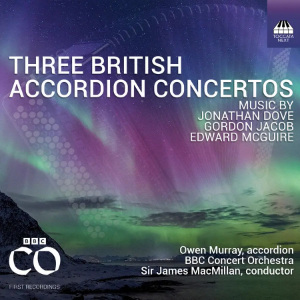
Three British Accordion Concertos
Gordon Jacob (1895-1984)
Concerto for Chromatic Accordion, String Orchestra and Percussion (1972)
Edward McGuire (b. 1948)
Accordion Concerto (1999)
Jonathan Dove (b. 1959)
Northern Lights (2019)
Owen Murray (accordion)
BBC Concert Orchestra/Sir James MacMillan
rec. 2024, BBC Maida Vale, London
Toccata Next TOCN0016[57]
In his long and prolific career, Gordon Jacob composed in almost every genre, and that includes concertos for almost any instrument to which he had access in his time. The Finnish composer Kalevi Aho has probably written more concertos for unusual instruments than anyone else. Jacob did not write for ukulele or ocarina, but he composed a substantial concerto for chromatic accordion. It received its first performance in 1974 and was published by Chappell & Co. the following year. There was another performance in 1976, but then the publisher lost the score and parts when moving office. Owen Murray, the present performer, found a copy of a manuscript. He informed the publisher, who was no longer interested, so he had it typeset himself. The work could eventually be played again in 2014. Jacob’s widow was in the audience.
I hasten to say that I have unashamedly “plundered” Paul Conway’s excellent, well-informed insert notes while reviewing this release. The concerto is laid out in four movements. The Adagio-Allegretto is the longest and the weightiest. The scherzo-like Allegretto comes after a solemn introduction, and there follows a brief cadenza. The Allegretto is dance-like, which is strongly emphasised by brilliant string writing punctuated by timpani. The music then wanders into a softer, somewhat introspective section embroidered by a capricious solo-violin line that will be repeated once later. A last short cadenza leads into a hearty coda, “underlined by timpani”.
The other three movements are all fairly brief: an intermezzo Quasi Menuetto, almost Neo-Classical, then a brief Largo which leads straight into the concluding Allegro moderato, again dance-like, briefly interrupted by a short-lived darker episode. Flourishes by soloist and strings conclude the proceedings with the incisive tutti punctuated by timpani strokes. Gordon Jacob was a formidable craftsman, if ever there was one. His AccordionConcerto, a superb example of his impeccable mastery, deserves to be heard.
Edward McGuire, too, has a sizeable and varied output to his credit, including several operas, chamber music and orchestral music. His Accordion Concerto was commissioned by Owen Murray, who gave the first performance at the 1999 Huddersfield Contemporary Music Festival. The work has three movements along a fairly traditional moderate-slow-fast pattern, although the dividing lines are not clear-cut, to allow for added formal freedom. The first movement Moderato marcato opens with an arresting gesture in the lower strings. The soloist is given what Paul Conway describes as a “halting, emphatic theme”. There is then some considerable interplay of thematic cells. As the work seems to be heading toward a climax, “the rug is pulled out from under the listener” and the music fades away mysteriously, with whiffs of themes above string harmonics.
The second movement Andante cantabile has “an air of wry nostalgia”. The composer indulges in some Scotch-snap rhythms. All this resolves in an extended cadenza which explores the expressive range of the solo instrument before disappearing in the hushed final bars. The concluding Vivo con bravura is full of dancing energy and exuberance. An episode for strings precedes a cadenza before soloist and strings heartily run to the work’s vigorous, irrepressible conclusion. McGuire’s Accordion Concerto is yet another splendid work of vigorous writing and rugged lyricism that is most appealing.
I do not think that Jonathan Dove and his music need any deep-going introduction. He enjoys quite a reputation as composer of operas, and of varied vocal and orchestral music. One of his finest recent works is the beautiful, moving In Exile from 2020 for baritone, cello and orchestra (available on Lyrita SRCD.413). His accordion concerto Northern Lightsis the most recent work here; Owen Murray first performed it in 2019. Sir Peter Maxwell Davies had been approached to compose a concerto for Owen Murray but he did not live long enough to complete the commissioned work. Dove’s concerto is dedicated to Max’s memory.
An aside: Northern Lights have regularly inspired composers. To name only those I know, we have Northern LightsOp.38(1946) by Uuno Klami; Liepāja Concerto No. 4 ‘Visions of Arctic Nights’ (2012) for clarinet, orchestra and electronics by Eriks Ešenvalds; and Hymns to the Nordic Lights(2011) by Tõnu Kõrvits.
Dove’s concerto also has three movements, although the first two – both marked Very spacious and played without break – might be regarded as a single entity. Both suggest vast expanses of time and space, to use a Whitmanesque turn of phrase. Nevertheless, the utter stillness which prevails in the first movement allows for some more energetic, pulsating writing redolent of, say, John Adams and Michael Torke. Stillness is restored at the very end of the movement, so that the music moves almost unnoticed into the second movement. This, too, has a more animated central section before reaching the expansive closing bars. In the composer’s words: “A watcher scans the sky, wondering – and is rewarded with a display of the Northern Lights”.
The third movement Musing opens with three notes ascending stepwise, repeated an octave lower. This sequence is soon revealed as the opening three notes of Maxwell Davies’s Farewell to Stromness, which somehow connects to the initially planned commission. A dancing section soon follows; it includes some bravura writing for the soloist and generates considerable energy until several flourishes lead into a majestic, almost alla Copland restatement of the theme from Farewell to Stromness. Dove’s Northern Lights is a most attractive, highly enjoyable and accessible piece of music, beautifully written – and a most welcome addition to the instrument’s repertoire.
Performances and recording are excellent from first to last, and Paul Conway’s well-informed notes are a further asset. This very fine release generously repays repeated hearings. Not to be missed.
Hubert Culot
Buying this recording via the link below generates revenue for MWI, which helps the site remain free













