
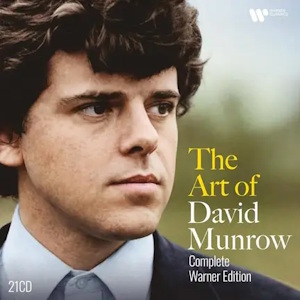
The Art of David Munrow
Complete Warner Edition
rec. 1969-75
Warner Classics 2685432094 [21 CD: 28 hours]
Warner commemorates David Munrow’s untimely death in May 1976 with this 50th anniversary 21-CD box of his complete recordings (as far as I can tell) for the label. It also includes LPs released on Nonesuch but not, obviously, on those many discs to which Warner has no access, such labels as Delysé, Transatlantic, Argo, Abbey, Harmonia Mundi, Decca, Philips, Vanguard, and DG Archive amongst them.
Nevertheless, many of Munrow’s most important recordings were made for EMI (now Warner) and their titles will be remembered by many readers, even if they’ve never actually heard them, or, indeed, have little or no interest in early music. The first disc was privately made in 1969 but picked up by Nonesuch in 1976 and is the only recording, as Edward Blakeman makes clear in his fine booklet note, to feature the original Early Music Consort – Munrow, James Bowman (countertenor), Mary Remant (fiddle), Oliver Brookes (viol) and Christopher Hogwood (harpsichord). A number of these players could double, so sonic variety was a feature of the ensemble from the beginning. The first album was called ‘Music of the Royal Courts of Europe 1150 to 1600’ but Nonesuch changed it to the more enticing ‘The Pleasures of the Royal Courts’, structured in five sections to cover successive European courts. The piquant conjunctions encountered – for example a pungent dance by Guglielmo Ebro followed immediately by the superbly refined ballade by Johannes Legrant – reflect Munrow’s healthy ear for contrast and stylistic variety.
By the time of the 1971 LP ‘Two Renaissance Dance Bands’ The Early Music Consort of London could expand to 17 players for the Susato collection of Dances from ‘Danseye’, which still sounds earthy and exciting, though a smaller ensemble of five musicians, The Morley Consort, takes on Thomas Morley’s Dances from ‘the First Booke of Consort Lessons’. The players here include lutenists Robert Spencer and Desmond Dupré and the consort’s performance is at its apex in the long, involving setting of Dowland’s Captaine Piper’s Pavan and Galliard. The album called ‘Henry VIII and his Six Wives’ derives from the music Munrow arranged and composed for the film of the same name, starring Keith Michell as the King and a host of leading actors, among them Charlotte Rampling, Jane Asher, Lynne Frederick, Barbara Leigh-Hunt, Donald Pleasance and Bernard Hepton (I remember seeing Barbara Leigh-Hunt with her husband Richard Pasco several times in ‘Wood Magic’, an Elgarian presentation). Munrow’s original compositions are interesting not least the weirdly spooky, Herrmannesque ‘Henry’s Loneliness’ which is decidedly non-HIP. Also valuable are the performances of the pieces ascribed to Henry himself. We also hear Susato’s Fanfare ‘La Mourisque’, another version of the same piece performed on CD2.
‘Music for Ferdinand and Isabella of Spain’ fuses courtly manners with rustic jollity and this collection of sacred and secular music comes principally from the collection Cancionero musical de palacio. Inevitably, as with many of Munrow’s recordings at this time, the music selection was compact – only one piece in this disc is longer than three minutes – which gives a rather imperfect impression of the ensemble’s talents. However, the refined performance of Pedro de Escobar’s Virgen bendita sin par shows what they could do and elsewhere the variety of keyboards used imparts a richness to the performance – listen to Christopher Hogwood playing, successively, regal, harpsichord and fretted clavichord on Tomás de Santa Maria’s Fantasias. One thing denied us is the lavish documentation that came with a number of the LPs in which Munrow elucidated the music performed, outlined his principles and suggested pathways to follow. Thus, the 3 LPs that housed ‘The Art of Courtly Love’ are here simmered down to two very well-filled CDs and offers the first example, but not the only one, of intelligent rejigging. Much is Original Jacket work but not everything. This wide-ranging selection contained numerous world premiere recordings in performances of zest and communicative vitality even when, such as in the piece by Pierre de Molins, things teeter on the florid.
Bach occupies CD 7. The two Brandenburg Concertos with Boult can be found in the Boult stereo Warner box. These were the only ones on which Munrow performed but there are also the Second and Fourth with The Virtuosi of England under the redoubtable Arthur Davison, who offers more generous slow movements than Boult. Whether you side with Boult or Davison – Boult is exceptionally fine – Davison phrases more tenderly in the slow movement of No.2. There’s also one example of Munrow’s collaboration with Yehudi Menuhin in the Concerto No.6 for harpsichord, two recorders and orchestra, a rearrangement of the Brandenburg No.4. Munrow’s recorder colleague throughout is John Turner whilst in No.2 the brilliant trumpeter is Gordon Webb.
The original soundtrack for ‘La Course en Tête’ was made in 1973 and was a documentary about the great Belgian cyclist Eddy Merckx. Munrow provided four pastiche Renaissance pieces that nestle very nicely against music by such as Praetorius, Susato, Corelli and the like. This disc was first issued in Europe in 1974 and only released in the UK in 1977 under the title ‘Renaissance Suite’. For lovers of period typography and illustration, you’ll be relieved to know that the original French-language LP cover has been used which shows the gallant Merckx pedalling hard, wearing a yellow jersey, hair blowing in the wind.
It wasn’t until 1973 that EMI recorded Munrow and the Consort in long-form music, Dufay’s Missa ‘Se la face ay pale’, one of their greatest achievements, and a forerunner of recordings of Dufay to come. It was released to mark the 500th anniversary of the composer’s death. Whereas other Munrow recordings give a perhaps partial impression of his expressive depth and stylistically penetrating insight, this Dufay disc (CD 9) is indispensable in its achievement.
Praetorius occupies the next disc, the Dances from Terpsichore as well as six polychoral motets, in three of which Munrow and the Consort are joined by the Boys of the Cathedral and Abbey of St Alban, where Peter Hurford was master of the music. There is rich dance variety in what was one of Munrow’s most popular albums. Munrow’s collaboration with Neville Marriner is also in the Marriner Warner box – recorder concertos by Sammartini, Telemann and Handel, this last a Hogwood reconstruction. In CDs 12 and 13 ‘The Art of the Recorder’ Munrow offers an overview of the versatility and breath of the instrument over the centuries – a necessarily hasty project that starts in the thirteenth century and ends up with Peter Dickinson’s Recorder Music of 1973 – this was hot off the press, composed specifically for Munrow and recorded in 1974. Once again Munrow works hard to keep staleness at bay. He plays on a variety of recorders and is accompanied by a richly wide carousel of instruments. He has great fun with Purcell’s crunchy false relations, in the Fantasia, and enjoys John Baston’s eighteenth-century Concerto just as much as Hindemith’s Trio from Plöner Musiktag.
Monteverdi’s Vespers of 1610 is directed by Philip Ledger in his 1975 recording, made in King’s College Chapel, Cambridge. Munrow is here because he directs the Consort in the recording and eloquently, though the presence of a stellar vocal team will probably be of more interest – Elly Ameling, Norma Burrowes, Charles Brett, Robert Tear, Anthony Rolfe Johnson, Martin Hill and the two basses, Peter Knapp and John Noble. When it comes to Purcell’s Come ye Sons of Art, I prefer John Eliot Gardiner’s near-contemporaneous recording – Munrow’s was made in 1975, Gardiner’s the year later. It’s just springier and more alive, despite the good singers for Munrow, one of whom, Charles Brett, sings on both recordings.
The 2-LP set ‘Instruments of the Renaissance’ was accompanied by a 96-page book written by Munrow, the sort of luxurious production values that were available in the mid-70s. It does nevertheless require focus and a degree of stamina to sit through so many small pieces, well selected though they may be to demonstrate the richness of instrumentation available at the time. Very few of the earlier pieces last much longer than two minutes and only a couple of later pieces – by Praetorius and Frescobaldi – last longer than three. These discs should probably be sampled slowly. I’ve reviewed ‘The Art of the Netherlands’ when it last appeared on Virgin Veritas.
CD 20 is called ‘Greensleeves to a Ground’ and ranges from Dowland, William Williams, Purcell and others to moderns. These include Vaughan Williams’ Suite for Pipes, a very light-hearted affair but also Edmund Rubbra’s Meditazioni sopra ‘Coeurs désolés’ in which George Malcolm’s rolled chords are authoritative and Munrow’s eloquent exploration of Rubbra’s beautiful lines is a disc highpoint. To show that the recorder can throw off its tie-and-tails and embrace jauntier leisure wear, he also plays Clive Richardson’s delicious Beachcomber. The final disc is ‘Monteverdi’s Contemporaries’, another sacred and secular selection made in November 1975 and his last recording with The Early Music Consort of London. He does in it what he invariably did in his recordings, which is constantly to investigate contrast and variety, – of style, instrumentation and sonority. So whilst Maineiro, d’India and Grandi may be better known these days, Ercole Porta, Cherubino Busatti and Giuseppe Guami are still relatively obscure figures. Munrow brought them, and so many other obscure figures, into the light. He supported his investigations with enthusiasm and learned research. He was an all-round figure, a populariser but one grounded in the discipline of informed performance practice.
There is a work index, with composer and CD numbers appended. Warner notes that the complete cast lists are available from their website but at the time of writing this review I couldn’t find then. As for remastering, Art & Son Studio has remastered CD 7 (except the Boult Brandenburgs) and CD 8 (La Course en Tête). Otherwise, the last available remastering has been used – often from 2016 or 2005-07 but some from the mid-1990s.
Now we really need a consolidated box devoted to those other scattered elements of Munrow’s discography if, in today’s climate, such a thing is even possible. For now, this sturdy, splendid Warner box will do nicely.
Jonathan Woolf
Buying this recording via the link below generates revenue for MWI, which helps the site remain free

Contents
CD 1 THE PLEASURES OF THE ROYAL COURTS I. The Courtly Art of the Trouvères · II. The Burgundian Court of Philip the Good · III. The German Court of Emperor Maximillian I · IV. Italian Music of the Medici Court · V. The Spanish Courts in the Early 16th Century
CD 2 SUSATO 12 Dances from the ‘Danserye’ · MORLEY Dances for Broken Consort from ‘The First Booke of Consort Lessons’
CD 3 HENRY VIII AND HIS SIX WIVES
CD 4 MUSIC FOR FERDINAND AND ISABELLA OF SPAIN
CD 5-6 THE ART OF COURTLY LOVE I. Guillaume de Machaut and his age · II. Late fourteenth-century avant-garde
CD 7 BACH Concerto No. 6 for harpsichord and two recorders, BWV 1057 · Brandenburg Concertos Nos. 2 & 4 (2 versions)
CD 8 RENAISSANCE SUITE: LA COURSE EN TÊTE original soundtrack
CD 9 DUFAY Missa ‘Se la face ay pale’
CD 10 PRAETORIUS Dances from Terpsichore · Motets
CD 11 TELEMANN Suite in A minor TWV 55:a2 · SAMMARTINI Concerto in F major · HANDEL Concerto in B-flat major HWV 294
CD 12-13 THE ART OF THE RECORDER The Middle Ages · The Renaissance · The Early Baroque · The Late Baroque · The 20th Century
CD 14 MONTEVERDI Vespro della Beata Vergine
CD 15 PURCELL Come ye Sons of Art · Love’s goddess sure
CD 16-17 INSTRUMENTS OF THE MIDDLE AGES AND RENAISSANCE Woodwind · Keyboard · Brass · Strings · Percussion
CD 18-19 THE ART OF THE NETHERLANDS Agricola, Barbireau, Brumel, Busnois, De La Rue, Des Prez, Ghizeghem, Isaac, Obrecht
CD 20 GREENSLEEVES TO A GROUND Dowland, Purcell, others from XVI-XVIIth century · Vaughan Williams, Rubbra and others from XIX-XXth century
CD 21 MONTEVERDI’S CONTEMPORARIES D’India, Grandi, Mainerio
Performers
The Early Music Consort of London, The Morley Consort (CD 2)
David Munrow Recorder Consort (CD 12-13)
Academy of St Martin in the Fields/ Sir Neville Marriner (CD 11)
The Menuhin Festival Orchestra/ Yehudi Menuhin
The Virtuosi of England/Arthur Davison, London Philharmonic Orchestra/Sir Adrian Boult (CD 7)













