
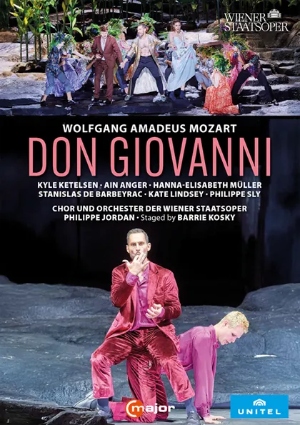
Wolfgang Amadeus Mozart (1756–1791)
Don Giovanni, K. 527 (1787), Opera in Two Acts
Libretto by Lorenzo Da Ponte
Don Giovanni – Kyle Ketelsen (bass-baritone)
Leporello – Philippe Sly (bass-baritone)
Donna Anna – Hanna-Elisabeth Müller (soprano)
Don Ottavio – Stanislas de Barbeyrac (tenor)
Donna Elvira – Kate Lindsey (mezzo-soprano)
Vienna State Opera Chorus & Orchestra/Philippe Jordan
rec. live, 5–20 December 2021, Wiener Staatsoper, Vienna
C Major 770508 DVD [169]
There is, near the close of Pier Paolo Pasolini’s 1968 film Teorema, a sequence in which Massimo Girotti’s industrialist strips naked in Milan’s central railway station and walks, screaming wordlessly, across the black volcanic ash of Mount Etna — a bourgeois patriarch reduced, by the visitation of a Dionysian stranger, to elemental matter. It is one of the most arresting images in twentieth-century cinema, and Barrie Kosky has appropriated it wholesale for his 2021 Vienna Don Giovanni, now released by C Major. We are told as much by Kosky himself in the programme book interview with the production’s dramaturg Nikolaus Stenitzer — an interview I will return to, because it raises the central question this DVD provokes.
What is baffling, given that this is the first thing one would seize upon if one knew of it, is that Teorema went almost entirely unmentioned in the press coverage of the premiere. That a Pasolini reference of this specificity should have eluded almost every reviewer of the production at its premiere is itself an indication of the conceptual density Kosky brings to the work. And on the evidence of the staging alone, one would not necessarily have guessed it was there at all. To watch this Don Giovanni is to be confronted with a great deal of bleak rocky landscape — alleviated slightly by modern dress, a Leporello got up in goth-adolescent fashion, a small pond, some ephemeral plant growth — without much clue as to what one is supposed to make of any of it. The interview settles the matter (the Etna source, the Pasolini structure, the explicit framing of Don Giovanni as a ‘child of Dionysus’ rather than the deity himself), but it’s not included with the DVD. And that lack of reference points is the crux of the difficulty here.
Anyone who saw Kosky’s Siegfried at Covent Garden earlier this year will recognise certain habits of mind. The Beckettian gloss on a male pairing, the willingness to let an entire scene play out in a register of comic absurdity that is also deadly serious, the careful calibration of visual style across acts — all of this is recognisably Kosky and is brilliantly realised in Siegfried. What is curious about this Don Giovanni is how much of this richness fails to make the journey from concept to stage. Kosky himself tells us in the interview that he conceived the Don and Leporello as Vladimir and Estragon playing ‘Waiting for the Commendatore’, as he puts it. The interaction between Kyle Ketelsen and Philippe Sly does indeed reach for something Beckettian in its mixture of dependency, humiliation, and exhausted complicity. Sly is, incidentally, the outstanding actor on this stage: alert in every gesture, vocally vivid, and clearly the singer Kosky has worked with most intensively. Ketelsen is charismatic enough, but the production seems determined not to let him project the dramatic momentum the role usually demands.
This is, on closer inspection, a deliberate choice. Kosky’s Teorema parallel does not concern only the volcanic backdrop. The structural logic of Pasolini’s film — a strangely passive outsider arrives, draws each member of a bourgeois household into something they were not prepared for, departs, and leaves them unable to reconstitute themselves — maps with some force onto what Kosky is trying to do with Mozart’s ensemble. Terence Stamp’s Visitor in Teorema barely acts, barely speaks; things happen around him. If that is the model, then Ketelsen’s curiously becalmed Don Giovanni looks less like a failure of stage presence than a particular conception of the role. As a structural device, the Teorema parallel does real interpretive work. The ending is where it stops paying. Pasolini concludes with one transfiguration and four catastrophes; Mozart and Da Ponte with damnation followed by a moralising sextet. Kosky’s heart-attack compromise for Giovanni’s demise is faithful to neither.
There are other influences, of course. Kosky speaks of Antonioni’s L’avventura, with its haunting question ‘is this really just happening, or is it someone’s memory of what happened?’ He speaks of the surreal comedies of Buñuel. He invokes Euripides’ Bacchae and the Old Testament father — Abraham and Isaac, the invisible patriarch of the Jewish tradition — and reads the Commendatore not merely as a wronged father but as the principle of patriarchy itself. The richness of his cultural references is undeniable. What is harder to defend is that almost none of this is legible from the staging alone.
I should say that as someone whose misspent life, never mind misspent youth, has been substantially consumed by film and theatre, I picked up most of the references unaided, and find it difficult to strip them away in order to ask what the production is doing for someone who has not. But even on the most charitable view, the staging on a moment-to-moment basis does not come across as richly or as meaningfully as Kosky must have hoped. Katrin Lea Tag’s costumes, garishly modern in counterpoint to the volcanic set, look crude rather than productively dissonant, and there is a curiously un-Koskyian staidness to much of the stage action. The marvellous orchestrated dances at the close of Act 1 — Kosky deploys three on-stage ensembles and has each social tier dance to its own band, restoring a point about a society on the verge of revolution that productions often blur — show what he is capable of when he is fully engaged. Such moments are not the rule. With Ketelsen and Sly subtracted, the remainder of the cast acts competently rather than memorably.
What one ends up with, then, is a Don Giovanni whose conceptual scaffolding is genuinely remarkable, but whose theatrical realisation makes that scaffolding largely inaccessible to anyone not equipped with the programme book or the relevant cinematic and literary reference points. There is something faintly elitist about this — even by the prevailing standards of contemporary opera production, which are scarcely populist to begin with. It would not have cost much to include Kosky’s interview in the DVD booklet. The material is hardly inaccessible — the programme book is easily found online — which makes its absence here all the more puzzling.
Musically, things are on a different plane. From a uniformly strong cast, Kate Lindsey is in particularly fine voice, and Stanislas de Barbeyrac as Ottavio sings with a tonal beauty and rhythmic poise the role rarely receives. Hanna-Elisabeth Müller is a Donna Anna of considerable presence, and Ain Anger’s Commendatore sonorous and authoritative. Philippe Jordan, conducting without a baton and presiding at the fortepiano in the recitatives, paces things impeccably, and the Vienna State Opera Orchestra plays superbly throughout. The Prague–Vienna conflation is used, which I regret in principle, but Jordan’s musicianship makes the case for the hybrid as well as it can be made.
Kosky is, to my mind, the most consistently interesting director now working in opera, and he is entitled to the occasional production in which the high concepts do not quite materialise on stage. That this Don Giovanni was premiered to an empty house at the height of the pandemic, with theatres only beginning cautiously to reopen, may go some way to explaining the slightly inert quality of the result. The remaining instalments of the Vienna Da Ponte cycle — Le nozze di Figaro of March 2023 and the Così fan tutte of June 2024 — are now both behind us, and have been received with a degree of critical division that suggests the same tension between conceptual ambition and stage transparency, though both have been generally agreed to display sharper direction of the singers than the Giovanni. If C Major proceeds to release them on DVD, the question of how much of Kosky’s unquestionable conceptual richness makes it across the footlights will be one to which we can return. For the present Giovanni I was glad to have seen it, with a reviewer’s privilege of not having to fork out for the DVD. Whether I could in honesty recommend that you do is another matter.
Dominic Hartley
Other cast
Il Commendatore – Ain Anger (bass)
Zerlina – Patricia Nolz (mezzo-soprano)
Masetto – Peter Kellner (bass-baritone)
Production Team
Sets and costumes – Katrin Lea Tag
Lighting – Franck Evin
Dramaturgy – Sergio Morabito, Nikolaus Stenitzer
Chorus master – Thomas Lang
Technical details
Picture format: NTSC 16:9
Sound format: PCM Stereo / DTS 5.1
Region code: 0 (worldwide) 2 DVDs (DVD 9)
Sung in Italian, with subtitles in Italian, English, German, Korean and Japanese
Buying this recording via a link below generates revenue for MWI, which helps the site remain free














