
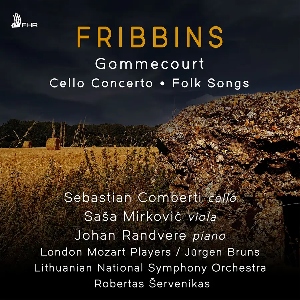
Peter Fribbins (b. 1969)
Cello Concerto (2024)
Gommecourt, Symphony for orchestra with piano obbligato (2024)
Folk Songs for viola and chamber orchestra (2022)
Sebastian Comberti (cello); Johan Panchero (piano); Saša Mirković (viola)
London Mozart Players/Jürgen Bruns (Concerto; Folk Songs)
Lithuanian National Symphony Orchestra/Robertas Šervenikas (Gommecourt)
rec. 2024/25, St. George’s Church, Harrow, London; Philharmonic Hall, Vilnius, Lithuania
First Hand Records FHR187 [63]
An album of new orchestral works by English composer, Peter Fribbins follows a collection of his chamber music which was issued back in 2010. In 2012 Jonathan Woolf reviewed Fribbins’ piano concerto and other of his works in various formats. Both those earlier discs were on the late-lamented Guild label. Peter Fribbins has had his music featured at the English Music Festival but I have not noticed his name otherwise when it comes to concert performances; that is not, of course, to Mr Fribbins’ discredit; more to my own.
A quick overview of the present CD seems in order: Gommecourt, is a four-movement symphony with obbligato piano. This traces the dramatic story of the composer’s grandfather, Tom Fribbins and his part in the Battle of the Somme in 1916. This is paired with a passionate, and at times wild, Cello Concerto, and the beautiful melodic lines of the Folk Songs for viola and chamber orchestra. These three concertante works are of fairly recent provenance and make for a pretty ‘meaty’ tranche of Fribbins’ music.
The Cello Concerto is a statement of faith in the resilient tradition of English tonal music. It is a shortish (20-minute, four-movements) work. The first of these movements is in the form of a steady, pulsing ascent which rises to an ecstatic statement. Much of the orchestral backdrop entails a sort of coupling between Finzi’s string orchestral writing (viz Dies Natalis) and the start of Martinů’s Fantaisies Symphoniques. The second movement suggests a lugubrious, furrow-browed meditation. This becomes an increasingly disrupted nightmare carried by the orchestra into a melodic pasture evoked by the cello. The third gives voice to an at first ruminating cello. This introduces a flighted chasseur section in which the solo disports with the full band. The finale harks back to the string-heavy textures of the first movement. Sebastian Comberti is an eloquent and secure soloist, placed centre-stage and forward by the engineer while the orchestra is set slightly back. The concerto ends abruptly defying the musical conventions of earlier centuries.
The four movements of Gommecourt are merciless, with the solo piano to the fore, mordant and slaughterous. The appalling killing in Gommecourt Wood is reflected in the artillery barrage that wreaked so much death. A Shostakovich-like bleakness inflects the solo piano, which is seemingly exhausted by so much waste of precious life. The lamentation that weighs down the second movement is followed by the third which reflects the kindness of German soldiers who gave coffee to the dying ‘enemy’ infantrymen on the battlefield. Drums echo the ‘crump’ of German artillery and some pages refer back to Bach’s Coffee Cantata. The finale has threaded through it the traditional tune for Psalm 23. Even so, the work ends with explosions from the big guns counterpointing sincere writing in which the strings sing peacefully.
Folk Songs, in three movements/tracks, adds impeccably to the literature of British music for viola and orchestra. The music is open in texture and inwardly expressive. It includes some of the most deliciously ingratiating writing on this disc. This is a quite wonderfully luminescent piece that can stand proudly alongside Howells’ Elegy and RVW’s Flos Campi. Nothing on this CD sounds anything less than engaging but Folk Songs is utterly captivating. Listeners and ambitious violists should track down this recording and the study score.
The producer here is one of those discreet but masterly figures in the world’s record industry: the one-time viola player Michael Ponder. His private recording of the Bantock Viola Sonata should be issued publicly. Listen to what he and the soloist and orchestra achieve in Folk Songs; an example is the lucidly engaging pizzicato in the central Scherzando.
The London Mozart Players used to be known to me from their Harry Blech concerts at Bristol’s Colston Hall (right or wrong, I shall always know it by that name) in Mozart and Haydn. I should add that the LMP’s vintage recordings, originally on HMV LPs, can now be heard on FHR.
Peter Fribbins has himself, on this occasion, written the treasurably detailed liner-notes. What is more, they are accessibly pitched at the general listener not the musicologist.
Rob Barnett
Buying this recording via the link below generates revenue for MWI, which helps the site remain free













