
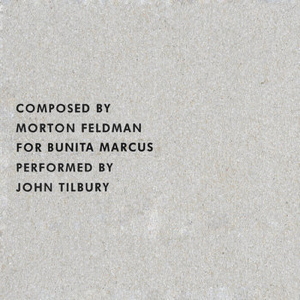
Morton Feldman (1926-1987)
For Bunita Marcus (1985)
Palais de Mari (1986)
John Tilbury (piano)
rec. live, 1 April 2007, Dublin Unitarian Church, Dublin, Ireland (For Bunita Marcus); live, 3 March 2012, Eldborg Concert Hall, Harpa, Reykjavik, Iceland (Palais de Mari)
Reviewed from a WAV download: 44.1 kHz/24-bit
Sold separately
True Blanking [98 & 25]
Welcome back to Feldman Centenary Corner, where I have been listening to a newly issued recording of what might be described as ‘mainstream Feldman’. That phrase needs to be interpreted with an informed relativism of course if it’s not to sound oxymoronic, but his late piano work For Bunita Marcus has been one of his most recorded pieces over the years since its composition. I estimate there are getting on for 15 recordings currently available, which is a notable achievement for an hour long single movement solo piano work, sustained at a low dynamic throughout. The two I most admire are by Marc-André Hamelin (Jonathan Woolf’s excellent, pithy review is here) and Philip Thomas on the definitive Another Timbre box set of Feldman’s piano music. I confess to not knowing either of John Tilbury’s two 1990s studio recordings of the work but was intrigued when the Norwegian label True Blanking announced a release of a live performance given in Dublin in 2007.
For Bunita Marcus is late Feldman. It was composed in 1985, the year after the four hour For Philip Guston (see my review of an excellent new recording earlier this year) and although much shorter than the earlier work it demands a similar intensity of focus. It’s essentially an exploration of the cumulative effect of repeated melodic and harmonic patterns over changing metre, the fading of the piano’s sound almost as important as the notes it articulates. Tilbury, rightly I think, feels that the metric variation is Feldman’s way of determining the music’s flow, ‘a way of notating rubato’.
A successful live performance of any Feldman work requires an implied contract of concentration between performer and listener. That seems to have been absolutely present in Dublin in 2007. Listening to it, one is certainly aware of the audience, but I think Nathan Moore is right in his sleeve notes to say that the very small amount of extraneous noise is somehow absorbed by the density of the music Tilbury is realising. ‘Density’ is Moore’s word and I think it’s spot-on. Not just because of the nature of the canvas that Feldman populates, there’s something magical about Tilbury’s touch, simultaneously projecting a depth and clarity of sound which has a tactile physicality.
I’m really happy to have the chance to experience this performance. The recording made by David Reid in the Dublin Unitarian Church is excellent and has been available to purchase on Tilbury’s own website for some time, I think. I’ve not had the chance to compare versions, but it appears the audio has been remastered for this True Blanking digital release, and the download also includes Tilbury’s interesting essay on performing Feldman’s piano music.
Palais de Mari, the composer’s final work for solo piano, receives a striking live performance from the Tectonics Festival of 2012 in Reykjavik. A piece of just over 25 minutes in length, the work reflects Feldman’s interest in Middle Eastern rugs and their patterning (my review linked above has more on this), and there’s no mistaking the audible tapestry presented in the music. Like For Bunita Marcus, repetition of material is varied by predominantly rhythmic displacement and, once more, there is an extremely soft dynamic level sustained throughout. Tilbury gives an engrossing performance, where again the live setting gives an added atmospheric dimension to the music. Until it suddenly doesn’t, that is, when an audience member’s phone rings just after the 23 minute mark. This is a huge shame. It doesn’t ruin Tilbury’s beautifully calibrated, liminal performance, but when you know it’s coming on repeated listening it induces a wholly inappropriate tension. As a Feldman devotee, I’m nevertheless glad to have this recording. If you’re new to the piece, though, Steven Osborne’s studio version (Hyperion CDA68108) is a safer place to start.
Dominic Hartley
Availability: Bandcamp (For Bunita Marcus), Bandcamp (Palais de Mari)













