
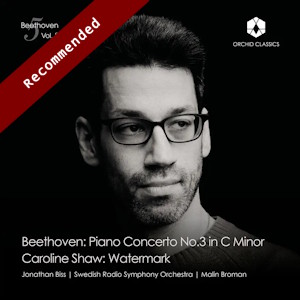
Ludwig van Beethoven (1770-1827)
Piano Concerto No. 3 (1796-1803)
Caroline Shaw (b. 1982)
Watermark
Jonathan Biss (piano)
Swedish Radio Symphony Orchestra
rec. live, 9-11 February 2022, Berwaldhallen, Stockholm, Sweden
Reviewed from a WAV download: 44.1kHz/16-bit
Orchid Classics ORC100433
Which is the more attractive prospect? Five new works for piano and orchestra by a who’s who of leading contemporary composers, played by Jonathan Biss? Or Biss — having given us one of the most rewarding Beethoven sonata cycles of recent years — turning to the Beethoven concertos? I suspect most readers will have spotted this as a trick question. Biss’s ‘Beethoven /5’ project has given us both. New works by Brett Dean, Sally Beamish, Timo Andres, Salvatore Sciarrino, and now, Caroline Shaw, each composed in response to the Beethoven concerto with which it is paired. The cumulative achievement is among the most thought-provoking contributions to the Beethoven discography of the last decade, and a serious addition to the contemporary literature for piano and orchestra. I’ll save wider reflections on the cycle for the appearance of the boxed set it surely merits and focus on this newcomer, which starts with a striking account of Beethoven’s C minor Concerto.
The booklet contains an exceptionally fine essay by Biss on the Concerto, which is worth calling out in its own right: he is one of the most thoughtful musician-writers we have, and his prose has the same combination of rigour and warmth as his playing. The argument turns on the comparison with Mozart’s K. 491. Biss reflects on the fact that the first two notes of the two concertos are identical in pitch and rhythm. Then the paths diverge. Beethoven’s third note completes the C minor triad where Mozart wilfully avoids it. This third note is, in Biss’s word, a ‘foursquare’ gesture by Beethoven, but an inspired one. He goes on to show how Beethoven takes Mozart’s two-note figure, pares it back to the bone, and builds something monumental. It is the kind of insight that will rearrange how you hear the music.
In Biss’s performance the Beethoven has that power and scale, the ‘irresistible force’ as he describes it, but also an equally compelling sense of drama. The opening movement is the most leanly operatic account of the Concerto I have heard: not just K. 491 being evoked, but Don Giovanni in its peripheral vision, and Biss the protagonist whose obvious charisma never needs to be argued for through showy virtuosity. The cadenza (Beethoven’s own) has the narrative concentration of a Strauss tone poem. One cannot, of course, know what internal narrative Biss is following, but the structural certainty and direction of his playing here are unusually suggestive, as if a story were being told whose details are private but whose shape is unmistakable.
The Largo is something special. There is great gentleness in Biss’s playing, a long-spun line, and an acuity of voicing that gives the slow movement’s surpassing beauty its full weight without ever lingering on it. Here and elsewhere, there is also a quality I can only call hieratic. I use the word advisedly. It’s part of the charisma already mentioned — a drawing-in of the listener which is unmistakably spiritual, and which exudes warmth rather than austerity.
The Rondo is playful, of course. But Biss has not forgotten the wrenching change of register at the movement’s start he writes about in his notes — the music yanked back into C minor and into conflict — and that violence is neither smoothed over nor splashily rendered. The C major conclusion is poised exactly where it should be, between comedy and triumph. Biss writes of ‘the music winking one moment and exultant the next’, and that is precisely what he and the SRSO deliver.
The details linger. By the already absurd standards of contemporary concert pianism, Biss’s touch is in a class of its own: the weighting of chords is always consonant with the mood, sometimes injecting wit, sometimes something more ominous. The small differences of articulation and arpeggiation at every iteration of an idea are miraculous in their precision. He has clearly absorbed everything there is to be said and inferred about the work, starting with the score itself, but the lightness and musicianship one hears mask the very considerable intellect that produces them: this is not a portentous or demonstratively cerebral account. The SRSO match Biss every step of the way: responsive, articulate, dialogic.
Caroline Shaw provides a brief and characteristically warm note for her composition Watermark (2018). It is, in her phrase, woven from material drawn from the C minor Concerto, sometimes by direct quotation (the close of her first movement folds itself into the final bars of what she calls Beethoven’s first-movement ‘race to the cadence’), sometimes by a more glancing form of reference, the harmonic turns and textures of the Concerto caught at an angle. She mentions, generously, that throughout the writing she had Biss’s recordings of the Beethoven sonatas constantly in her ear: a detail it would be easy to read past, but which in fact tells you a great deal about how the piece sounds. Watermark has been written for this pianist, with this pianist’s musical sensibility absorbed at a level deeper than dedication. It thinks with his phrasing.
The title is the key. Shaw writes that Watermark refers in one sense to Alan Tyson’s research on the manuscript paper of the Piano Concerto No. 3 to determine its date of composition, and more broadly to the way a document’s origin can be embedded in it in barely visible ways. Her title does triple duty, I think: the literal watermark of the manuscript paper; the figure of an indelible trace persisting beneath a surface; and, by extension, the way a great earlier work goes on dating — fixing the provenance of — everything composed in its shadow. As concepts for a Beethoven response go, this one is unusually rich.
The opening of the score makes the conceit audible. The whole orchestra is instructed to hum on C, in any octave, until their instrumental entries. Above this the piano enters, marked in the score, just for this opening page, Jonathan; thereafter the part reverts to Piano. It’s a small touch, but a telling one: Shaw is writing for a person, not a position. The piano’s first phrase is hymn-like against the humming, almost chorale-like in its weighting of consonant chords, and for a moment the music sounds less like a response to the Third Concerto than a memory of the slow movement of the Fourth — that same air of a single voice speaking out of stillness. The C is everywhere from the first bar; one hears it as a held pedal beneath the texture, indelible, the watermark made literal in sound.
The first movement runs eight and a half minutes from this hush to its closing transformation. It builds beautifully, and rises to substantial, highly dramatic and authentically Beethovian climaxes before the cadenza arrives near the close. From there Shaw pulls off the watermark conceit at its most direct. The close of Beethoven’s own first movement surfaces fully present, unmistakable, and is then immediately and delightedly refracted through Shaw’s harmonic vocabulary — bright, slightly tilted, unmistakably hers. It is a beautifully judged moment.
The second movement opens on a single line in the piano, marked a familiar phrase, but with slightly different rubato each time, a long-breathed melody returning across slightly varied timings — gentle, unaffected, almost folk-like in shape, threaded with triplets. It’s a structural decision that maps strikingly onto Beethoven’s own Largo, also beginning with the piano alone in a similarly long-breathed melody which the soloist will then revisit and inflect. Shaw has not exactly quoted the Beethoven here, but she has quoted its way of beginning if you like, and one of the deep pleasures of Watermark‘s slow movement is hearing this kinship register without ever being underlined. When the strings finally enter beneath the piano they bring with them what is unmistakably an echo of Beethoven’s Largo — poised, vibrantly warm string playing, the SRSO at their finest — and the effect is very moving. The Beethoven does not so much break through here as become discernible, as if the watermark had at last been held to the light. The second cadenza, around two-thirds of the way through, wanders through some gorgeous Shaw chordal progressions, gently varying. It concludes with a freely written right hand over a sempre pp left-hand vamp in continuous quaver pulse which the player is explicitly told ‘does not have to line up exactly with right hand’. The rhythmic looseness is part of the writing. Biss handles the layered freedom with extraordinary poise.
The opening of the third movement is almost entirely Beethoven. Or is it? It opens with what is recognisably the Rondo subject — except that Shaw has placed both hands an octave higher than Beethoven, and the brightness tells. Where Beethoven strides, Shaw almost skitters; what is grounded and theatrical in C minor at the original octave becomes, at Shaw’s pitch, fleet, bright, slightly airborne. Within a few bars the Beethoven has dissolved into something else — Shaw’s own figuration, her own harmonic colour — and the movement, the shortest of the three at four minutes, runs its course at speed before stopping. Stopping is the right word. The work finishes very quietly. The piano, isolated, unaccompanied, playing a simple five-note phrase, a last small flicker before the piece is gone. It’s the sort of ending that lands in the room in a particular way, and I was glad that the Orchid engineers have left in the audience’s response — the warm applause here for the close of a substantial new piece for piano and orchestra is not always a given on disc, and capturing it underlines Watermark as a living and vital work receiving the first of what I hope will be many performances.
I say that because this is a humane, generous, intelligent and genuinely affecting composition. High concept in the best sense of that phrase, breathtakingly executed. One might have expected Biss to inhabit the piano part comfortably, given the care Shaw has taken over the writing for him, but what one actually hears is more than comfortable habitation. His sensibility permeates the part as much as his musicianship does. He is by turns lyrical, hyper-articulate, tender and luminous, at the heart of things and yet profoundly collaborative with the orchestra. The SRSO, led by Malin Broman, are exemplary throughout — alert, supple, characterful. The Berwaldhallen acoustic and Orchid’s engineering catch everything.
Biss’s Beethoven essay closes on a paragraph I have re-read several times in the days since I downloaded the album. ‘There is always more that can be said’, he writes. ‘But it feels unnecessary. Once you know that Beethoven can hold you in his grasp with just two notes, you know what is essential about him. Who else can? Not even Mozart, with his limitless sophistication and inspiration and beauty. Beethoven is a one-off. His greatness cannot and perhaps should not be explained. Better to be astonished anew on each hearing.’
It is a remarkable thing to write at the close of a substantial project devoted in significant part to Beethoven. And it is, I think, the secret of the ‘Beethoven /5’ commissions taken as a whole. The five new works have not been there to explain Beethoven, or to gloss him; their purpose is to refresh the conditions under which one is astonished by him. Each new piece returns the listener to the corresponding concerto with senses sharpened and assumptions disturbed. Watermark does this beautifully. To hear the C minor Concerto with Shaw’s first movement still in the ear is to hear Beethoven’s foursquare third note — the one that completes the triad Mozart refused — as itself an indelible trace, a watermark of his musical character that goes on showing through everything that follows. Shaw has not explained Beethoven. She has helped one to be astonished by him again. ‘Being astonished by Beethoven’, Biss writes, ‘is a gift to one’s life’. On the evidence of this final volume, so is being astonished by the music he goes on making possible more than two centuries later.
Dominic Hartley
Buying this recording via the link below generates revenue for MWI, which helps the site remain free













